by ELIA GOMIŠČEK
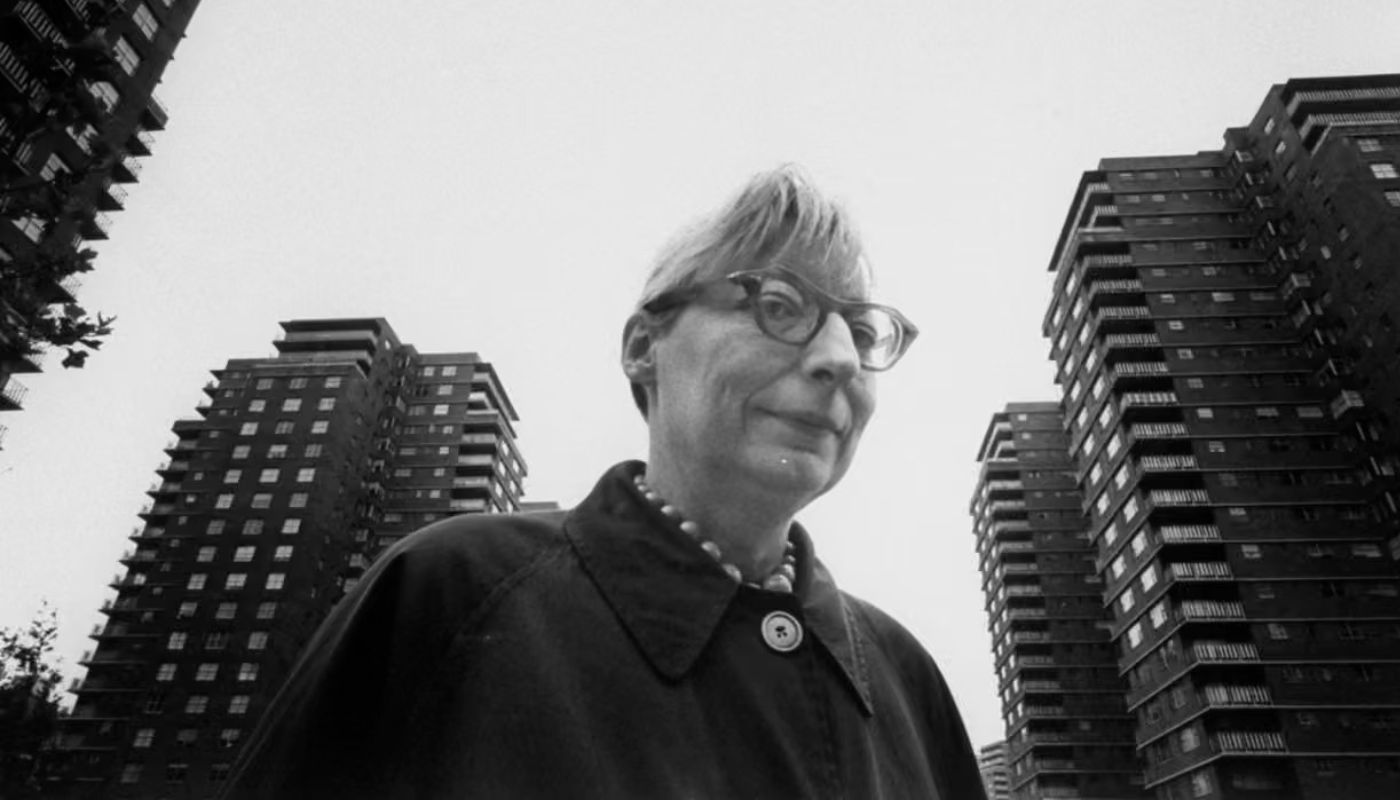
Jane Jacobs published the essay The Death and Life of Great American Cities in 1961, in which he criticizes the American urban policy of the time, which he blames for the collapse of many of the city’s neighborhoods. From this piece come four general rules for a more lively city. Jacobs was born in Pennsylvania in 1916 and moved to New York City during the Great Depression, where she developed an interest in urban planning and activism. More than half a century after its publication, I believe that the ideas presented by Jacobs are still relevant and progressive.
COMPACTNESS. Density is a prerequisite. Neighbourhoods with a high population density allow for the existence of small shops and service activities, as well as the financing of efficient public transport, so that there is no need to rely on a private car to perform smaller tasks. Jacobs lived in Manhattan, where there are 30,000 inhabitants per square kilometer, which are unimaginable numbers for us, considering that there are barely 1,000 in Gorizia, 2,000 in Ljubljana, 2,500 in Trieste and 7,500 in Milan. But we can also talk about density and its advantages. Density is directly related to the drastic reduction in emissions and time lost in transport.
DIVERSITY. Old buildings must be preserved and supplemented with new ones, without changing the character of the neighborhoods. According to the author, the demolition of historic buildings to make way for larger and more modern buildings – a phenomenon that was very common in the United States at the time – was harmful. Historic buildings give the city’s boroughs their identity, and if renovated, they can provide inexpensive spaces for new businesses. In addition to preserving the identity of the place, the mix of palaces from different eras can be much more enjoyable and inspiring for the locals than a monotonous type of buildings made of concrete, steel and glass.
MIXED USE. The vibrancy of cities depends on the variety of activities offered by each neighborhood. When an area has only one function, the streets are emptied during times of inactivity. For example, if a neighborhood is dominated only by offices, the streets of that area will be completely empty in the evenings and on holidays. Therefore, mixed-use housing should be encouraged, in which housing, green spaces, shops and services coexist and are accessible on foot – the notion of a 15-minute town. The separation of destinations — offices on one side, shops on the other, the rich living here and the poor living there — reduces the daily gatherings that enliven the city. Today, many neighborhoods are monofunctional, especially in some urban areas, dependence on the car continues to limit the quality of life and sustainability of cities. This is the point that is most dear to my heart, as our small towns have also emptied for hundreds of shops and services, both in the suburbs and downtown. For example, it is now more common for Gorica residents to take a car and take a 20-minute drive to Vileš than to take a 10-minute walk to the nearest store.
SHORT BLOCKS. Shorter blocks of buildings encourage meetings, movement, and life in the neighborhood, while long blocks isolate people and make paths monotonous and cluttered. This point applies more to North America, but fortunately our cities were planned at a time when walking was mandatory and cars were not yet available, as evidenced by the many one-way streets and pedestrian crossings in our cities, which are rare in the United States.
In northern European countries, these concepts are already being used, but in our country, only a few cities with far-sighted administrators are beginning to correct these mistakes; They are reclaiming spaces that were previously taken over by cars, re-establishing tram lines and expanding green and social areas. Our streets must not only be a means of getting us from point A to point B, but must once again become vibrant spaces where we can meet and create community.
“Cities can offer something for everyone only because and only when everyone co-creates them.”
Original: “Cities have the capability of providing something for everybody, only because, and only when, they are created by everybody.”