
AWARENESSES
by ELEONORA BRISSI
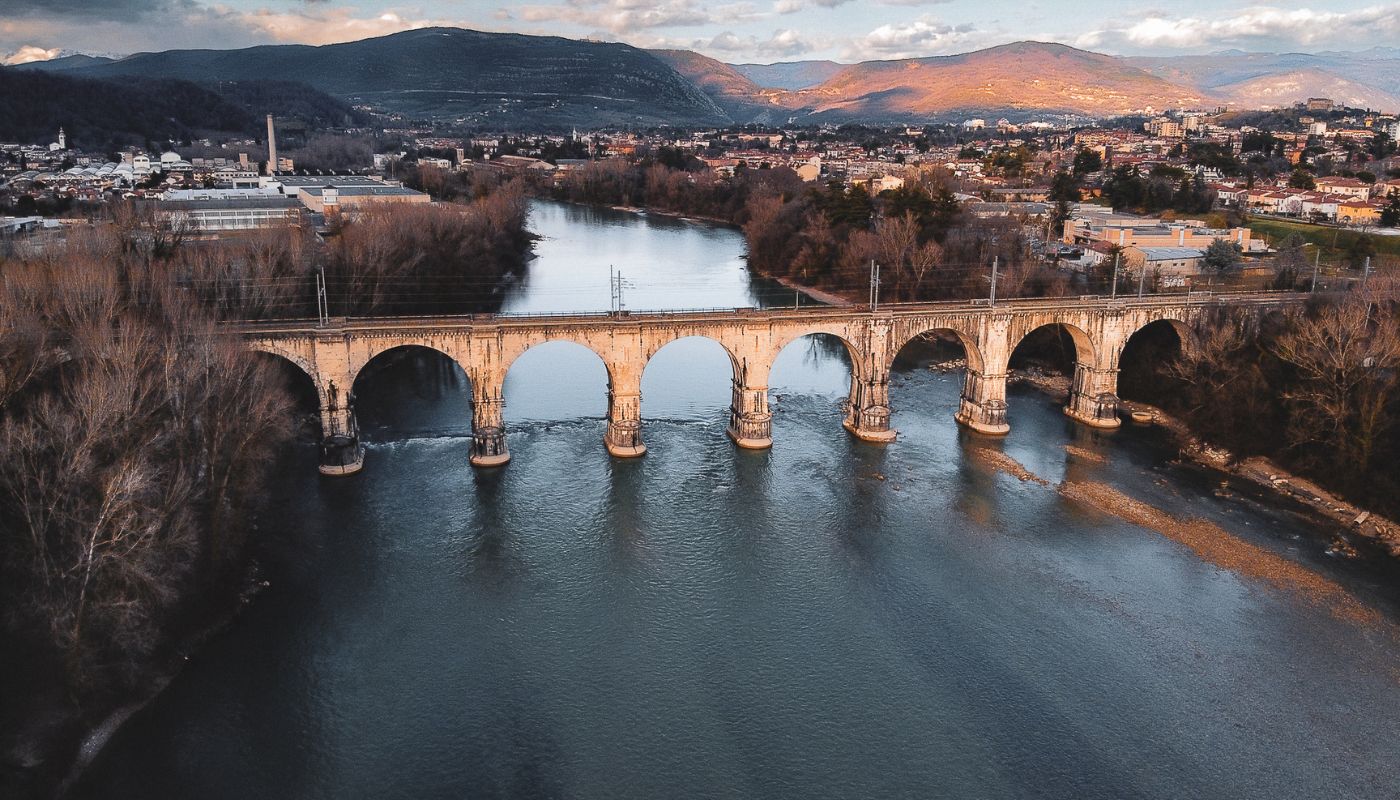
On a strip of land bordered by the Natisone River to the north, the Isonzo River to the east, and the sea to the south, a social group has long lived who, despite being located in Italy, speak Slovenian. Most call them a “minority,” but for me they have always been “zamejci.” People who brought their traditions, protected them, and spread them, even at the cost of their lives.
The value and need to belong are inherent in man, Aristotle already maintained that we were social animals, and throughout the history of philosophy there have been attempts to trace a path that indicates the way from the state of nature, in which each man thought of himself, to structured societies such as they are now that try to invest in welfare and create quality relationships between individual individuals.
The best way to belong is to communicate, and there are many ways, but how much greater power do words have, and how much more powerful are those we understand, not to mention those we know and use, often carelessly. Language is a prism that reflects the light of a people and embellishes it with nuances and iridescence that make it unique. Yet every language is contaminated by others; every culture, as Giangiorgio Pasqualotto argued, is like a great tree, whose trunk is separate, but whose roots and branches are intertwined, in a labyrinth with no real escape, with those of the other trees that make up the forest. Thus, every tree nourishes another tree in a silent and hidden, yet undeniable and necessary, symbiosis. The idea of otherness seems to dissolve in these thoughts, and I am otherness because someone is different from me, but at the same time I have learned something from them, and vice versa. In the constant exchange with others, I have discovered and defined myself.
Before my prefrontal cortex was fully developed, my parents enrolled me in kindergarten with Slovenian as the language of instruction. I believe it was important to them: on my father’s side, throughout our family history, they had always spoken Slovenian, and keeping it alive in their consciousness was invaluable, also in memory of those who had sacrificed so much to preserve it throughout the storms of history. Thus, I grew up in an environment that didn’t speak my parents’ language, but which belonged to them, the language for which my great-grandparents had fought in the war of liberation.
Of course, fitting into a linguistically unfamiliar context is difficult, especially when the effort is seemingly meaningless: spending the years of fragility, which are those of adolescence, unable to express the infinite world that inhabits us, opens a chasm of solitude. The silence is shattered by a few words: “Ostaneš z mano na kosilu?”
There is only one possible answer and that is: “Yes.”
From that moment on, I began a lifelong friendship with Greta, and for the first time I felt able to communicate, both with myself and with others, in Slovenian, making it increasingly a part of me. Enriching my vocabulary offered me new horizons in my relationships with others: the need to have friends, to tell them how I felt, what made me happy, to share their joys and sorrows, allowed me to assimilate a new language, a new culture, and to apply it first in my studies and then in my work.
Just as Greek and Latin served as the seeds for the germination of modern languages, Slovenian allowed me to let friendship blossom, a priceless treasure that continues to fertilize and enrich linguistic knowledge over time in a harmonious virtuous circle.
I owe so much to the people I’ve met and interacted with because, with perseverance and commitment, they’ve brought me to a higher level of awareness, opening many doors and allowing me to discover new facets of the universe around me. They’ve allowed me to recognize where I come from, and although I’m a trunk, I have branches and roots that constantly connect and unite with others.
To paraphrase St. Jerome: the heart is an instrument and languages are its strings—the more you know, the more music you can play. In this sense, I like to think about how much music each of us is capable of producing, listening to, reproducing, and protecting, transforming the world into a symphony of understandings.