
AND THE CINEMA THROW AWAY THE GUN
by LUCIO FABI
Pacifism, mourning and memory in three films from the post-war period (1919-1923)
The end of the Great War ushered in a period of great political and social uncertainty for Italy: a victory “mutilated” for some, a great collective mourning suffered by the population, diverse ideologies and political movements in extreme, violent conflict. During that period, anything seemed possible, and cinema, before the fascist “revolution” clouded consciences, attempted a pacifist reading of the world and society. The festival, organized by the Circolo Arcigong of Gorizia from November 4 to 26, 2025, focused on three medium-length films that reflect on a turbulent period in Italian history, contrasting with the exuberant rhetoric of the regime that was being established.
In 1919, director Elvira Giallanella expressed a pacifist perspective in stark contrast to the recently concluded conflict in her film “Humanity,” a film that had lain dormant for decades in the basement of the Cineteca Nazionale, but was discovered and restored in 2007 by the Orlando Association of Rome. The film was inspired by a children’s story by Vittorio Bravetta entitled “Tranquillino After the War Wants to Recreate the World… Again,” a poem with color illustrations by Golia. Presented as a “humorous-satirical-educational” work, the film opens in the bedroom where Tranquillino and Serenetta are sleeping. During the night, the children get up, and while the girl goes to steal from the jam jar, the boy takes his father’s cigarettes. The smoke gives Tranquillino a distressing dream: the world has been destroyed by a terrible war, and it is up to him to rebuild it. The following scenes show the children wandering through a ghostly landscape, filled with ruins and devoid of any trace of human life. In his attempt to recreate the world, Tranquillino discovers that he harbors the same destructive impulse that led humanity to ruin. Finally, desperate and fearful, the children seek comfort in prayer and find refuge in the arms of a bearded God.
Filmed in the aftermath of the First World War, partly in the areas where the fighting had taken place, around Gorizia, with the ruins of the bombed-out cemetery and countless war relics emerging from the ground, “Humanity” is perhaps a unique example of a woman’s use of cinema to firmly condemn the war. The film’s educational purpose makes it even more interesting. Indeed, although the title doesn’t appear on censorship lists or in magazines of the time, it cannot be ruled out that it may have circulated within non-commercial channels, such as schools or educational and recreational facilities.
The second film in the series is titled “Gloria: Apotheosis of the Unknown Soldier.” Filmed between October and November 1921 by the Italian Film Federation and the Union of Cinematographic Phototechnicians, it documents the journey of the train carrying the body of the Unknown Soldier, chosen from eleven coffins of unknown fallen soldiers, received in the Basilica of Aquileia by Maria Bergamas, mother of a fallen Irredento soldier from Trieste whose body had never been recovered. For the many families of the nameless fallen and for all of Italy, devastated by the conflict, the agonizing “choice of Mary” gave rise to a religious and civic legend capable of representing the sacrifice and patriotism of the entire country. Loaded onto a special train bearing the symbols of victory, the chosen coffin traveled slowly from Trieste to Rome amidst reverent crowds and indescribable scenes of patriotism and mourning.
The most impressive demonstration of a united Italy in the collective mourning that emerged from the war culminated on November 4, 1921, in Rome, in the presence of King Victor Emmanuel III, with a grand procession and the body of the Unknown Soldier buried with full honors at the Vittoriano, the royal mausoleum inaugurated in 1911 and becoming the Altar of the Fatherland for all Italians. This medium-length film also had a difficult history: opposed by Mussolini because it offered too “pitiful” an image of the Italian people, and included only in a few parts (the choice of Aquileia, the final ceremony at the Vittoriano) in the eponymous film “Gloria,” which praised the victorious war with footage from the various fronts of the conflict and a finale with Mussolini on a white horse, it soon disappeared from public screenings. Discovered in the archives of the National Film Archive, the restoration of “Gloria” was carried out by the Cineteca del Friuli from several prints recovered from various European film libraries (the film had been shown among emigrant clubs), following a chronological order and based on historical information on the unfolding of the event.
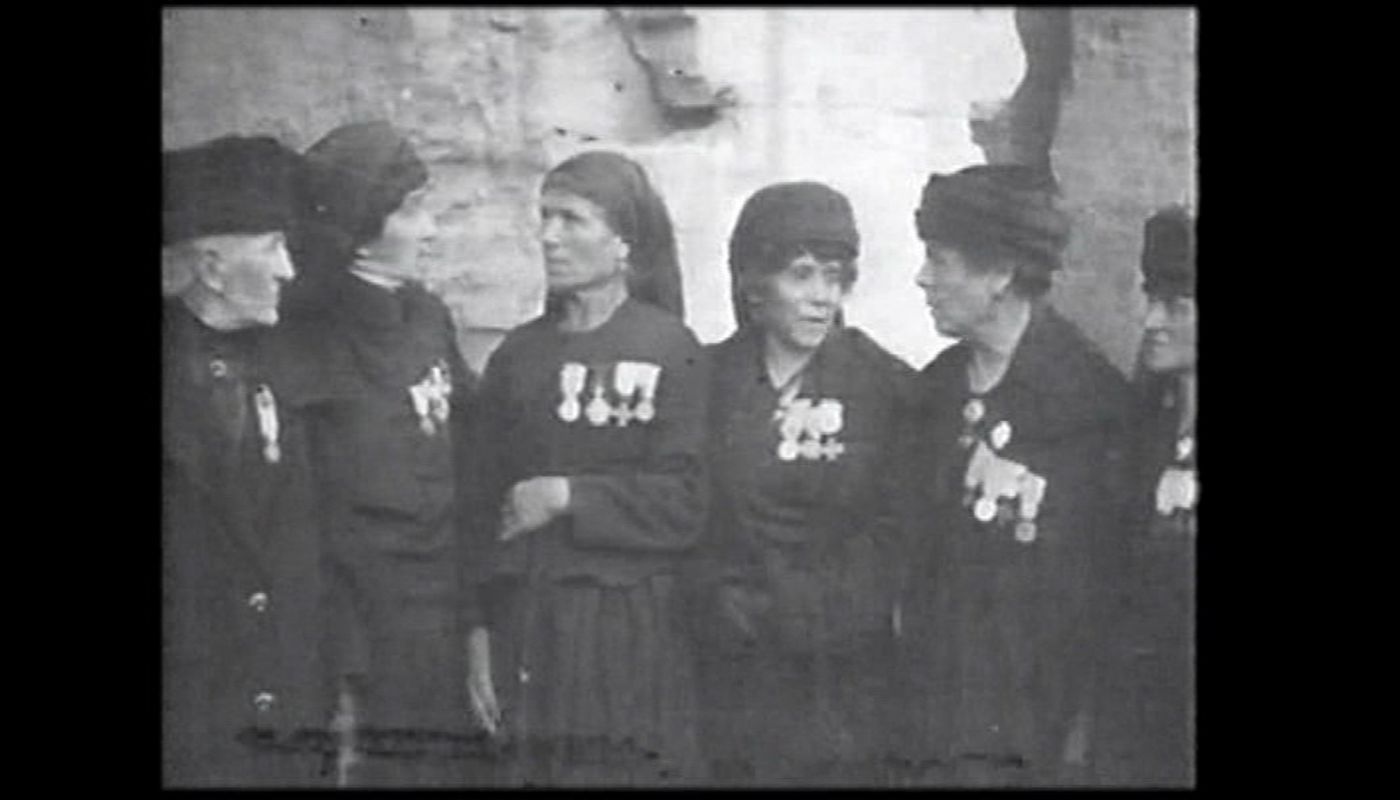
The third medium-length film in the series, undated but presumably from the early 1920s, produced by the Istituto Italiano Proiezioni Luminose, a Milanese production company with public funding for educational purposes, follows the pilgrimage of a group of widows and mothers of fallen soldiers to various cemeteries on the front lines of the Italo-Austrian War. From Trento, the “Veterans of Sorrow,” as they are known, visit Buonconsiglio Castle and the graves of the irredentist volunteers Cesare Battisti, Damiano Chiesa, and Fabio Filzi. They then pass through the cemeteries of Monte Zugna and Valsugana, interspersed with war scenes and touching images of the compassionate collection of the bodies on the battlefield.
The second part of the film begins in Udine, where the group is received at the Town Hall and visits the local cemetery. Another insert identifies Captain Giannino Antona Traversi, an officer in the Central Office for War Memorials, as he records the dog tags recovered from the bodies of the fallen. From Udine, the pilgrimage heads to Cividale, visiting the Rubignacco orphanage for war orphans, before arriving in Caporetto, with unprecedented and dramatic panning shots of the Slovenian town. In Bovec, they visit the cemetery that holds the remains of Major Pericle Negrotto, commander of the volunteer Bersaglieri battalion. The journey then continues to Tolmin, with a view of the Plava cemetery, with the eloquent patriotic caption: “Now the Isonzo sings Italian.”
An important chapter concerns the Sant’Elia cemetery in Redipuglia, with the still unfinished chapel-lighthouse, which leads us to suppose that the filming, devoid of civilians, took place before its opening on May 24, 1923. The scenes of soldiers using pneumatic hammers and sledgehammers to carve out the graves of the fallen, collected from the various cemeteries in the surrounding area, are eloquent.
The journey continues on Monte Grappa with the Cadorna road and the cemeteries of Monte Pertica and Asolone, to arrive at the Chapel of the Madonnina, today incorporated into the Grappa Shrine,
on Col di Lana and on the Piave, with scenes of children bringing flowers to the fallen, and ends in Rome, in front of the Colosseum and with the tribute at the tomb of the Unknown Soldier.
Despite a certain rhetoric and propaganda intent (the group’s embarrassing Roman salute at the Colosseum), the film portrays the genuine grief of a group of mothers and war widows embarking on a painful journey in search of the burial sites of their loved ones. At times, the faces in the frame powerfully express the pain of individual and collective grief. However, there are also moments of relaxation and genuine enjoyment along the journey, largely accomplished in military trucks, with moments of reflection but also of satisfaction for a journey that for many will also be an adventure. In the background, the signs and gestures of a regime, the Fascist one, which appropriates private mourning to transform it into propagandistic proclamations.