
OVERT AND OCCULT BETWEEN PORZÛS AND GLADIO
by FRANCO JURI
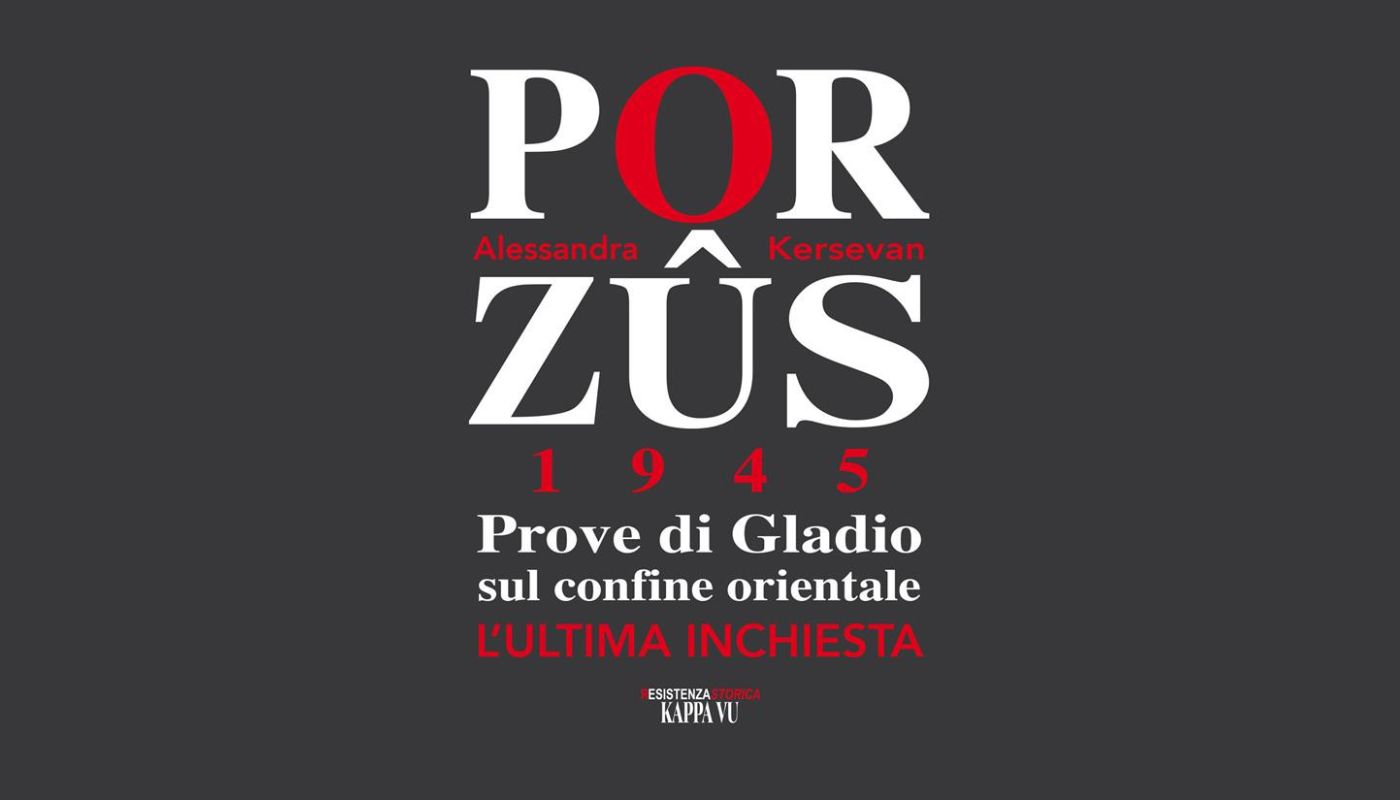
That history and, consequently, historiography are a perpetually boiling magma, in which there can be no “comfort zone” guaranteed by politics, is reminded by the intense 1084 pages of the book by Alessandra Kersevan Porzûs 1945 – Gladio Trials on the Eastern Border, published last year by Kappa Vu, the Udine-based publishing house that has long offered space to those who investigate, often against the grain, the history of these complex, multiethnic and multilingual lands. The book’s scale is understandable considering the author has dedicated 30 years of meticulous research, documentation, verification, and comparison of data and testimonies, as well as previously unpublished insights, following her first book in 1995 on the tragic events of Porzûs, which occurred within the Garibaldi-Osoppo Friulian Resistance in February 1945 and which cost the lives of 17 partisans of the Osoppo Brigades.
To recap: that tragedy of national and even international significance has, since the end of the war and the various trials of the perpetrators and alleged instigators of the massacre in the 1950s, in the midst of the Cold War and under strong political pressure, a truth that we could define as institutional, “remembrance day,” and therefore untouchable, repeated for decades by various historians, writers, journalists, politicians, and film directors who have dealt with it. This truth, recently reaffirmed by the book Blood on the Resistance by Tommaso Piffer, professor of history at the University of Udine, published shortly before Alessandra Kersevan’s work, provides the following narrative: on February 7, 1945, a commando of the GAP (Patriotic Action Groups, dependent on the Garibaldi Brigades and the Friulian PCI) commanded by Mario Toffanin-Giacca treacherously attacked a garrison of Osovan partisans in the mountain pastures of Topli Uorch, not far from the village of Porzûs, above Attimis. After a summary trial, the GAP members killed four people and wounded one while fleeing. Among those executed in Osovan were commander Francesco De Gregori “Bolla,” Gastone Valente “Enea,” and Elda Turchetti, reported by Radio London as a Nazi spy, but as a prisoner, she became known at the Osovan mountain pastures under the nom de guerre “Livia.” Aldo Bricco, “Centina,” managed to escape, wounded, and was later treated in a Slovenian partisan hospital. A very young Garibaldian, Giovanni Comin, “Tigre,” reached the mountain pastures alone, but was killed by Garibaldians while attempting to escape in the ensuing confusion. The rest of the Osovani, including Guidalberto Pasolini, Pier Paolo’s brother, were taken down the valley to the Bosco Romagno area, where they too would be killed in circumstances that are still unclear.
The official narrative, which crystallized in the postwar period—partly as a price for a national and reconciliatory reorganization of the highest-ranking members of the defunct PCI—presents the action as the result of very specific orders from the local Communist Party, the Garibaldi Natisone Division, then operating beyond the Isonzo River in the Trnovo Forest (Trnovski gozd) under the command of the IX Slovenian Corps, and thus of the Slovenian/Yugoslav partisan army. Although the charges of high treason against the homeland were dropped in the Gappisti trials due to Garibaldi’s collaboration with the Slovenian resistance, while the Communists’ responsibilities remain, official historiography, most recently that of Piffer, insists on the Slovenian instigators, of whom Giacca, through the leadership of the Friulian PCI, was a dutiful and cruel executor. In this regard, Piffer published a letter from Slovenian commander Julij Beltram in which he argued, also naming Bolla, that the alleged Osoppo traitors should be liquidated. The defense’s attempts to explain the reasons for the violent act with well-founded suspicions of collusion between the Osoppo command and the fascists of the X MAS and the Nazis, mediated by the clergy, to jointly confront the “Slavic-Communist danger” in eastern Friuli, were ignored or at least relativized to the maximum extent possible where they could not be completely denied.
Now Kersevan’s book, with its detailed and previously unpublished documentation and reading of what can be found in the rich but fragmented memoir literature, the fruit of years of research in Italian, Slovenian, English and American archives, and of direct and indirect testimonies, manages to overturn much of the official anti-Garibaldian narrative, amply demonstrating that contacts between the Osoppo leaders, the “white partisans”, the Badoglio, Fascist and Allied secret services, as well as with the infamous X MAS of Prince Junio Valerio Borghese and the German command itself, occurred on several occasions, with particular intensity precisely at the beginning of 1945, shortly before the events of Porzûs. It should also be considered that Garibaldi’s followers, and especially the Gappisti, who operated in the plains and cities, exposed themselves more than others to danger, arrest, and killing, often through denunciation, learned from various sources of these “secret” contacts, strictly prohibited by the Northern Italy National Liberation Committee (CLNAI). That relations between Osoppo and Garibaldi’s followers, despite some attempts to unify their commands, were far from good at the time, is demonstrated by a series of memorials and documents attesting to the opposition of the Osoppo, which had been formed with the help of priests and soldiers and the support of the wealthier and more aristocratic Friuli, precisely to “rebalance” the influential and well-organized presence of Garibaldi’s communist partisan movement, to come under the command of the Yugoslav allies in the predominantly ethnic Slovene areas, as did the Garibaldi Natisone Division. Commander Bolla himself (Francesco De Gregori), an officer in the Royal Army until October 1943 and – as the author reveals – a volunteer fighter in Spain alongside the Francoists, in his memoirs did not consider the Slovenian partisans and Garibaldi’s men to be allies, but described them as the “hidden enemy”, while the Germans and Fascists were the “overt enemy”. The disagreement between the Osovan anti-communists and the Garibaldian communists increased as the end of the war approached, along with the victory over Nazi-Fascism with the advance of the Slovenian partisan troops, who in turn saw the Osovans as a reactionary and nationalist enemy, whom they compared, unfairly to many Osovans who were sincerely anti-Fascists, to the collaborationist beautiful Slovenian garda , which therefore did not recognize the right to garrison the areas with a predominantly Slovenian ethnic population.
Alessandra Kersevan focuses and describes with particular attention to detail and a wealth of sources the complex problem of ethnic-ideological relations in the Operational Zone of the Adriatic Coast annexed by the Third Reich, and the resulting friction between the various components of the Resistance. And so, in the complicated war landscape of eastern Friuli, characters and interests enter the scene that make the last months of the “hot” war a dark beginning of the cold one in which plots and attempts at secret alliances overturn many of the principles of the Resistance supported by the CLNAI.
The drama of Porzûs matures in this exasperated climate, while in Friuli, with the De Courten plan, emissaries, agents, mediators, and double agents seeking an alliance that would include Osoppo in a common anti-Slavic and anti-Communist Italian front, including and recycled Junio Valerio Borghese’s X MAS. The names, like the facts, are documented: Cino Boccazzi, an agent for the SOE, the British secret services, and later the American OSS; Major Mario Argenton, an agent for the SIM, the Badoglio navy’s secret services, and a “white” member of the CLN; Maria Pasquinelli, a fascist fanatic and X MAS agent, known for killing British Brigadier General Robert W. De Winton in Pola in 1947; Antonio Marceglia, an officer in Badoglio’s navy and SIM agent; Italo Sauro, son of the irredentist hero Nazario and Mussolini’s right-hand man in the anti-Slavic ethnic cleansing; Prince Junio Valerio Borghese, head of the X MAS; and others. As proven by documents and often contradictory depositions at the Borghese (1947) and Porzûs (1952) trials, which Kersevan carefully cites, from the first to the thirty-first of January 1945 a dense network of meetings unfolded between Osoppo residents, Badoglio agents and fascists which led, again in January, to the meeting between the supreme commander of Osoppo Candido Grassi “Verdi” and the delegate of the X Mas Manlio Morelli, a well-known war criminal. But Kersevan also presents us with the parallel correspondence and memoranda of the Friulian curia with the German commands and the head of the SS police, General Odilo Globocnik, from the letters of the archbishop of Udine Giuseppe Nogara to the memorials of Don Aldo Moretti “Lino”, one of the founders of Osoppo. The agreement, supported by Bolla, between the Osovans and the fascist militia for a joint garrison in Ravosa was, however, “overt.” The official reason for this was to defend the population from the raids of German-collaborating Cossacks, who were therefore allied with the fascists. Garibaldi’s men, as well as their “overt” Slovenian allies, were kept in the dark about these contacts, but nevertheless received various rumors and evidence of what was happening. Nor did they go unnoticed, as the better treatment afforded to Osovan prisoners compared to Garibaldi’s in Nazi-Fascist prisons.
After the Porzûs massacre in February 1945 and the end of the war, attempts at an anti-Slavic and anti-communist alliance between the White Resistance and the Fascists, which had “secretly” blossomed in January 1945 and culminated in the enlistment of the collaborationist “Tagliamento Alpine Regiment” in the Osoppo Army, gradually became more visible and institutionalized, encouraged at the height of the Cold War by the Border Zones Office established by the De Gasperi government and coordinated by Giulio Andreotti. And so began the saga of secret armed organizations with a notable presence from Osoppo and former members of the X MAS; from the 3.CVL to the Organization O, ending with Gladio, a NATO creation within the framework of the anti-communist operation. Stay behind, protagonist for decades of the bloody strategy of tension in Italy, whose existence was recognized in 1990 by Giulio Andreotti and Francesco Cossiga.
Alessandra Kersevan’s book reveals aspects and facts that have been previously unpublished or deliberately kept quiet, which should make many historians who have studied Porzûs blush a little.
P.S
I think it’s fair to point out that my father, Vittorio Juri “Marco,” a commander of Garibaldi’s GAP staff, was sentenced to life imprisonment for the events at Porzûs. In 1967, he was pardoned by President Giuseppe Saragat, along with other convicted Garibaldians. He spent 21 years in exile in Zagreb, Opatija, Pula, and Koper, where he remained even after the amnesty until his death. Before his death in 1981, he began writing a memoir, unfortunately unfinished, in which his account confirms many of the facts documented by Alessandra Kersevan.