
ABOUT SLOVENSTICISM IN ITALY
written by POLONA LIBERŠAR
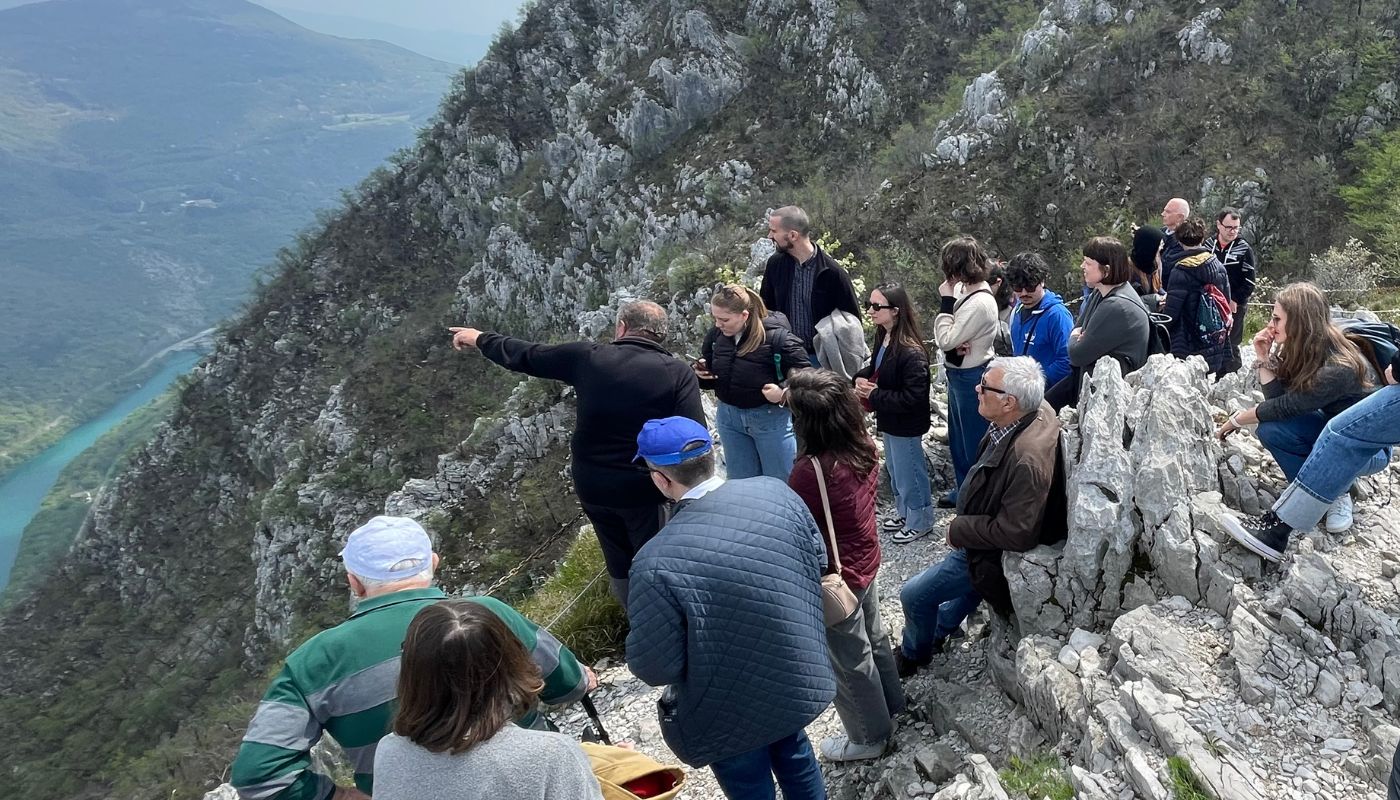
Slovenian teachers at universities in Italy are extremely pleased with the initiative to write a short summary of our Isonzo-Soča departments, as there is certainly a lot that the reader does not know, and perhaps there will be some pleasant surprises among the information. The history of teaching Slovenian is more than a hundred years old, and lecturers often started at one university and continued at another; or they earned their doctorates and taught elsewhere. Currently, Slovenian can be taught at as many as five Italian universities. A frequent question that our interlocutors ask us is how many students we have and who is interested in Slovenian at all. The students at most departments are not numerous, but they are extremely interested and remain great promoters of Slovenian and Slovenia even long after they have completed their studies. Students of all Slovenian studies mostly know each other well, because every year, in addition to formal studies, we also prepare other projects for them, of which the annual excursion to Slovenia is by far the most popular. Last year, we spent three days in Goriška because of GO25 and the students were thrilled.
Currently, almost all Slovenian studies have female Slovenian teachers employed at the Centre for Slovenian as a Second and Foreign Language (CSDTJ) of the Department of Slovenian Studies of the Faculty of Arts, University of Ljubljana and seconded to Padua: Polona Liberšar, Rome: Sanja Pirc, Trieste: mag. Rada Lečič and dr. Karin Marc, and Udine: Zvonka Kajba. CSDTJ enables Slovenian studies to order books and textbooks. It co-finances various projects, such as joint excursions, which we traditionally prepare together: our students get to know each other, collaborate (e.g. back-to-back conversations, book presentations, translations, etc.), meet outside of formal studies, and arrange to participate in the summer Seminar of Slovenian Language, Literature and Culture, for which scholarships are also awarded by CSDTJ.
When it comes to the beginnings of Slovenian studies at Italian universities, we have to go all the way back to Naples. The current head of the department, Dr. Maria Bidovec, emphasizes that Slovenian studies at the University of L’Orientale can boast of some kind of records, namely that it is the furthest from Slovenia, and it was the first to teach Slovenian since the academic year 1914/15. Slovenian has been studied in Naples for longer than at the University of Ljubljana, which was founded only in 1919. The first lecturer was the Venetian Slovene Bruno Guyon, who in 1902 published one of the first modern manuals for learning Slovenian for Italians at the Milanese publishing house Hoepli. Grammatica, esercicii e vocabolario della lingua slovena. Interestingly, Dr. Bidovec published an exceptional manual in 2021 with the same publishing house. Slovenian grammar .
In 1914, Bruno Guyon was also invited to Padua, as the Italian army wanted to teach its officers the basics of Slovenian due to the war, so that they could communicate more easily with the inhabitants of the northeastern territory at the front. In 1920, the first Chair of Slavic Linguistics in Italy was established at the University of Padua, which accelerated interest in Slavic languages, literatures and cultures, and the first major step was taken for Slovenian with Dr. Arturo Cronio, who allowed his students to write diplomas related to the Slovenian language and literature (the first diploma thesis is from 1937 on the topic of Prešeren’s poems). His most famous graduate was certainly Boris Pahor, who graduated in 1947. At the University of Padua, it has been possible to study Slovenian continuously since 1963, when Dr. Martin Jevnikar became the head of the department, and the current head of the department is Dr. Han Steenwijk.
Founded in Rome in 1303, La Sapienza, as one of the oldest universities in the world, has always made a significant contribution to the formation of Italian society. Directly involved in key events that marked the economic, cultural and socio-political development of Italy on several occasions, it has also made a significant contribution to world science with seven Nobel laureates among its ranks. Under its auspices, it is possible to study almost 40 foreign languages, and since 1971, Slovenian has also been taught at the Department of Slovenian Language and Literature. Years ago, the chair was held by Dr. Miran Košuta, who is today the chair in Trieste, and in the meantime, Dr. Maria Bidovec lectured, she was succeeded by the late Dr. Andrea Trovesi, and is currently taught by Dr. Anna Bodrova.
The situation is somewhat different at the University of Trieste, as there are two departments where Slovene can be studied. One is the Department of Humanities, where Slovene has been present since the academic year 1943/1944. The head of the department is Dr. Miran Košuta, who, in addition to his lecturing work, is also the author of excellent publications for students and the wider public and a translator of Prešeren’s poems. Students can study Slovene as a first subject or elective, or as part of an independent study program in the Slovene Language and Literature, where they acquire topics from the history of Slovene literature and the theory of the Slovene language.
The second is the Department of Legal and Linguistic Studies and Interpreting and Translation, whose beginnings date back to the academic year 1973/74. The first professor of Slovene was Countess Janja Auersperg Novak, who is known to Slovenians in Italy primarily for the international historical and literary award (the Auersperg Award/Premio Auersperg), which is awarded for merits in ≫ weaving cultural ties ≪. In the academic year 1995/96, at the initiative of Prof. Marija Pirjevec, a Slovene language teaching department was established, and in the academic year 1996/97 they moved to the Trieste National Hall, a symbol of Slovenianness in what was once the largest Slovenian city.
Dr. Martin Jevnikar, who was the first holder of the Slovene Studies Chair in Padua, has been working since 1972 to promote Slovene studies at the youngest of the universities where Slovene can be studied, the University of Udine. The university was officially founded in 1976 with the aim of becoming a scientific centre and support for all language communities living in the area. Many of Udine’s Slovene students do indeed come from the surrounding area, especially Veneto, but also from the Canal Valley. Dr. Jevnikar worked there until his retirement in 1983, and was succeeded by several renowned names, including Lojzka Bratuž, Ivanka Hergold, and Dr. Maria Bidovec. Today, continuity is ensured by Dr. Roberto Dapit, who was also a lector for Italian at the Faculty of Arts in Ljubljana, and is now the author of various books mainly related to Resia and its traditions.
The current state of Slovenian studies is stable, they all have their own lecturer who is employed at the university, a teacher from Slovenia, and most importantly: really excellent students who maintain contact with their lecturers even after their studies. To spice up this rather dry summary of the activities of Slovenian studies departments, I invite you to read a student of Slovenian at the University of Padua.
I started studying Slovenian last year as a second language at university. In previous years I studied Russian and Spanish, so I already knew one Slavic language. My friends often ask me why I study Slovenian, and at first I didn’t know why. I think it’s because I’m interested in Slavic languages. Besides, in my opinion Slovenia is beautiful. I was in Slovenia for the first time when I was little and I remember very well a really beautiful street in Ljubljana. Maybe that memory inspired me. I like studying Slovenian and it would be great if I knew it better. I can’t wait to spend a few days in Ljubljana. I baked my first potica for Christmas! It wasn’t as tasty as the original, but then I made another one for my friends and family: they loved potica! Look at it!
Sources and more information: Stanonik, H. Steenwijk (ed.) 2022: Tra ricerca sul campo e studi a tavolino: Contributu per i cento anni dalla nascita dell’academico Milko Matičetov / Between the field and the cabinet: On the 100th anniversary of the birth of the academician Milko Matičetov . Padua: Coop. Libraria Editirice Università di Padova.
Nidorfer Šiškovič, S. Kranjc, M. Lutar (ed.) 2019: Slovenian and Slovenian studies at universities around the world. Ljubljana : Scientific Publishing House of the Faculty of Arts, University of Ljubljana.
Šekli and A. Žele (eds.) 2018: Proceedings of the Slavic Society of Slovenia 28, Slovenian Studies and Slavic Studies Abroad – Udine. Ljubljana: Union of Slavic Societies of Slovenia.