
BUILDING IMAGES FOR THE FUTURE. AN OPPORTUNITY FOR GORIZIA
by ALESSANDRA MARIN
It was September 2002 when – working on the program of the Advanced Laboratory of Urban Design of the fourth year, in the Degree Course in Architecture of the University of Trieste with his colleague Andrea De Eccher – the idea emerged of dedicating to the cities and the cross-border territory of Gorizia and Nova Gorica, which two years later would become a unified territory in the European context, the exercise of the academic year 2002-2003.
Since then, the UNITS Urban Design working group – above all by virtue of the constant personal commitment of the writer, evidenced by many other laboratories and degree theses, conferences, publications, cross-border research activities that have followed one another for twenty years – has dedicated energy and ideas to this territory, even before the choice to locate the headquarters of Architecture itself and, obviously, later; and from that moment on with greater vigor, as he was supported in this effort by colleagues from the other disciplines of the project.
The beginning of the University of Trieste’s research in Gorizia began shortly after the approval of the general town plan that marked the turn of the millennium in Gorizia and attempted to answer the questions opened a decade earlier by the fall of the division of Europe into spheres of influence, which on the one hand opened up new hopes and perspectives, but on the other questioned the local economies and ways of life in the Gorizia area (I use the term in a geographical and non-geographical sense based on that division and dialogue across the border that had already resumed in the sixties.
The plan, drawn up by Gregotti and Associates at the end of the nineties, focuses attention especially on the reconfiguration of border areas, promoting strategic projects to give shape to new urban centralities. This plan promotes, in the free areas or in the process of being decommissioned between Gorizia and Nova Gorica, five large-scale urban design actions, probably designed as a stimulus to activate cooperation in rethinking a wide territorial area.
In doing so, it realizes a vision of the post-border future: the Park of large equipment behind Via Terza Armata, the Business Park at Casa Rossa, the strategic transformation area of the former Sanatorium and former Psychiatric Hospital, the Residential Park between the border of Solkan and the Isonzo – together with two projects dedicated to industrial areas at the confluence of the Corno into the Isonzo and the new urban gate, still on the river, at the IX Agosto bridge – are defined as opportunities for the integration of the provision of services and the creation of new residential quotas, but also for the construction of new centralities and mending between the two cities.
A vision that did not find realization due to the lack of investment (economic, but above all of trust and imagination, especially in the medium-long term) in the city in the following twenty years: the most significant part of the more than forty variants to the Gregotti plan tried to respond precisely to the failure of that vision, which left the city imprisoned in an outdated form, and in search of new stimuli and answers on an economic and social level.
In 2016, the municipal administration approved, in order to get out of this impasse, the Guidelines for a “structural” variant (never started), focused primarily on the need to “deal with the border areas [between the two cities] and landscape and environmental problems as a priority”. Two issues that remain relevant also in the definition of new guidelines (less articulated and which essentially confirm the previous ones) in March 2019, and which, given the conformation of the “border areas”, partly overlap. But which do not seem to have been fully understood in their potential, if the border areas are mentioned as a possible attractor of tourist activities and opportunities to build a new system of places for major events, rather than to reconnect the ecological and landscape networks, a true territorial armor that the border has not been able to break.
On the basis of these assumptions, a collaboration was activated with the Department of Engineering and Architecture of the University of Trieste, which prepared the conditions to achieve the strategic objective of the drafting of the new Municipal General Regulatory Plan (PRGC), starting from a knowledge and proposal base based on scientific research that began in 2020, which produced: documentation relating to the identification of a method and the definition of first hypotheses for the concrete elaboration of operational indications for the adaptation of the municipal urban planning tool to the Regional Landscape Plan; drafting of a report dedicated to the identification and in-depth study of a repertoire of good practices useful for giving suggestions for the drafting of general guidelines for urban planning, with specific reference to the reuse and regeneration of the building heritage and urban open spaces; enhancement of urban, peri-urban and extra-urban landscape textures; sustainable mobility; redevelopment and management of collective equipment; identification of new forms of production and urban economy.
The research, coordinated by the writer and involving professors and young university researchers (Prof. Sara Basso, architects Valentina Cechet, Igor Ciuffarin, Luca Del Fabbro Machado, Sebastiano Roveroni), took place within two years, unfortunately without triggering an effective dialogue – on the basis of the proposals gradually developed – with the political component of the administration, and thus arriving, after a long wait for feedback, to the final delivery in early 2023 of a large study dedicated to the construction of scenarios, visions and project strategies for Gorizia 2040, the cross-border capital.
Fortunately, dialogue with the technicians, both on the Italian and Slovenian sides, has never been lacking, being the result of a long habit of common work. Also for this reason, the design structure of the study for the new urban plan intended to address the issue of planning not only at the municipal scale, but by broadening the gaze to strategic and design images from a cross-border perspective, also in consideration of the necessary interaction activated for years through the EGTC / EZTS Institute activated with Nova Gorica and Šempeter Vrtojba. In this way, it was proposed to consider, as far as possible, a form of planning less conditioned, than the one currently in place, by administrative limits, at least as regards territorial systems, strategies and hypothetical scenarios.
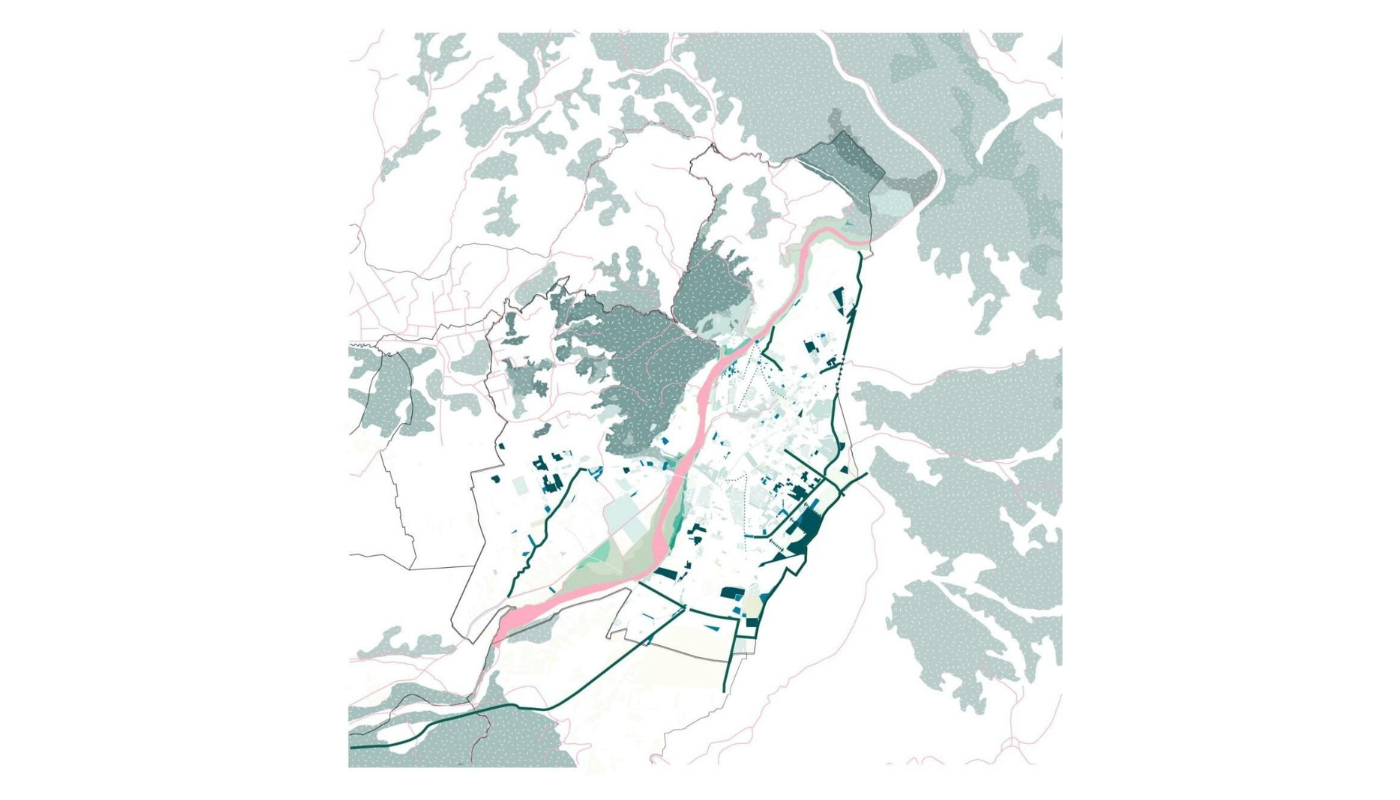
The study conducted by DIA-UNITS has a programmatic nature and was designed as a preparatory to the actual formulation of the urban planning directives for the new General Municipal Regulatory Plan of Gorizia. It proposes the objectives that the new Plan will have to pursue, the issues it will have to address and the methods of drafting; above all, it makes explicit the strategies identified as desirable in comparison with the context and with the good practices explained within it. He then suggests a system of directives starting from the construction of an “overall vision”, in which the main fundamental territorial “systems” are underlined with which, inevitably, planning will have to deal: environmental, settlement, production and trade, infrastructure and slow mobility, services and public spaces.
These territorial systems structure the formal and functional dimension of the territory and constitute a tool for “designing” and giving hierarchy to strategies regardless of mere administrative boundaries.
The research paper proposes, in order to guide the future drafting of the urban plan, the purposes that it should have:
– imagine and represent a vision for Gorizia in 2040 in which the city is attractive, resilient, respectful of its environmental and cultural resources, healthy and
inserted in a transnational axis of production and tourism flows;
– make the processes of territorial governance more flexible, so as to be able to accommodate and adapt to constantly changing situations, but ensuring an environmental and cultural structure that is fairly structured and enhanced;
– review the settlement, expansion, protection and planning logics which, over time, have led to stagnant situations in all the strategic areas already recognized by the previous administrations in the territory of the Isonzo capital.
The study goes so far as to suggest a group of general objectives of the Plan, which I briefly summarize here:
Configuring a new structural framework of the territory based on open space, the environment, the landscape and public space: an objective that has a priority and structural nature and concerns the definition of a frame based on the “ecological dominant”, seen as invariant in the construction of the structure of the plan. Ecological networks are therefore identified as a support for both biological connectivity and human practices. However, it will be necessary not to generically declare a greater sustainability of the territorial transformation and urban equipment, but to proactively define the conditions to ensure that the environmental impact, from now on, is as low as possible, and possibly balanced by improvements, compensations, compensations.
Containing land consumption, eliminating environmental consumption: the main objective stated above can be pursued by defining the quantity and quality of the areas concerned. The main need is to reduce the areas of urban expansion, the result of oversized forecasts and therefore left on hold, in particular due to the demographic decline.
But even where there is no land consumption, anthropization can cause consumption of the environment, impoverishing the soil, polluting air and water: it will be necessary to define areas of landscape enhancement with ecological principles, protecting the existing, increasing the capital present and defining rules of compensation and environmental mitigation proportionate to construction and human activity.
Regenerating, restructuring, redeveloping the existing urban heritage: structuring the future of the city on the landscape-environmental framework involves the need to intervene on the built heritage with the incentive of recovery, expansion projects
densification, as well as restyling and energy requalification, seismic, etc., making the areas of intervention more attractive in terms of social, landscape, environmental, commercial, as well as architectural quality.
Promoting soft mobility and especially the reduction of car traffic: promoting the strengthening of the public transport system and the synergy between the road network and the soft mobility network, which will have to be completed by a system of widespread and enhanced exchange areas between vehicles.
The set of objectives described above is designed to give greater habitability to Gorizia, meaning by the word “inhabit” not only the residence, but the uses that characterize
belonging to a place, including travel, leisure, study, health activities: for this reason, the ultimate goal is to ensure habitability, fair inclusion and the right attractiveness that Gorizia can provide.
The research report then came to outline visions, strategies, possible areas of application, as well as a working method that primarily used listening, participatory co-design and creative discussion as an approach to the planning process. A study that in our opinion, three years later and still waiting for a plan that rethinks the future image of the city, constitutes a precious opportunity for Gorizia, which we hope will be at least partially seized.
La lingua originale di questo articolo è l'Italiano.