
THE BORDER IS NOT A LIMIT, BUT A THRESHOLD
by VALENTINA RODANI
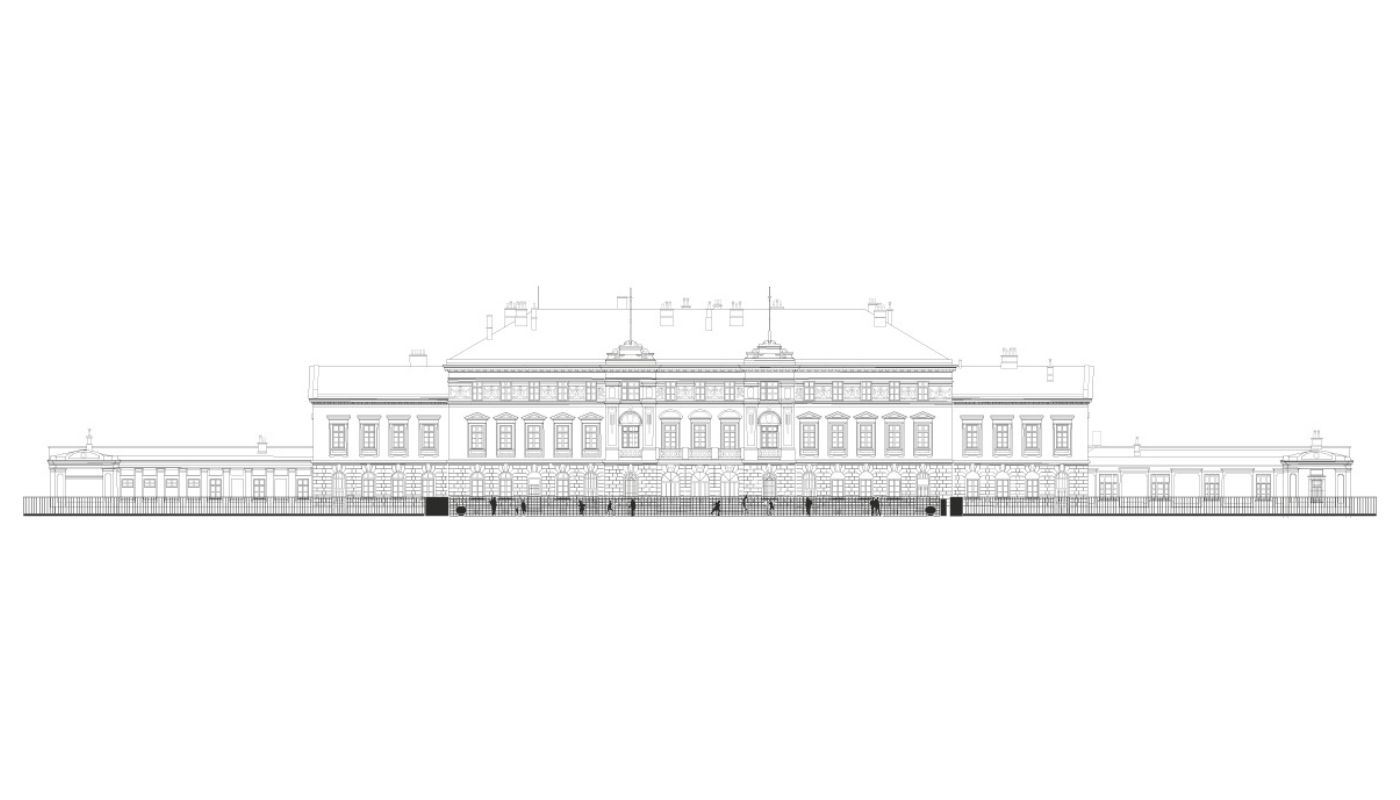
“By temporarily transforming the border fence into a play net and spatially activating a badminton court, the cross-border community has subverted the symbolism of the border as a limit and defused the trauma of confinement, simultaneously reclaiming the spatiality of the threshold of the Transalpina-Trg Evrope Square and with it the freedom to cross it.»
March 12, 2020 will remain a watershed date in the collective memory of the cross-border conurbation between Italy and Slovenia. Only a few days earlier, the European Grouping of Territorial Cooperation (EGTC GO) had launched the International Competition of Ideas for the design of the area of the Transalpina Square-Trg Evrope and the border strip between the Solkan and Casa Rossa-Rožna Dolina crossings. The atmosphere was full of future visions, oriented towards the celebration of the first joint European Capital of Culture in 2025. Then, suddenly, the border line became flesh, iron and separation again. Sixteen years after the demolition of the historic fence erected in 1947, emergency measures to deal with the COVID-19 pandemic have reintroduced a physical barrier in the beating heart of a community that had painstakingly learned the art of permeability. That trauma, however, triggered a spatial and social response that was in some ways unprecedented.
Precisely around that barrier, the citizens of Gorizia and Nova Gorica staged an act of poetic and urban resistance: the banal fence, created to divide and confine, has been re-signified as a game net. By playing badminton from one side of the dividing line to the other, the community defused the trauma of confinement and overturned the very ontology of the border. The rigid line of the limit has been blurred in the community’s performance, turning into a threshold. It is from this precise moment, in which institutional rigidity collides with social fluidity, that the concept of “liminal architecture” takes shape, giving way to a path of research through the boundaries of architecture.
The doctoral research entitled Liminal Architecture. Enduring experimentation on the threshold of the moving border , awarded by the National Association of Historical-Artistic Centers with the Gubbio Prize 2024 and recently published as Liminal architecture. Permanent experimentation on the thresholds between Gorizia and Nova Gorica , is part of this critical groove. The aim is to explore the theoretical and operational universe that is generated when the architectural project decides to inhabit the frontier line, not to celebrate its division, but, on the contrary, to explore its potential as a third space, often and full of meaning.
On a methodological level, the work creates a dialogue between the field of border studies – multidisciplinary studies on borders – and the disciplines of architectural and urban design, finding a research lens in the anthropological and philosophical category of the “liminal”. Liminality – originally theorized by Arnold van Gennep and Victor Turner and more recently made operational by Homi K. Bhabha – here becomes a condition of social, spatial and temporal transformation.
The research inhabits the critical tension between two ways of understanding the border, never a limit, but a third liminal space where the limes – the border understood as a border, an edge often in transition – and the limen – the border understood as an architectural threshold, an interstitial space of transition – meet and interact.
Liminal architecture is the study of how design theories and practices can operate within this tension, transforming the limes into limen, and investigating with which postures, gazes and devices architects address this condition in the project.
A few months after the badminton episode, in full isolation, the winning project of the international competition for Piazza Transalpina, promoted as part of GO! 2025. The proposal by the BAN studio perfectly embodied this liminal tension, in fact the project gave shape to a building capable of physically crossing the phantasmal line of the border, doubling the square through a large semi-hypogeum passage and a terraced square roof: a dynamic, scenographic and flexible stage designed to accommodate cross-border public life.
Yet, as often happens in the urban history of the Gorizia conurbation, that architecture has remained on paper, not finding its complete physical realization. This outcome, far from decreeing the failure of the project, opens up a central question for the discipline: what does it mean for architecture to measure itself against the unfinished or with the “failure to realize” on the borders?
The central thesis of the book suggests that the experience of designing the border – even when it does not translate into a permanent artifact – offers architecture an interesting boundary condition. The design process itself, in fact, activates an intense flow of experimentation at the intersection between architectural interventions, urban visions and aesthetic and socio-spatial practices. It is a laboratory in which different actors, complex policies, different languages and cultures cooperate. The negotiation that takes place during the design of the threshold is itself architecture, understood as the production of situated knowledge and the synergistic construction of the cross-border European Capital of Culture.
The operational core of the research delves into the specificity of the “Gorizia laboratory” through a critical mapping of case studies, architectural and urban projects but also aesthetic and socio-spatial practices that have interpreted the Italian-Slovenian border during its various phases of historical and political transition not as a limit but as a threshold in the making: from Leonardo da Vinci’s mobile menagerie to Antonio Lasciac’s Villa on Rafut, from the Ferrari/Ferrarijev Villa and Garden to the Plan for the Reconstruction of the Towns and Cities of the Isonzo/Posocje to the Adriatic-Black Sea Waterway with Max Fabiani’s Transkar Canal, Edvard Ravnikar’s Nova Gorica, but also the Hotel Argonauti of the OHO Group and Niko Lehrmann, Marko Pogačnik’s lithopunctures and monuments scattered throughout the Italian-Slovenian landscape, from the Topolò/Postaja Topolove Station to Robida’s Acdemy of Margins, up to the design experiments started with Europan 2 and which will lead to Alfonso and Antonio Angelillo’s Designing the Border to finally arrive at the design experiences in Piazza Transalpina/Trg Evrope and the border strip as part of GO!2025.
Ultimately, what is the meaning of the boundary for architecture? And, conversely, what is the boundary of architecture itself? As Daniel Libeskind radically warned in 1987, “architecture cannot solve any problem – it itself is inherently problematic and questionable”.
The book does not claim to offer manualistic answers or definitive solutions to these universal questions. Rather, it aims to demonstrate how the conurbation of Gorizia and Nova Gorica is not a marginal geopolitical periphery, but an epicenter of theoretical-critical production for the complex times in which we live.
Working on the threshold of the border often means crossing real minefields. This is true in a literal sense – as demonstrated by the recent war devices that emerged in the construction sites of the Transalpina railway station – but it is especially true in a figurative sense, where deep layers of cultural, social, linguistic and political boundaries overlap. The role of architecture that emerges from this study is twofold: on the one hand, it has the task of undoing physical and mental walls, slowing down their dramatic global proliferation; on the other, it has the responsibility of giving shape, matter and space to the places of coexistence, interaction and dialogue. Liminal architecture, codified starting from the Gorizia laboratory, thus offers itself as a lens to inform contemporary architectural thought and practice, reminding us that the quality of a civilization is not measured by the walls it erects to defend itself, but by the dignity and beauty of the thresholds it knows how to design to welcome.
«A concrete wall that is almost imperceptible given its size – it is less than fifty centimeters high and less than thirty thick – and its position – in fact delimits some vague and passageway spaces – spontaneously welcomes people waiting in increasing numbers, who sit down, meet, talk, wait. Some children play with it, jump over it, probing gravity and balance they reimagine that wall, the spaces that cross it and the visions of the world they bring with them. The everyday nature of the gesture is inversely proportional to the intensity of the experience it can reveal: being on the border, probing a limit, in the balance, with bated breath, on the threshold. The wall in question in fact materializes the demarcation line between the memorial stones of Piazza Transalpina-Trg Evrope and the former pass of via San Gabriele-Erjavčeva ulica, between Gorizia and Nova Gorica, between Italy and Slovenia. The same wall has been transgressed several times over the years, contested, forgotten, lived, rethought, redesigned, and finally transformed, becoming a diachronic stage of design experiences in the making. »
La lingua originale di questo articolo è l'Italiano.