
HERE WHERE LANGUAGES LOVE EACH OTHER
by PATRIZIA DUGHERO
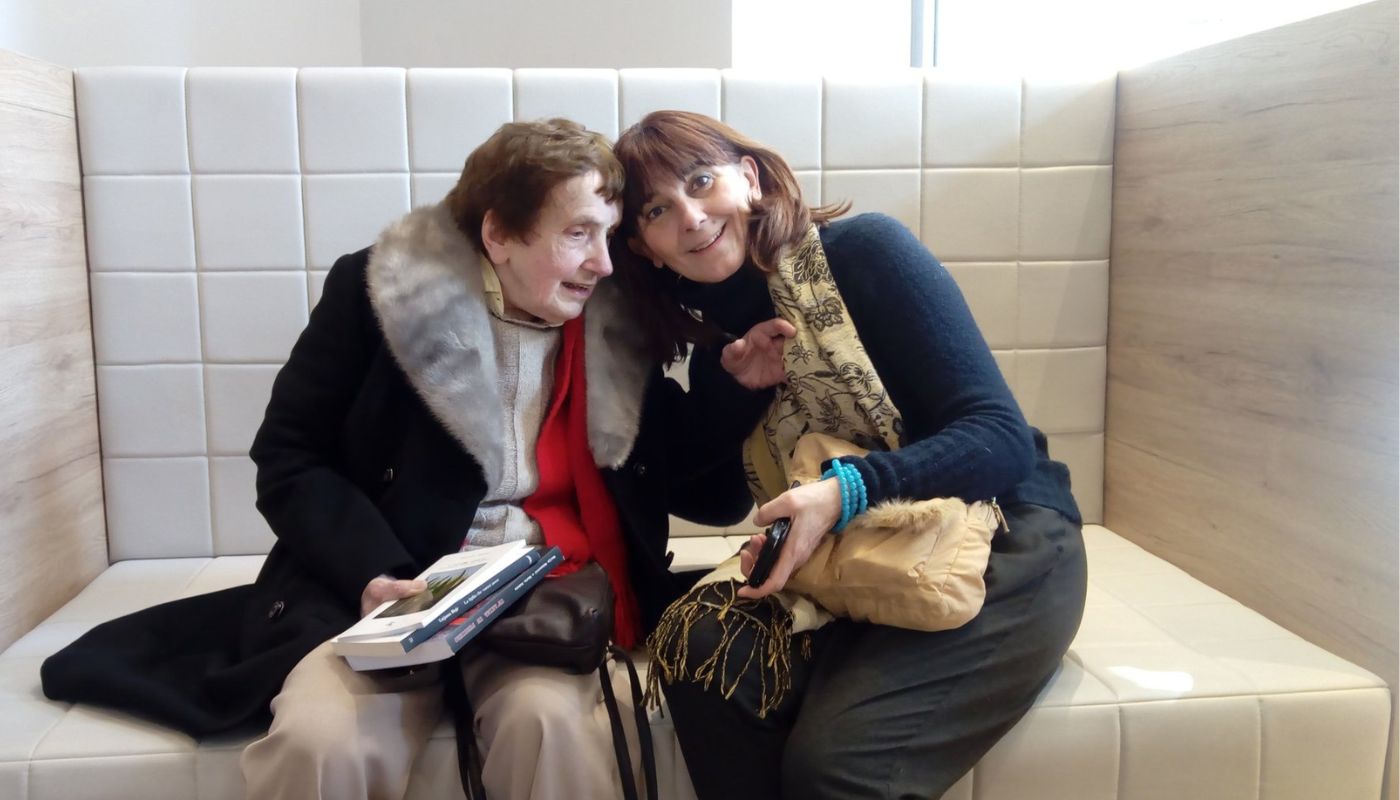
There are translators who cross a language to take a voice elsewhere. And there are translators who make the passage itself a form of existence. Jolka Milič belongs to the second category. Born in Sežana in 1926 and linked to that borderland all her life, she lived at the point where languages meet. Slovenian and Italian, for her, were not just two languages to be known and transferred, but rather two shores of the same human landscape. Her activity as a translator, critic and publicist (supposedly also as a poet) developed precisely within this geography, crossing the linguistic and cultural border. Her translation work is impressive in its breadth: more than one hundred and seventy poets of Slovenian and world literature have entered her work, while over one hundred collections have welcomed her translations. But what matters most is not the number, but the direction of the movement: Milič translated from Italian to Slovenian and from Slovenian to Italian, crossing the bridge in both directions. The border, in his experience, does not appear as a line that separates two belongings, but as a threshold to be crossed. The language of the other is a house in which to enter carefully, without erasing one’s own voice. Furthermore, Gorizia is a concrete stage in her education – in 1947 she obtained her master’s degree there – therefore a symbolic place of her vocation to unite what the border had separated. Her voice was therefore born from the Karst and Goriška, crossed Trieste and arrived in Italy without ever abandoning the Slovenian language. It is no coincidence that a testimony published by the Municipality of Sežana defines her as an “ambassador of the culture that should unite people”. And it was precisely when speaking of the cross-border area that Jolka recognized in the dialogue between Italians and Slovenes a task that was still open: to get to know each other and to make closeness a true sharing. In this sense, his work is not just translation: it is a pioneering exercise in reunion, which now, here in Gorizia, cannot be forgotten. Therefore love together starting from language: love as attention, care, willingness to let oneself be modified by the other. Translating, for Jolka, means accepting that one’s own language is not enough; recognizing that a word can possess another life beyond one’s own, that an image can survive the passage, but also transform, lose something and gain something else. Jolka Milič’s translation is therefore a practice of relationship. It is no coincidence that she turned with particular intensity to poetry, a place in which a language becomes more irreducible: rhythm, sound, silence, ambiguity, measure, cultural memory. Translating it means entering into a fragile material without breaking it.
His relationship with Srečko Kosovel, a poet from the Karst and a fundamental figure in Slovenian poetry, is emblematic. Milič dedicated an important part of her activity to her translation into Italian – she edited Poesie di velluto and Integrali and later Tutto il mondo è come, Kons, Kons 2 and other works – more than half of the numerous Italian editions of Kosovel’s works are linked to her work. In Sežana, the place from which to start, but also the limes between Trieste and the Slovenian Karst, this mediation acquires a particular meaning: two directions that must not produce opposition, but can generate a third dimension, the space of confrontation. Thus her voice as a translator and mediator has brought Slovenian poetry to Italy, creating a dialogue between two cultures that are close and profoundly different at the same time. The poems had to be able to “travel over languages and across cultures”, not simply be transferred, but set in motion: “translator”, we often said to ourselves, “as a ferryman”, making sure that the two shores can recognize each other, because Jolka, the more deeply she loved one language, the more she sought the other.
In the pages of “Fili d’aquilone”, an online magazine “of images, ideas and Poetry” – https://www.filidaquilone.it – her commitment emerged with particular evidence. She was editor of the magazine and over the years presented and translated numerous Slovenian poets there, consolidating her role as a bridge between the two literatures. Her presence continued until her death on January 21, 2021. Issue 57 of the magazine was dedicated to her memory, signed by Alessio Brandolini, poet, coordinator and co-founder of the magazine, whom I had the pleasure of meeting by sharing, at Jolka’s instigation, a brilliant participation in the festival “XV. Mednarodni Lirikonfest Velenje” (2016). I keep the memory of it, a fluid communication for all speakers of the Slavic languages, without the need to pour into English, even when the debates became strong and concerned the focus, such as poetry, translation, otherness, language and identity: «Vsi smo beg XXI. st.! / Poezija = razbito ogledalo» / «We are all escape from the twenty-first century! / Poetry = broken mirror».
In this space I would also like to place the experience of Spinare i versi / Presti verze, my collection of haiku, which she translated and wanted. There is something particularly intense in the fact that it is haiku, already by their nature a form of crossing: very few words must contain an image, a time, a breath, often a threshold between the human and the natural. Translating them means making a crossing within a crossing. In the passage from “Spinare i versi” to “Presti verze”, the Italian word is accepted by the Slovenian language without losing its origin; it changes rhythm, sound, body (therefore form and above all hyphenation) but continues to carry with it the image from which it was born. After this experience, it was Jolka who pushed me to bring, from Bologna to Gorizia, Qudulibri, the publishing house I had founded and which continues to publish so much poetry (much in translation), because “it cannot be that there is no poetry publisher in Gorizia”, he told me. I listened to his stubborn trust and today I feel that this choice also belongs to his legacy: a poetry to be preserved, but above all to be brought to life. This is perhaps his most profound lesson, his legacy is not only in the translations he left, but in having demonstrated, through poetry, that the border, when crossed by the word, can cease to be an end. For this reason, thinking of the two joint Gorizias, I feel that here the word love is not an ornament, but the exact word, while Jolka, with his rough, sometimes caustic, often provocative manner, remains a “poetic mother” who taught me that the most loved language is the one that knows how to open a door on the language of the other.