
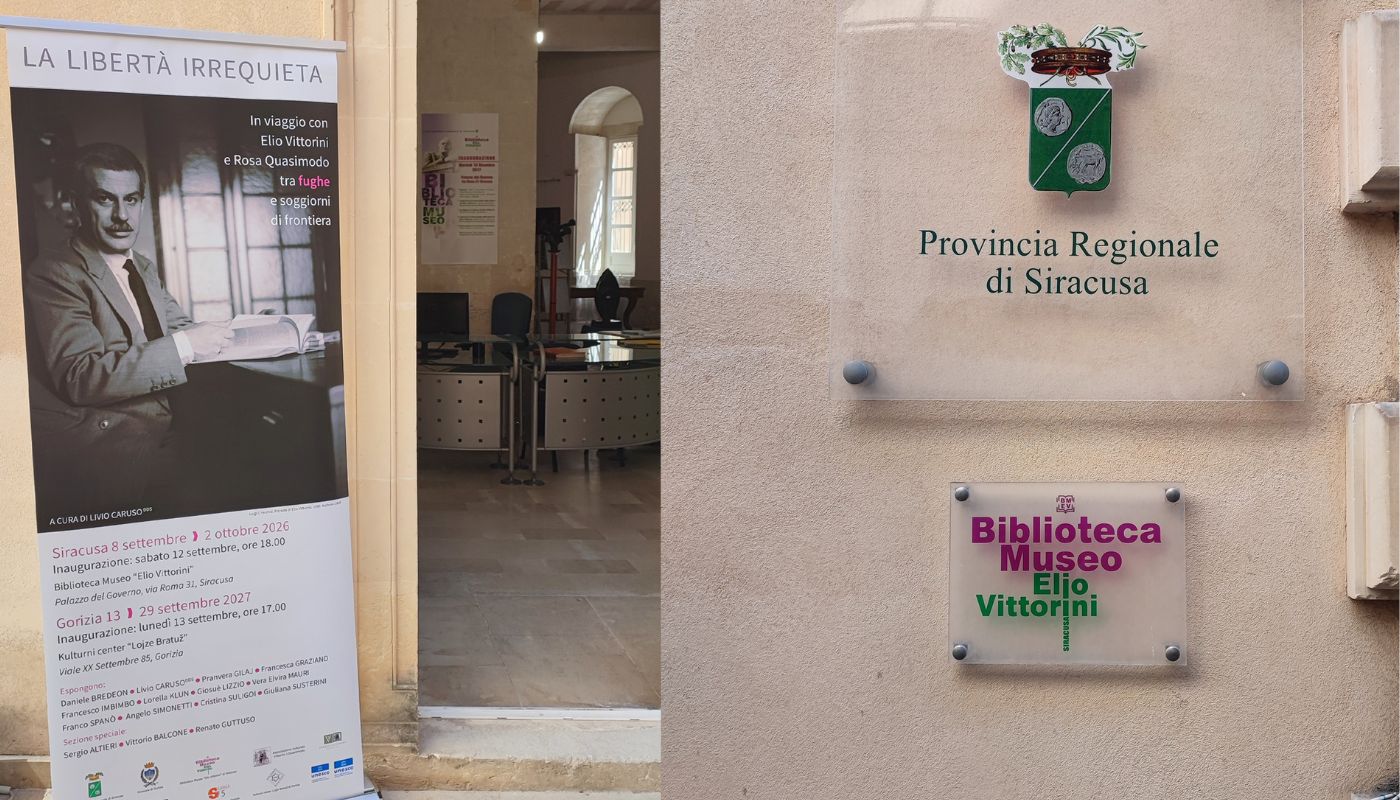
RESTLESS FREEDOM
by LORELLA KLUN
“One night in August, I made arrangements, he waited for me at the window of his room, I crossed the entire shed of the station barefoot, and entered his house, which was at the other end of mine.
With the complicity of his brother Ugo, we fled in a carriage to a small hotel outside the city.” 1
This is how Rosa Quasimodo, sister of the poet Salvatore, tells of her “fuitina” with Elio Vittorini, at the time considered whimsical and rebellious and consequently disliked by the family. It was the year 1927 and the reparative marriage was not enough to appease the gossip, so much so that the couple shortly after moved to Gorizia, where they stayed for a few years.
The artistic project “Restless freedom. Traveling with Elio Vittorini and Rosa Quasimodo between escapes and border stays”, curated by Livio CarusoDDS, the Cultural Association for Contemporary Arts “Prologo” of Gorizia and the Free Art Group “Linea 180”, takes its cue from the meeting of Rosa and Elio to create an exhibition that collects sculpture, painting, photography, publishing and literature.
The first stage of the exhibition is hosted from 8 September to 2 October 2026 at the “Elio Vittorini” Library Museum in Syracuse, on the occasion of the 60th anniversary of Vittorini’s death (1908-1966) and the Elio Vittorini National Literary Prize; on the centenary of the couple’s arrival in Gorizia, the exhibition will move to the Kulturni Center “Lojze Bratuž”.
The catalogue, published by Lithos Editrice of Rome and by Libreria antiquaria Drogheria 28 of Trieste, alongside the works of contemporary artists, presents valuable historical and documentary contributions, starting with the analytical reconstruction of the stays in Gorizia edited by Marco Menato. The couple initially stayed at the Ursich guesthouse, and then moved to Rosa’s parents (her father had left his post as station master in Syracuse to escape the “scandal” of the fuitina), in Piazza Tommaseo, known as Piazzutta and then in Via dei Leoni 21. Although in the following years Elio moved to Florence, Gorizia represented a safe haven for Rosa, so much so that here, in 1934, she also gave birth to her second son Demetrio.
In addition to Menato’s texts, from the Gorizia headquarters of the Venezia Giulia Chamber of Commerce, there is a substantial documentation relating to the radiotelephone shop, opened at number 32 Corso Verdi, by Vincenzo and Gaetano Quasimodo, respectively Rosa’s brother and father. Vincenzo, an engineer who had found work in the Civil Engineering Department of Venezia Giulia and who had already settled in Gorizia in 1926, had also begun to collaborate with the magazine “Squille Isontine”. Antonella Gallarotti2, in her textual contribution “Frammenti goriziiani di Salvatore Quasimodo”, identifies Vincenzo as the intermediary between the Gorizia magazine and Salvatore Quasimodo: in the May 1926 issue preserved at the Isontina State Library, the poem “La càtarsi” appears, in which the poet dialogues with a river: “We will see you humble at the mouth, / kneeling to the sea that does not care / the living symphony of your voice / which even of the snow is a creature.” The echoes of the Anapo river then seem to ideally reverberate in the Isonzo, suspended between Sicily and Gorizia.
After a few years, other places attracted the restless Vittorini: he began to work for the magazine Solaria and moved to Florence: “I can no longer do anything alone. And I will never do anything if I have to be alone all the time. […] Coming back? No, I’m not coming back… You’ll be fine here too… You’re smart too and here you can be happy among many people who will know you, among many friends… 3”
So in 1930 Rosa, together with her son Giusto, joined her husband in Florence; initially they were hosted in the house of Pasquale Sgandurra, Elio’s uncle, a teacher and well-known sculptor. It is Rosa herself, in her memoirs, who recounts: “It was full of statues. At night, the moonlight entered through the windows, and the statues so white frightened us. During the day, little Giusto offered candies to ingratiate himself with the statues, and left them on their bases.4”
To further explore the couple’s events, Marilisa Bombi thinks about it who, in the text taken from her podcast “Voices from the border”, also tells of the slow disintegration of love. Vittorini, introduced to the literary and cultural environment of the time, became increasingly attached to Ginetta Varisco, whom he met in 1932, arousing Rosa’s anguish: “If you feel you can return to me with affection and goodness, do it, if not, out of pity, for the love of God, for human charity. Leave me alone – forever -. I will not resign myself, but I will get used to it.5”
The cracks and misunderstandings widened over the years, until the separation, but between the two remained an affection that unraveled through Vittorini’s militancy in the Resistance, stood up to the impositions of fascism and faced the pain of the untimely death of his eldest son.
Historical and iconographic research, texts and documents have inspired all the artists who have joined the project: each has addressed particular themes, declining them according to their own expressive language.
The theme of travel recurs in many of the works. The railway in particular, in addition to being the workplace of Rosa and Elio’s respective fathers, takes on several values: the train and the tracks represent not only the physical and geographical journey, but the interior, cultural and evolutionary journey of Rosa and Elio.
The Sicilian artist Francesca Graziano, in her engraving on linoleum plate “Like the tracks”, tells of “a story that began next to the tracks, two parallel lines that never meet, but choose to proceed in the same direction”.
The diptych in oil and mixed media on canvas by Livio CarusoDDS represents both the couple’s journey to Gorizia and the path towards their separation; in the canvases appears, together with other symbols, the name Erica, the protagonist of the novel “Erica and her brothers, but which also represents the girl that Vittorini, from the window of Piazzuta’s house in Gorizia, saw passing.
Also in Franco Spanò’s digitally processed photograph appears the train dynamized by the blur and the inscription, as current as ever: “Culture is not a profession for the few: it is a condition for everyone, which completes the existence of man”. Two arrows then point to Gorizia on one side and Viale Gorizia on the other; the latter address, due to the curious coincidences of fate, was Vittorini’s last residence in Milan.
The encounter between souls, love, the opposition to the social conventions of the time, have inspired other artists: Cristina Suligoi has created an acrylic on wood in which the couple, after escaping, waits for dawn: theirs is a suffused squeeze that seems to illuminate the darkness, “an embrace along an August night in which waiting, desire, passion and fear towards an uncertain future but full of promise merge”.
Vera Elvira Mauri, in the large canvas “With suitcases towards Gorizia” also recounts the embrace before the trip: Rosa, seen from behind, is dressed only in printed paper, to underline how both nurtured a deep passion for literature, poetry and freedom of thought.
The work by Giosuè Lizzio depicts a couple along a village street; the clear separation between the luminous cones of the street lamps and the other chromatic backgrounds creates a sort of safe “archipelago” within which the two figures move, as if the path consisted of crossing a hostile darkness passing from island to island.
But love can also reveal itself as a fragile form, crossed by an original crack: the photographic diptych “Chrysalises” by Lorella Klun investigates the relationship between Rosa and Elio experienced as passage, distance and transformation; the two bodies then inhabit the same space, but in different emotional times.
Angelo Simonetti created the compressed foam sculpture “ROQUELVI”, whose title was born from the anagrams of Rosa Quasimodo and Elio Vittorini; in the shape he inserted symbols that tell the story of the couple, such as the seed of Samara, emblem of the journey and the nib and the drop of ink, symbols of writing and stories that unravel between past and present.
Among the artists, on the other hand, there are those who have focused their research on the figure of Vittorini, considered one of the most representative intellectuals of twentieth-century Italian culture: the painter Giuliana Susterini in her “Next stop Gorizia” encaustic pastel on a pinstripe board, inserts symbolic elements such as the train, which recalls escape and travel and a red carnation resting on a pile of the writer’s books: the flower not only represents love for Rosa, but is a direct reference to the famous novel.
Pranvera Gilaj with “A journey”, a work made with acrylic and mixed media, gives us an intense portrait of Vittorini: “A cut of light, the smoke between your fingers./The darkness of Sicily that becomes memory. /Beyond the dark sea, on the tracks of the North./If life is a journey, history descends on Gorizia.”
Vittorini was also a key figure in publishing: he directed the series “I gettoni” for Einaudi, discovering and launching authors such as Italo Calvino, Beppe Fenoglio and many other emerging storytellers of the second post-war period; among his many acquaintances, he also exchanged letters with Biagio Marin, a poet with a strong linguistic and regional identity, very attentive to the civil and poetic dimension of the word. Daniele Bredeon with his pictorial work, focuses on this relationship, quoting Marin’s verses: “Solo ‘l sol al suo logo, fermo, difuso, ne l’azuro” (Only the sun has its place, still, safe, lost in the blue).
Francesco Imbimbo with “At the roots of culture”, chooses to present a pencil and fade drawing on paper because, as he himself says, “Vittorini’s is an Italy in black and white and I would not have been able to tell it in color without betraying the most genuine figure”. Imbimbo pays homage not only to the intellectual who claimed the autonomy of critical thought with respect to any orthodoxy, but also to the linguistic experimenter who with his style broke with the nineteenth-century Italian narrative tradition.
Let’s take for example Conversation in Sicily, an allegorical and visionary novel, written in a strongly rhythmic and symbolic prose. It is a work that anticipates post-war themes and sensibilities and that in the 1953 edition, illustrated by the photographs of Luigi Crocenzi, proposes, ahead of its time, the image no longer subordinate to the word.
Thanks to the availability of the CRAF, the Spilimbergo Photography Research and Archiving Center, it was possible to access the conspicuous collection of Luigi Crocenzi and the exchanges of letters between the photographer and Vittorini.
A special section is then dedicated to two Masters: Sergio Altieri and Vittorio Balcone, protagonists of the art scene from the second half of the twentieth century to the present day.
Sergio Altieri, born in 1930, presents a tempera on canvas which, initially entitled “Rosa”, was later modified both in symbolic and visual terms to make it more adherent to Sicilian culture. The little girl who was previously dressed in pink thus covered herself with a black shawl, almost to merge with the gloomy background, becoming “The child bride”.
Vittorio Balcone, born in 1939 in Tripoli, is a sculptor who has lived in Gorizia since 1967. His “Rosa and Elio. A thwarted love” is an assembled wooden bas-relief that, with its circular, organic and changing shapes, wants to create a link between Syracuse and Gorizia; it is precisely the two human profiles at the center of the composition that put symbols and elements in dialogue.
Livio CarusoDDS, curator of the exhibition, emphasizes how the project is not a closed and pre-packaged package, but can (must!) expand and grow over time, through interdisciplinary collaborations and contributions. Space then also for the poetry of Giovanni Fierro: “Men and no and yes and perhaps, winter is mild / in the hands and fingers that count until / the little , the nail that remains in the soul / and every time the ability to be happy, then / and only then does everything have a meaning / if the name and surname pronounced / are closer to forgetting love … 6”
The intent is to create not only “a sort of multidisciplinary concert, all aimed at representing the theme addressed in the most plastic way”, but also to create a broad and community communicative dimension.
1. Rosa Quasimodo, Tra Quasimodo e Vittorini, ed. Lunarionuovo, 1984
2. Antonella Gallarotti, “Frammenti goriziiani di Salvatore Quasimodo” in La libertà irrequieta. Traveling with Elio Vittorini and Rosa Quasimodo between escapes and border stays, 2016; originally published in Borc San Roc, 2020
3. Letter from Vittorini to his wife, 6/1/1930, in Tra Quasimodo e Vittorini, pag. 88
4. Rosa Quasimodo, ibidem
5. Rosa Quasimodo, ibidem
6. Giovanni Fierro, “The Civil Land”, Staying on Vittorini’s Side – 2