
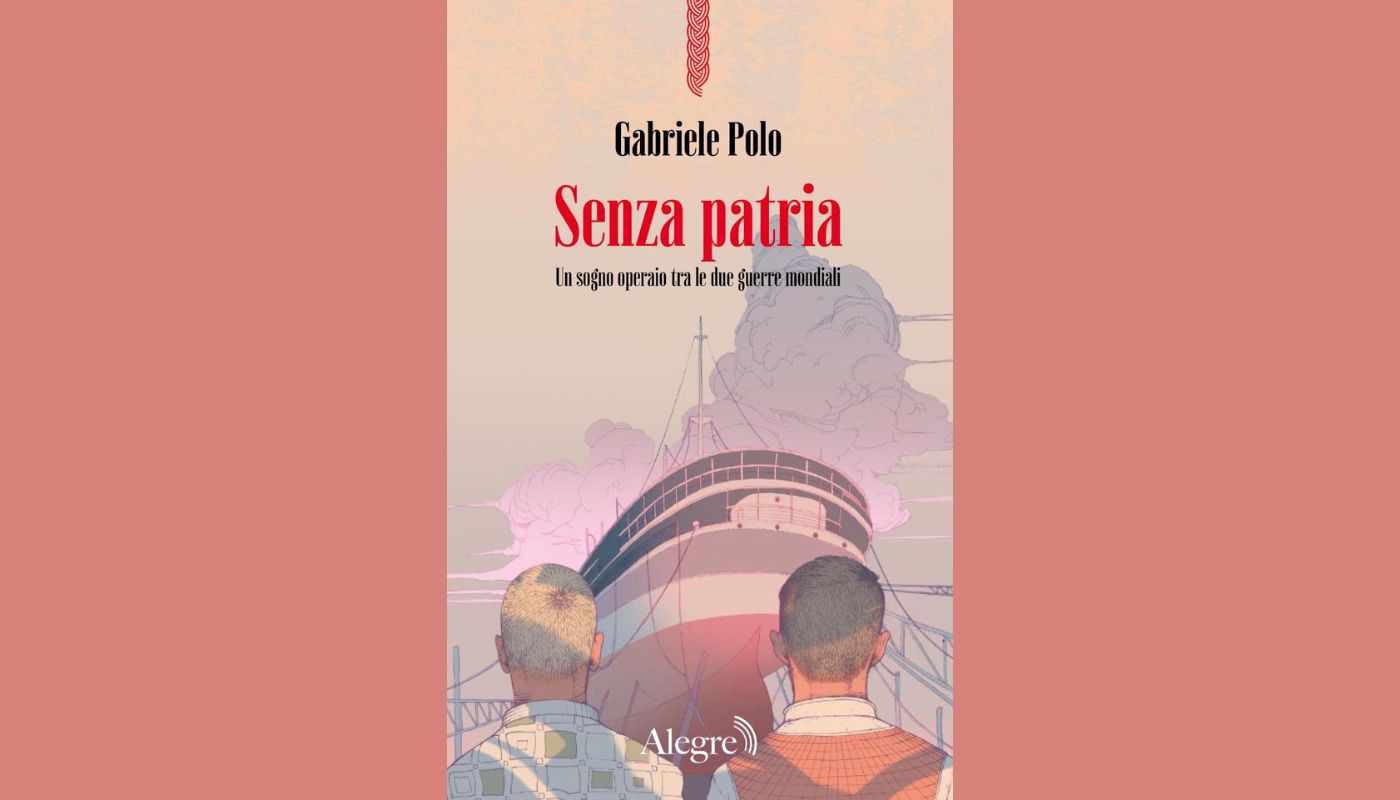
“WITHOUT A HOMELAND” BY GABRIELE POLO. WHEN A NOVEL CHASES HISTORY
by LUCIO FABI
“Mom, what is our country?”
“This, where we were born and live…”, Maria Luigia replies, looking at him worriedly and telling him the most obvious thing.
“But no… I mean… are we Italians? Austrians? Half-Slavs? Or what?”
His mother calms down, he has not gone crazy, nor drunk.
“Ah, in that sense… Mah! Robe de siori…”. Things for gentlemen, for the rich. “For those who have so many ideas and few thoughts…”, he closes the speech and moves on to polenta.
Gabriele Polo, “bisiacco” (born in San Canzian d’Isonzo) transplanted to Rome, journalist and writer, director of “Il Manifesto” from 2003 to 2009, has recently published a historical novel on the story of two “cantierini” brothers, “without a homeland”, or children of the social-internationalist dream, Francesco and Luigi. A frontier story, made up of passions, clashes, desires and ideologies, which unfolds along that “short century” that we know well, lived very intensely between the factory and the world that is transformed through two world wars.
The story of Francesco, Luigi and their family represents the path of a community that through work tries to overcome the centuries-old marginality reserved for peasant people.
The Cosulich shipyard, entrepreneurs who from the beginning of the twentieth century “created” a factory and a working-class town with paternalistic rules, represented an opportunity for the young people of the surrounding area to free themselves from poverty. Together with their salary, they acquired skills and a social conscience that led them to contest the bosses’ choices and often to change the times and rhythms of production. The big ships sailed the seas, an organized workers’ socialism grew in the shipyard with which the bosses had to come to terms.
Coming from a poor family, his father Adelchi, a sailor, due to a storm without his boat with which he transported gravel from the Isonzo to Trieste, his mother Maria Luigia fighting every day to put together lunch and dinner, in the shipyard Francesco from “jug warmer” becomes a specialized worker on the lathe. He knows his comrades, he understands that he is part of a collective history, that the world can be improved. The war, the great one, interrupts all this. Francesco is sent to Galicia with the Austrian army, his family is transferred to a refugee camp in the interior, because the country in which they lived, occupied by the Italian army, becomes the rear of the battlefield. In a trench Francesco is saved by the Slovenian Boris, a shipyard comrade found in the unit. Together, prisoners of the Russians, they live the great dream of the Bolshevik revolution, which they would like to re-present when they return to their homeland, in the meantime Italy and no longer Austria.
The reality presents itself with a very different face. The construction site rebuilt by the Cosulich family has changed its face, the traditional workers are partly replaced by a workforce from the Kingdom, including the many “Gallipolini” wanted by the hierarch Starace (of Gallipoli) to “dilute” the socialist and revolutionary spirit present on the construction site. The prevailing fascism forces socialists and communists to operate clandestinely inside and outside the factory, Francesco continues to hope for socialism. Boris, oppressed like the entire Slovenian community in language and social manifestations, will end up moving to the new Yugoslav state. Luigi, now a teenager, “Scaldabrocche” in the factory, plays football in the shipyard team, hangs out with young people of his age, goes to parties organized by the Cosulich. All this generates friction and disagreements between the two brothers, diluted by their mother and Giovanna, Francesco’s young wife.
The shipbuilding crisis of the thirties, the recrudescence of the presence of fascism inside and outside the shipyard and finally the entry of Italy into the war and the invasion of Yugoslavia, cemented the spirit of resistance of the two brothers, who in September 1943 participated in the partisan battle against the entry of the Germans into Gorizia. Luigi later joined the Yugoslav resistance and coherently, at the end of the conflict, chose to go to Yugoslavia to build, together with 2000 shipyard workers, the new communist country. He returned a few months later, when international events transformed them into enemies of Tito’s socialist regime. He escaped imprisonment thanks to Boris, who had become a big shot in the Federation, but he was unable to return to the country, as he was a non-aligned communist. He had to take refuge in Czechoslovakia, from which he returned disappointed in 1968. Francesco, on the construction site, goes through the contradictions of the post-war period, remaining faithful to the socialist idea. The two brothers meet again over a glass of wine. How it will go, they wonder. “We’ll see”. We are on the threshold of ’68, when still, inside and outside the factory, people were fighting for a better society. Today the construction site looks like a great Moloch capable of swallowing everything and everyone. The fault, perhaps, was of those who came after, but: “It’s progress, baby!”