
THE GREAT EXHIBITION ON ST. MARK IN AQUILEIA
by ANDREA BELLAVITE
Three fragments, a European story
Once upon a time there was the manuscript text of a Gospel, that of Mark. It had been composed many years ago, probably between the fifth and sixth centuries AD. After various complex vicissitudes he arrived in Aquileia and was taken into custody by the bishop, during the period in which he resided in Cividale.
In that period and until the fifteenth century it was considered the original writing of the evangelist. In fact, according to a widespread tradition starting from the sixth century, at the origin of the promotion of the diocese of Aquileia to a Patriarchate, Mark would have reached the limit of the current lagoon and would have started the Christianization of the territory.
Being therefore composed of the main interpreter of Peter, he had aroused in all those who approached, a sort of deep veneration, to the point that both the simplest and the most famous people wanted to leave a sign of their admiration by writing their name on the parched pages.
The fact is that it was only in the 400s, in the midst of humanism, that scholars were able to deny history as it had been taken for granted and to place the composition of the codex in some monastery, probably in the Adriatic area. This recognition comes after another fundamental fact, which marked the story of this highly original volume.
In the mid-fourteenth century, the King of Bohemia, Charles IV, a fervent Catholic and passionate collector of relics and memories of the ancient Church, passed through Aquileia. He was so interested and pressured so much that he obtained a substantial part of that precious artifact as a gift. It was then torn up and sent to the sovereign’s court, in Prague, where it was preserved with all the circumspection and care of the case.
In 1420 the Friulian area of the patriarchate of Aquileia was annexed to the Republic of Venice, where from 1451, in continuity with the glorious history of Aquileia-Grado, the Patriarch had assumed ecclesiastical jurisdiction over the islands, thus starting the patriarchate of Venice. The other Patriarch, residing in Udine, had seen fit to honor Venice as well, dedicating another part of the Gospel Book to it. And so, what should have been the original of the evangelist, found itself broken into three parts, one in Venice, one in Cividale, one in Prague.
This is how the story went for a few centuries, but many people were nostalgic for this very important find, to the point that real pilgrimages were organized, to contemplate it with their own eyes, even though they knew they could not touch it and much less leaf through it.
It is precisely the awareness of the importance of this work that has led the Aquileia Foundation – the Foundation that brings together representatives of the State, the Friuli-Venezia Giulia Region, the Municipality of Aquileia and the Archdiocese of Gorizia – to promote the creation of an exhibition aimed above all at putting together the three broken fragments.
And so, for the first time in 700 years, the Gospel was reunited, solemnly accompanied by Prague, Venice and Cividale in the rooms of Palazzo Meizlik in Aquileia. On September 12 there was the inauguration of the exhibition, which will last until April 25, a date chosen precisely to coincide with the feast of St. Mark the Evangelist. Preserved in bulletproof glass caskets, the three pieces are visible in the final part of an evocative itinerary, during which it is possible to learn about various other aspects of Aquileian history, the legend of St. Mark and the wonderful patriarchal basilica.
A sumptuous catalogue has also been edited, in which scholars from different parts of Europe have wanted to underline the originality and specificity of the Aquileian event, recounting not only the adventures of an ancient manuscript, but proposing a close and compelling connection between this particular history and the broader European history. It is a bit as if the entire passing of the centuries in the heart of Europe has found in the Gospel book a point of reference around which to revolve, in the passing of works and days.
The exhibition itinerary
The exhibition on the Gospel Book of St. Mark will be open from September 12, 2026 to April 25, 2027. The admission price is 5 euros. For those who have an entrance ticket to the house of Titus Macro, the domus episcopalis, the baptistery and the basilica (12 euros), the price is only 2 euros. In addition, the visit is included in the regional card and in the Aquileia Card, which also offers the opportunity to visit the archaeological and early Christian museums of Aquileia as well as the one on underwater archaeology and that of the Treasure of Grado for free. In short, it is an excellent opportunity to devote time to a very interesting territory, in its main cultural institutions.
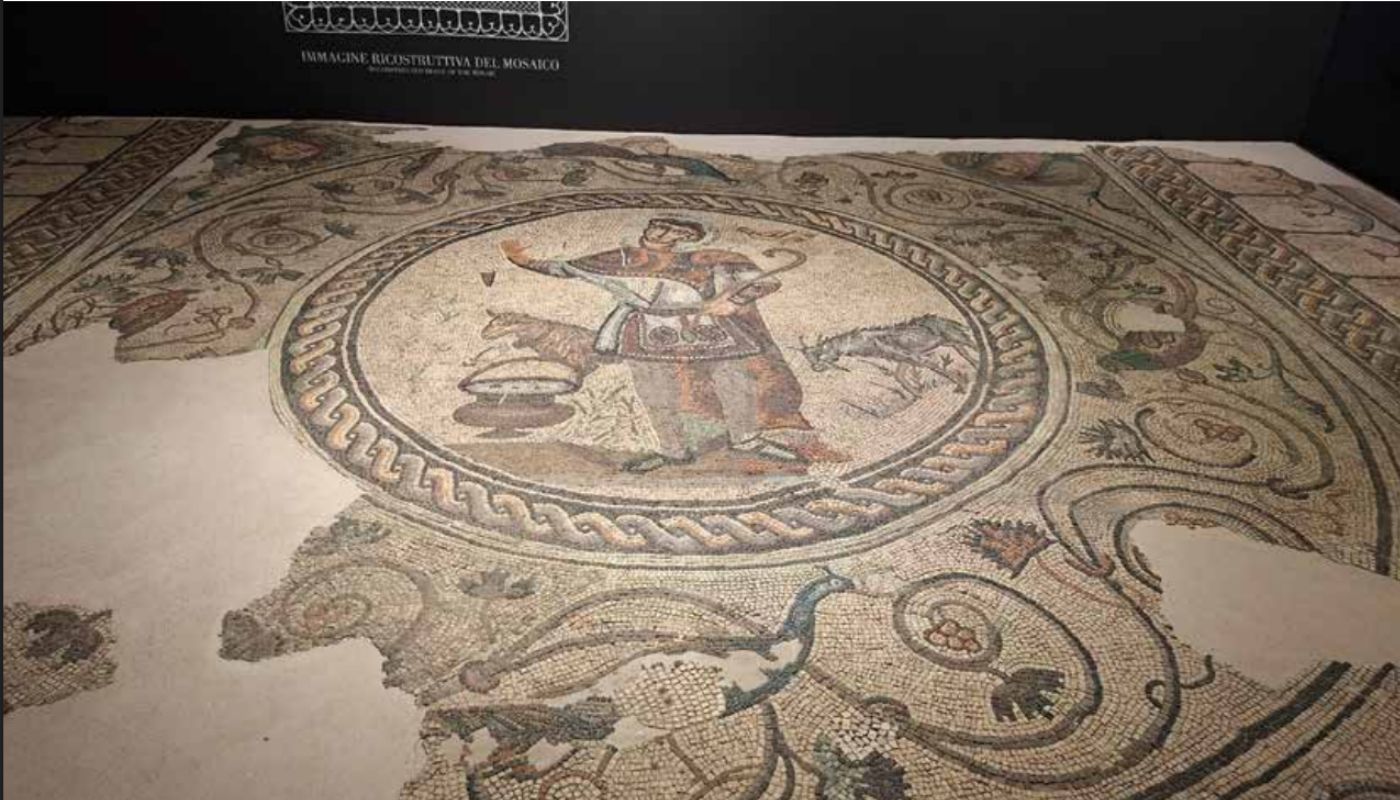
The exhibition is hosted by the Meizlik Palace, at the entrance to Piazza Capitolo. The first surprise, after the compartment dedicated to the ticket office and the sale of the catalogue, is to encounter, superbly enhanced, the mosaic of the shepherd in the singular dress. It is a work from the beginning of the fourth century that was placed until about twenty years ago on a kind of concrete stilt house, where today you can admire the original reception room of the House of Titus Macro. Next to it, you can immediately walk through the legend of St. Mark, with the help of the slides that illustrate the arrival of Mark in Aquileia, chosen by Hermagoras as the first bishop, the episcopal consecration by Peter himself. The images are all taken from the splendid crypt of the frescoes of the basilica. With a series of paintings, masterfully painted by an anonymous artist of the twelfth century, the “Passio” dedicated in the eleventh century to Saints Hermagoras and Fortunatus is represented through paintings. The vision of the photographs is a subtle invitation not to miss the opportunity to visit the church.
Going up to the first floor, you can admire the first lapidary finds that name the evangelist and discover the role of Grado in the whole story. Among other things, there are some artistic objects of exceptional importance, such as the chapel – reliquary of the Anziani saints (IV-V century!), jealously preserved in the treasury of Grado or like the ivory panels that embellish the so-called throne of St. Mark, preserved in the basilica of St. Mark in Venice.
Welcomed by two paintings of fine workmanship, the San Marco del Guardi painted for the church of Belvedere, where tradition indicates the hypothetical landing of Mark and the luminous San Pietro with San Marco and Sant’Antonio del deserto del Tominz, ordinarily kept in the basilica, but unfortunately never exhibited to the public.
Crossing a curtain of fabrics that create a feeling of expectation and surprise, one enters the room where the three fragments are kept. The silence of the visitors is striking, evidently very aware of the importance of what is presented before their eyes. On the left is the fragment of Cividale, very well preserved, in the center the fifteenth-century silver case, which contains what remains – little – of the piece entrusted to Venice. On the left there is a large pericope from Prague, which unfortunately has not been granted for more than a month and a half and will soon be replaced by a conforming manuscript, elaborated by an expert contemporary of ours.
Obviously, one cannot touch the parchments, locked in their crystal cubes. However, after admiring the documents proving the distribution of the Gospel in Prague, one returns to the light of day and has one last surprise. The entire reassembled volume has been digitized and consequently it becomes possible, with a simple touch of the fingers, to leaf through everything, page after page. One can also venture into trying to decipher some Latin phrases or expressions. But one should not be discouraged if one does not succeed, in the end only specialists are able to reconstruct the charm and beauty of the texts.
Just to name a few, beyond the donor committee and the scientific committee who have given prestige and offered ideas, those who have invested time and energy in this great undertaking are above all the archaeologists Cristiano Tiussi, director of the Aquileia Foundation and Luca Villa, the main fitter. With them, a key element in achieving the goal was Martina Dlabajova, a true “genius loci” of Prague, who made it possible to weave and fully realize relations with the Czech Republic and the Archdiocese of Prague.
The exhibition is open every day, with winter hours 10-16. Not to be missed!