
THE CUNNING OF THE LOVE MIND
by MIRT KOMEL
Loveliness because everyone supposedly knows that lovers behave foolishly, and a sober person cannot get rid of the impression that in all their foolish doing there is something very clever at work that works in defiance of their own inclinations and desires.
Perhaps it is from this that the ancient Greek personification in the image of Eros or his Roman twin brother Cupid comes from, who shoots arrows with his bow, with which he makes a man fall in love, so to speak, against his will – moreover, all the more so than one distances himself from love and repeats that he will never fall in love, etc. and blasphemy, that he becomes all the more an easy target for the arrows of Eros.
No wonder love, the most terrible thing that can happen to a human being (apart from annoying bedbugs or an unfortunate sip of fermented milk), has been addressed in a variety of ways, going from extreme to extreme to avoid it: from the monastic monasteries of asexual asceticism, to classical Christian marriage and its variously varied versions in the form of closed, open, or semi-open relationships, all the way to the hippie communes of free love. But what if, time and again, it has been shown that love finds a way to mix up people’s plans, so that things never turn out the way the actors with all their restrictive or elusive means wanted them to be.
It is precisely in this respect that love resembles that famous Hegelian cunning of the mind, which, however, needs to be slightly transformed in order to grasp what the specificity of love is as the cunning of insanity.
As a starting point, Hegel’s “cunning of the mind” from Mind in History is as follows: it does not matter what the subjective motives of world-historical figures, such as Caesar or Napoleon, are; even if they act with purely narcissistic intentions, which are then covered by one or another altruistic purpose, such as “for the good of the republic”, there is always a “cunning of the mind” behind their backs, according to which their actions turn out to be something different from what was originally intended, and only here do they acquire their true world-historical meaning.
The scariness of world-historical figures, which disgusts gentler souls and fascinates Machiavellian anime, lies in the fact that outwardly they act altruistically, passionately referring to this or that common thing, while inwardly we sense that they have some very pragmatic personal interests, which they pursue with cold-blooded intransigence; The Hegelian point is, first of all, that the discrepancy between subjective motives and what appears as action is transformed into intellectuality, where the relations are reversed: it is not that world-historical figures use the general for their own passions, but that the general uses subjective passions to put the intellect into practice at the level of events; a mindfulness which, furthermore, can never be predicted in advance, but only deduced in retrospect.
Marx, who in particular in this respect continued Hegel’s thought of history, tried to turn the historical logic of necessity into the future, which, as Hannah Arendt says in one of her exercises in political thought, entitled Between the past and the future, to politics, which is, after all, a matter of freedom, imbued the same scientific necessity as Hegel did to history. Once Marxist theory caught on, of course, there were also some who wanted to trick history in this way and to inculcate the cunning of the mind in their own doings, but, as Hannah Arendt says in About the Revolution: Anyone who wants to trick history in this way in order to calculate the effects of his actions in advance will always pull this short and become a historical pretender.
The same goes for love: if you want to pretend to love and make a fool of it, then it is inevitable that love itself deceives you and it shaves the fool out of you – and this despite the fact that you are not a bearded baby yourself.
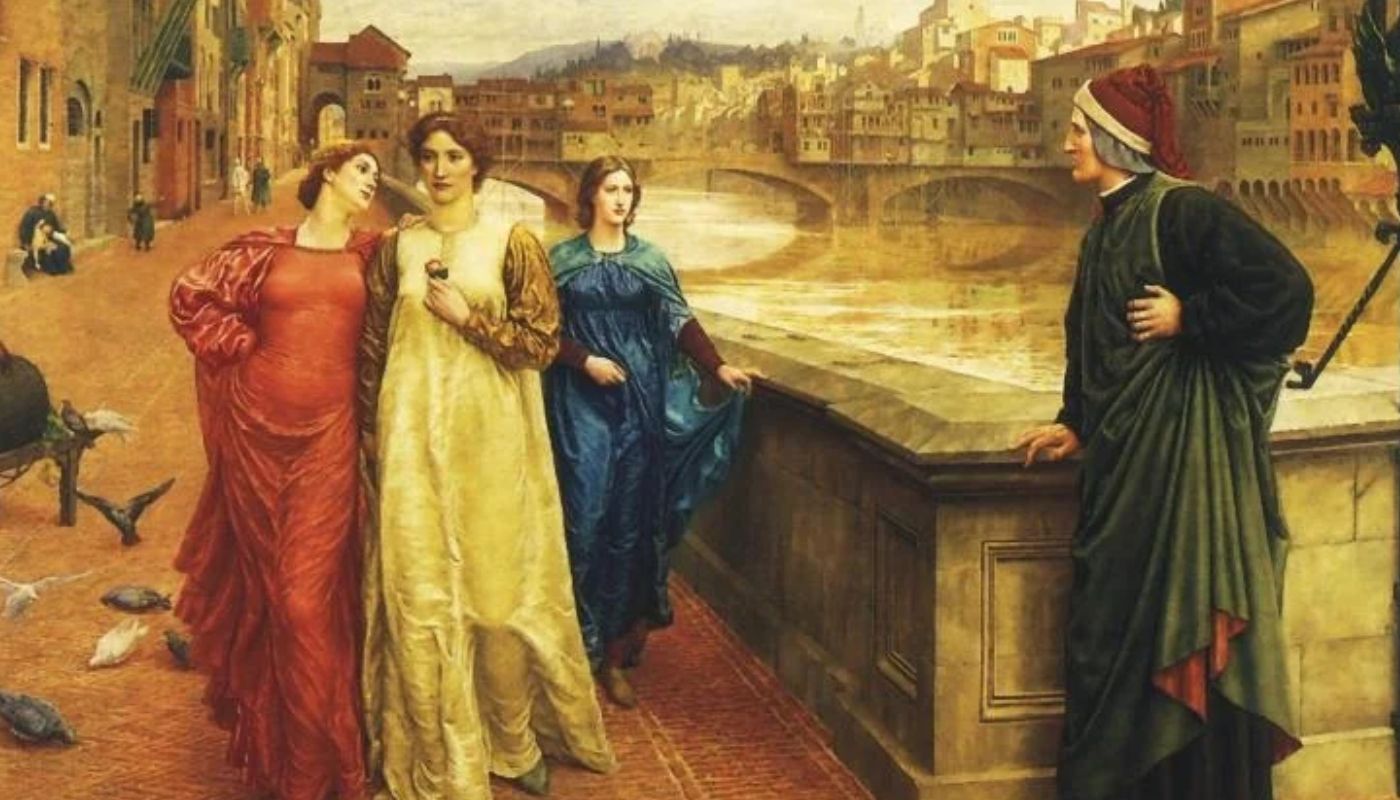
I think that it is Dante, in his collection of sonnets La Vita Nuova , who can show us in detail not only what is going on in the soul of the lover, but also a series of strategies for how the person in question tries to trick love with a capital L, and how conversion Love itself tricks himself.
To begin with, I think it is good to point out that love is always one such strange ménage à trois, since in addition to the lover-ljubljena_i pair it always presupposes a third, i.e., a “great Other” (god or God or someone else), and that for this reason we must also bear in mind that even in the case of Dante’s love for Beatrice we must bear in mind that there is also a Other present at all times, namely Cupid, who is described in the first sonnet of The New Life as follows:
A ciascun’alma presa e gentil core
nel cui cospecto ven lo dir presente,in
cio che mi riscriva ‘n suo parvente,saluto
in lor segnor, cioe Amore.
In an unauthenticated form, the introductory version means (we will subordinate the form to the content for ease of understanding): “To every soul that is besieged, and to every kind heart, in whose presence I speak in order to hear what they think, I salute in them a lord or lord, that is, Cupid.” And immediately afterwards we get an even more accurate description of the god’s moves:
Gia eran quasi che aterzate l’ore
del tempo che omne stella n’e lucente,quando
m’apparve Amor subitamente,
cui esenza membrar mi da orrore.
“It was almost three o’clock, at the time when the stars are shining, when Cupid suddenly appeared to me, the essence of which, as far as I remember, fills me with horror”, Dante’s extremely precise definition of love, namely, that it is something terrible, in its essence, in its essence, and the horror continues further in the concluding verses:
Allegro mi sembrava Amor tenendo
meo core in mano, e nella braccia avea
Madonna involta in un drappo dormendo.
Poi la svegliava, e d’esto core ardendo
Lei paventosa umilmente pascea.
Apresso gir lo ne vedea piangendo.
“I found Cupid happy, holding my heart in his hand, and in his arms he had a girl wrapped in a blanket, sleeping. And then he woke her up, and this burning heart she ate in terror and humiliation. And at last I saw him go away weeping.” (Simplified: Cupid held in his hands and Beatrice as the object of love, and the burning heart of the poet who produced the sonnet, and the moment she consumed that heart, Cupid departed.)
In very general outlines of the relationship between poetry and love, this could be understood as meaning that love appears in the absence of the beloved object, when the latter is missing or, as in Dante’s case, unattainable. Let us think of our good old Goethe, who always wrote about love when meeting and even before contact with the beloved, or after he had already said goodbye (his autobiography Song and Truth can be a very entertaining read in this regard if read in parallel with his Werther or Faust).
And yet, interestingly, already in Second a sonnet that begins with verses O voi che per la via d’Amor passate (“O you who tread the path of Love”), there is a fourth element that makes the Dante-Beatrice-Amor love triangle a square: the so-called Bella Difesa, “beautiful defense”, or Donna-Schermo, the “woman-shield” that Dante places between himself and Beatrice in order to defend the love he feels from the notorious tongues; what confuses him, however, is the fact that he falls in love with the shield, and this at the moment when he Third sonnets in question Donna-Schermo he sets off and travels; and he wraps up his camouflage love, doubling his camouflage, so to speak, by singing about some deceased friend of Beatrice’s.
On the basis of this experience, in the fourth sonnet, the poet meets Amor again, this time in a completely different form, as a neglected traveler, who stands in sharp contrast to the first smiling and gentlemanly figure, also in that Amor himself now suggests to him to find another “woman-shield”, also secondo lo consiglio della Ragione, “according to the dictates of reason”, as he says in the accompanying text.
Cavalcando l’altrier per un
camino,pensoso dell’andar che mi sgradia,trovai
Amore in mezzo della via
in abito leggier di peregrino.
Nella sembianza mi parea meschino,come
avesse perduto signoria;
e sospirando pensoso venia,
per non veder la gente, a capo chino.
“While I was riding along the road, and contemplating the journey that had made me uncomfortable, I came upon Cupid in the middle of the journey, in the simple dress of a traveler; in appearance he seemed to me a pauper, or a prisoner (meschino), as if he had lost his dominion, and, sighing, he walked thoughtfully with his head bent so as not to see the people.”
(Note: Plato in the Symposium defines Eros as the richest and the poorest at the same time, as are lovers.)
Quando mi vide, mi chiamo per nome
e disse: »Io vengo di lontana parte,ov’era
lo tuo cor per mio volere,e
recolo a servir nuovo piacere.«
The moment he saw me, he called me by name, and said: “I come from far away, from a distant place where your heart was—the use of the past is important: ov’era—and the continuation: where your heart was according to my will, by my command (per mio volere), which now says that it must serve a new pleasure.”
And the “new pleasure” is precisely the new donna-schermo from the next, fifth sonnet, which, however, produces a turn in Dante’s relationship with Betrica: the latter come to the ear of rumors about this new woman, and therefore he does not greet him when they meet, so that the poet now writes, in coded form, a pardoning poem in which he tries to explain what is happening:
Ballata, i’vo’ che tu ritrovi Amore,e
con lui vadi a madonna davante,si
che la scusa mia, la qual tu cante,ragioni
poi con lei lo mio segnore.
“Song, I want you to find Cupid again, and go with him to my Madonna, and give her my apology, which I sing here, along with my lord’s explanation.”
In the sixth sonnet, however, a turning point occurs, both in style and content, because now we are no longer dealing with the dramaturgy of the action, but with a very real conceptual operation that stiffens and weighs the value of love, beginning with the realization that love lacks precisely thought as such:
Tutti li miei pensier’ parlan d’Amore
“All my thoughts speak of Love” means precisely the problem of not talking about anything else; Love blocks thought, which, nevertheless, in this sixth sonnet, finds its way in the form of a sonnet that sniffs precisely the stinging of love, after which whining is impossible; the same thought then appears in the eighth sonnet, where he says that everything that meets him passes away in the mind when he sees it:
Cio che m’incontra, nella mente more,
quando’i’vegno a veder voi, bella gioia
In the seventh sonnet, however, a kind of regression occurs: a friend takes Dante to a soiree, where he accidentally meets Beatrice with her friends, which causes another concussion that causes him to sing a plea for understanding, and at the same time he is already announcing the eighth sonnet, in which he weighs himself whether he would go back to see Beatrice, or rather never again, and this groaning and pain continues through the ninth sonnet, until the dilemma is resolved through a combination of thought and form, thoughts about love as such, and the form of singing its virtues:
Donne ch’avete intellecto d’amore,io
vo’con voi della mia donna dire,non
perch’io creda sua laude finire,ma
ragionar per isfogar la mente.
Io dico che pensando ‘l suo valore,Amor
si dolce mi si fa sentire,che
s’io allora non perdessi ardire
farei parlando innamorar la gente.
E io non vo’parlar si altamente,ch’io
divenissi per temenza vile;
ma tractero del suo stato gentile
a rispecto di lei leggieramente,donne
e donzelle amorose, con voi,che
non e cosa da parlarne altrui.
“Women who know what love is, I want to talk to you about my woman, not to exhaust the praise, but to clear my head. I say that if I think of its value, Cupid appears so sweet to me that if I did not lose my fiery, I would make people fall in love by my very speech. But I do not want to speak so high as to become mean and terrible, but I will treat her tender condition with respect for her, and I will discuss with you, beloved women, for these are not things that I can sell to anyone else.” This is followed by an invocation of the Angel, which appeals to the divine intellect, evoking God and divine love in relation to man, where Dante conceives the thought of love, which will then lead him all the way to the end of the sonnets from La Vita nuova.
In the eighteenth sonnet, for example, love is identified with cor genitle, with a kind or tender heart that no longer excites but soothes: “So long has Cupid held me in his dominion and accustomed me to his dominion, that just as he was formerly strong when he held me, so now he is blissful in my heart”:
Si lungamente m’a tenuto Amore
e costumato alla sua segnoria,che
si com’elli m’era forte in pria,cosi
mi sta soave ora nel core.
The idea of advancing love from painful passion to calm serenity is the basic guideline that Dante takes in La Divina Commedia, where through hell and purgatory to a reunion with Beatrice at the gates of paradise, which will allow him access to the love of God; fundamentally, this idea is already sketched in La Vita nuova, especially in the fifteenth sonnet, where Beatrice is identified with Christ, a motif that is also repeated in the Commedia, insofar as the role of the amor terrain is to lead to amor divina, as evidenced by the architectural structure of hell and purgatory in relation to the purely conceptually composed paradise.
There were many such instances in those days when Christianity was still shaping the fundamental phantasmatic framework of love—even before Dante and Beatrice, there were Petrarch and Laura—and many more instances where unheard, or unattainable, or simply forbidden, love gives rise to a devout worship of the love of God, in the direction of the dialectical purification of carnal love passions into the intellectual worship of love in its purest form, i.e., the love of God.
And here, of course, is the paradox: substantively speaking, Dante instrumentalized love as a function of knowing the Christian god, and on the side he invented dolce stil nuovo, a sweet new style, i.e. a less Latinized and more indigenous Florentine language, which became the basis for the Italian national language many centuries later. In short, from the cunning frenzy of love back to the cunning of the mind, which bypasses the particular intentions of individuals who, with their love, transform all the common into the particular, but nevertheless produces the common from the particular. Why?
But the answer is simple: because the world in which we live, beyond all private particulars and solipsistic dreams, is nevertheless common to all. And to the extent that the unconscious is structured as a speech, it is precisely the speech that binds us and binds us together in a community.
The point where things break down and never work out is precisely the point of affection as some kind of stupid cunning of the mind that once fell on Dante.