
ANNIBEL CUNOLDI ATTEMS. CROSSINGS / PREHAJANJA
by CRISTINA FERESIN
The confrontation between cultures, the relationship with emblematic places, the overcoming of physical and symbolic boundaries, the idea of the passage from one state to another, from one form of existence to another. These are the coordinates on which Traversmenti / Prehajanja, the latest exhibition by the Gorizia-based artist Annibel Cunoldi Attems, is developed, hosted in the Spazio Crew of SDAG SpA a socio unico, in the former border crossing of Sant’Andrea in Gorizia, from 15 May to 9 October 2026.
The exhibition is part of the broader context of Crew – Crossing Views, an Interreg project that has identified the cross-border areas of Gorizia and Šempeter-Vrtojba as its fulcrum, with the aim of recovering and redeveloping places with a strong symbolic and cultural value, returning them to the communities as spaces for meeting and relating. The project is led by SDAG SpA a socio unico and, as partners, the Municipality of Šempeter-Vrtojba, the IUAV University of Venice, the Faculty of Architecture of Ljubljana, the Kulturni dom Nova Gorica and, as an associate partner, the GECT GO/EZTS GO.
The Spazio Crew is located in a place deeply marked by history: a crossroads crossed over time by different populations, who have left traces, memories and experiences. Its redevelopment offers the opportunity to give this space a new function, keeping alive the relationship with the cultural stratification that characterizes it.
The theme of “Crossed Visions”, at the basis of the initiative, is the concept of border, understood not as a geographical limit, but as a changing condition and space of passage. It is on this dimension that Annibel Cunoldi Attems’ research is grafted: in Traversmenti / Prehajanja, passage becomes a key to investigating the relationship between identity, belonging and change, through a look at the past but deeply rooted in the present and open to the future.
The artist’s works thus enter into dialogue with the place and its history, helping to reinterpret its meaning through the language of contemporary art.
Active on the international scene, Annibel Cunoldi Attems has been developing for decades a research that intertwines language, space and memory, crossing different expressive media: from graphics to painting, from photography to installation. After studying art in Paris and graduating in German language and literature, she began her career in the mid-seventies, dedicating herself in particular to engraving.
In the eighties he introduced the theme of “mental prisons”, focusing his investigation on the limits that condition space and thought. During the Roman period (1983–1990), painting expanded in large dimensions, taking on a strong architectural value; subsequently the artist arrived at three-dimensional and installation works, using materials such as wood, metal, concrete and stone.
Since 1990 he has lived and worked in Berlin, a city that marks a decisive turning point in his career: here his work is enriched through photography, objects and above all the word, which becomes a central element of the installations. His site-specific works, created in important museums and institutions, including the Neue Nationalgalerie, the Martin-Gropius-Bau, the Akademie der Künste (headquarters of the Academicians), testify to a constant dialogue with the architectural space and with the historical and cultural context. The theme of the border runs through all his production, finding a particular resonance in the cross-border territory of Gorizia and Nova Gorica.
The exhibition stems precisely from the relationship with places of crossing, spaces that go beyond their original function to become symbols of memory and transformation. In this sense, the CREW space, located right between Italy and Slovenia, represents the ideal context to host his works.
The exhibition brings together black and white photographs and installations in which image and word are intertwined in a reflection on places, their history and their value over time. The shots dedicated to the Old Port of Trieste return architectural details of a place suspended from the glorious past, taken as a metaphor for spaces waiting for new relationships. Classical columns, iron structures and urban fragments emerge through the strong luminous contrast of the Plexiglas prints, transforming themselves into traces of history and identity.
Anhovo, a small Slovenian town marked by the presence of the former asbestos factory, now a cement factory, is the site of a work with a strong visual impact that reflects on the relationship between environmental awareness and economic development. Presented in negative and specular form, the work Anhovo: a problematic balance (2025) multiplies points of view and suggests a reading of reality that goes beyond simple representation.
Among the places investigated are the Glienicker Brücke, the famous “Bridge of Spies” between Berlin and Potsdam, a symbol of the Cold War and today an emblem of German unity, reinterpreted by the artist through a new perspective and Diversité, an installation dedicated to the neurologist Jean-Martin Charcot (1825-1893), who combined modern neurology with psychiatry and introduced drawing and photography as a method of investigation, in the “Loges de Viel” of the famous Pitié-Salpêtrière hospital in Paris. The project was part of the cultural program of the twentieth anniversary of the Paris-Berlin twinning (1987-2007).
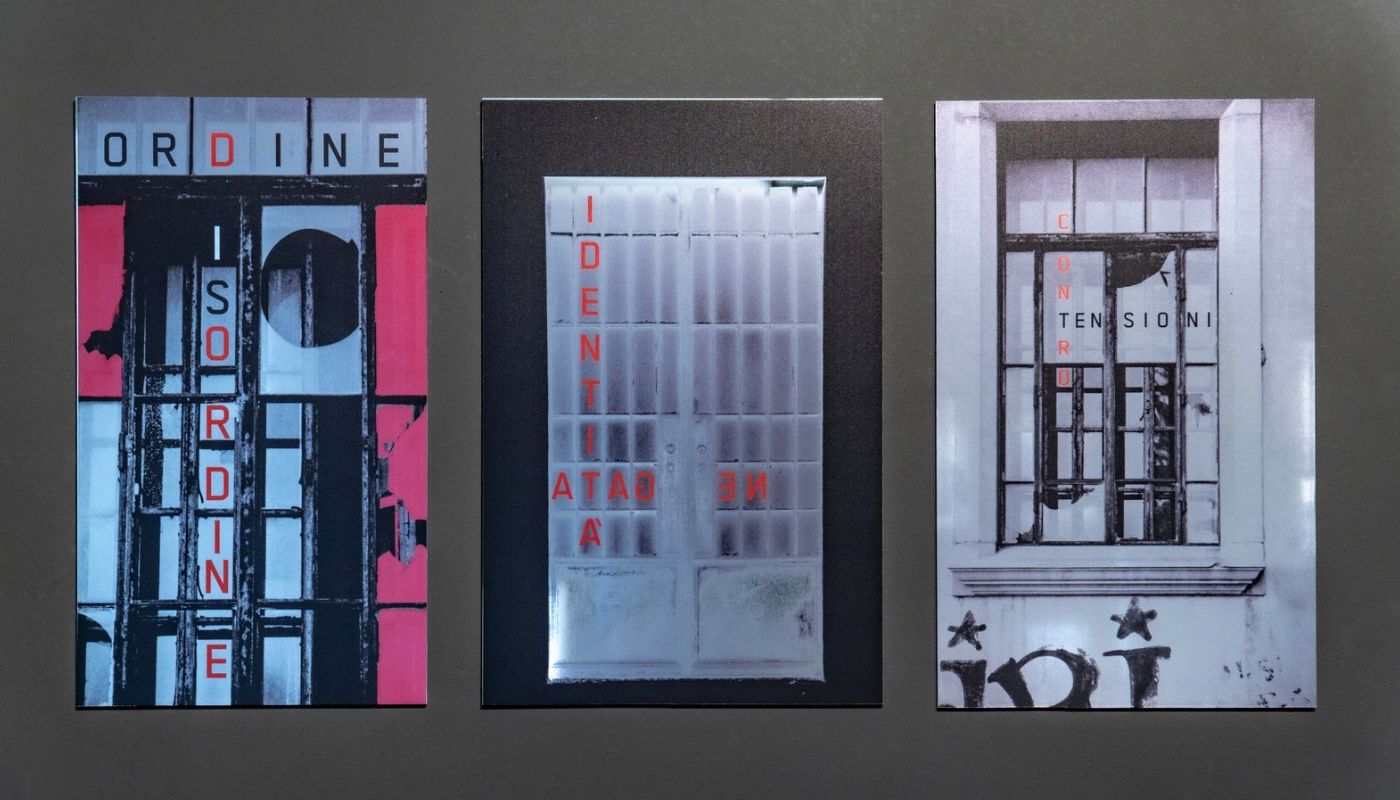
Finally, the central to the exhibition is the word, carefully chosen, studied and juxtaposed with others to generate meanings that go beyond usual use. In the installation Freiklang / Kontrolle / Provocation (“free sound / control / provocation”), the concept of freedom is compared with that of control, while the artist’s in-depth study of Franco Basaglia (1924-1980) takes shape through photographs of the historic buildings within the Basaglia Park in Gorizia, in particular the “Palazzina delle agitate” whose details interpenetrate with the concepts of Basaglia himself.
The central image of the installation is emblematic, with the entrance door of the building represented in negative: before crossing the threshold, the individual still possesses his own identity, while crossing it is denied to him. An image that forcefully restores the distortion of being and the loss of individuality.
These are works that intend to arouse in the visitor a reflection on the thin line that separates diversity from what we usually define as “normality”, leaving everyone the freedom to elaborate this experience. It is a research that Annibel Cunoldi Attems has been carrying out for some time, questioning issues related to Basaglia’s reflection.
The shots printed on a mirror and crossed by terms and conceptual fragments taken from the psychiatrist’s texts, such as “denied identity”, “tensions/countertensions”, “order/disorder”, evoke the passage between the inside and the outside, between different states of being, between one’s own world (Eigenwelt), the external world (Aussenwelt) and the internal world (Innenwelt). They are thus configured as a current reflection on the relationship between language and space, capable of transforming the limit into an opportunity for encounter, dialogue and sharing.