
HORIZONS OF DIALOGUE. INTERVIEW WITH UMBERTO DIMITRI
by ELEONORA BRISSI
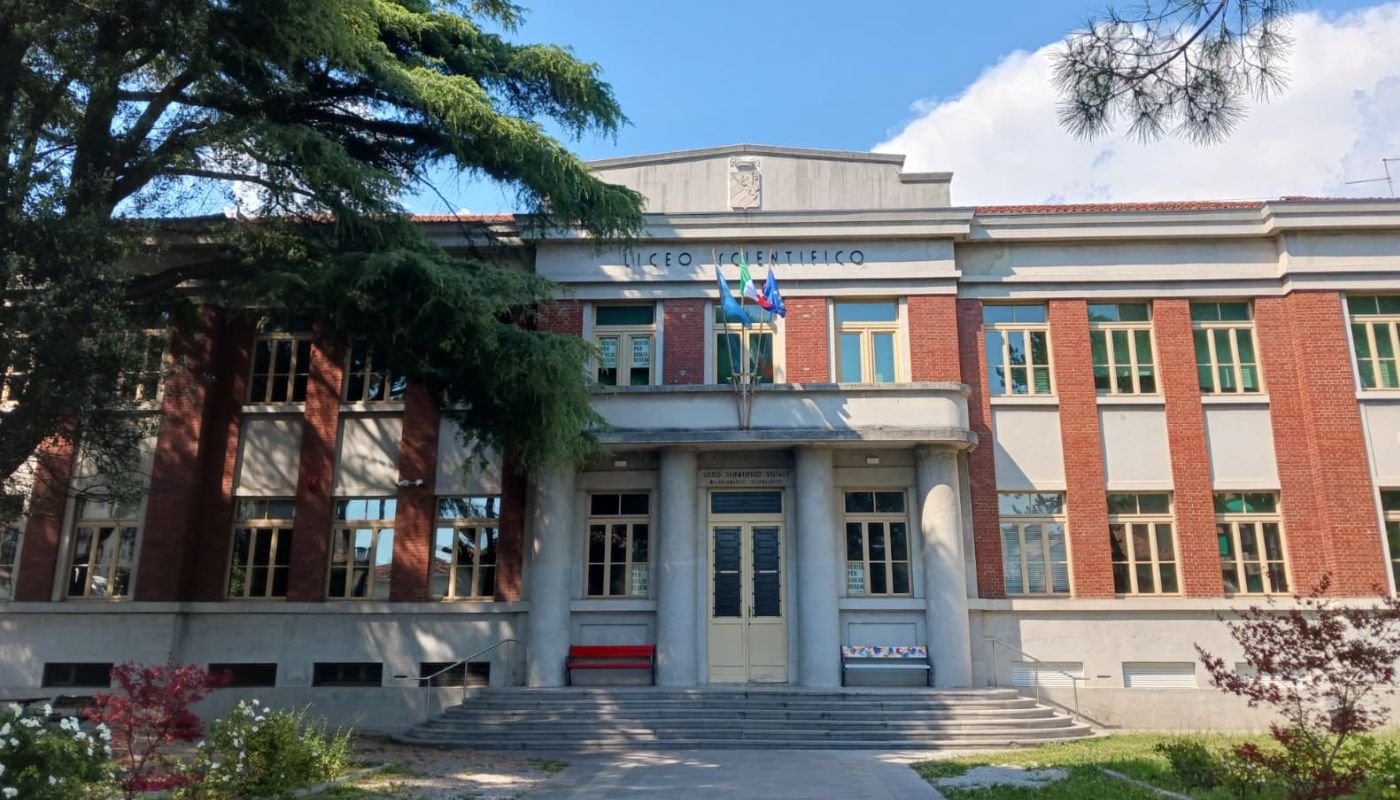
Umberto Dimitri is a student at the “Buonarroti” scientific high school in Monfalcone, he is in his fifth year and after high school he plans to enroll in the faculty of biomedical engineering. This year he was a school representative, a position he held with great dedication. He is a member of the UDS, the independent union for students and schoolchildren in Italy, which has allowed him to cultivate interests related to the humanist sphere of his character. Umberto is aware of the abilities of his peers and is committed daily to creating a reality that represents the values he advocates even when this implies going against the tide, as he did in March, at the Geographies festival, intervening during a presentation.
How do you represent?
I try to make students feel as involved as possible, making them part of the decisions. I want to show that we representatives are not their superiors, but spokesmen for the needs of our comrades. This year we worked on participation in student assemblies, trying to encourage interventions even more, creating moments in which there were real debates, even on current issues. The aim was to make them places of discussion again. Over the years, despite the fact that guests of a certain level were invited, the students remained static, because they became lectures. The assembly, however, was not originally created for that.
Has your experience in a trade union given you the opportunity to reflect on some contemporary and societal issues that are rarely addressed in the classroom?
Yes, it is first of all a matter of having the opportunity to train by having the opportunity to work in the field of current affairs every day. The most interesting aspect, in my opinion, was to have the opportunity to compare myself with people with much more experience, much more knowledge: they encouraged my desire to express myself and to confront myself. Seeking shared solutions, in my opinion, was the most formative activity, because opening up to dialogue, to collaboration, is the most important thing of all. I tried to bring this modus operandi, the one based on dialogue, even within the assembly.
And was there participation, was there a response from your schoolmates?
In my opinion, yes. The assemblies that we managed to imprint in that way there, therefore seeking debate, dialogue, trying to get the students to express themselves, were successful. Especially because, in the end, the goal was not to define a position that was correct or wrong, but to get people used to talking to each other, to also listening to the opinions of others, which in my opinion is perhaps an even more important thing than knowing how to express one’s own.
Do you think that in your experience of confrontation with a political authority you have been listened to or have you not had this feeling?
The thing that was regrettable was the waste of an opportunity to create dialogue. My goal as a citizen, as I presented myself there (I was there as Umberto, not as a representative of the Buonarroti high school), was to try to open a dialogue on a crucial issue for Monfalcone, which is what was expressed in the book presented in Geographies.
I am saddened that the intervention was seen only as a controversy. That was not the main goal. I realize that the speech could have been, in some ways, provocative, but the presentation itself, in some points, was. The main objective was not to protest, but to have a confrontation. I presented the experience of a high school student who experienced the opposite dynamics to those presented in the book and I wanted to expose this point of view.
Do you think the tendency not to listen to what young people have to say is common?
The main battle is played out on the question of competence. We young people are in a phase in which we are learning a lot, we are not accomplished beings, who claim to have the truth in our hands. However, we have food for thought that we can provide, we can bring a vision that cannot always be understood, even if only for mere age factors, which push us to see young people as not sufficiently competent and not legitimized to be heard.
Do you think that school, still very static in teaching methods, is able to provide the right tools to move in a world that is so sudden?
School is an area that inevitably lends itself to dialogue, but in recent years there has been a drift that admits less and less confrontation. The school sins in not stimulating students to constructive confrontation, not only with the reference adult, but also among peers. The way of approaching some subjects is also problematic. Philosophy is based on dialogue, but it is treated in a purely notional way: one learns the thoughts of philosophers, without understanding how in reality the study of philosophy, at least as I have interpreted it, is a giving of tools, giving ideas for learning to think. The emphasis should be placed on what I can bring to my everyday experience from a certain line of thought, instead, all the subjects have been reduced a bit to transmitting notions, losing sight of critical thinking, the one for which high school is so exalted. Unfortunately, due to the very extensive programs, there is a lack of time to devote to the development of oral skills. I am a person who has tried to develop his own critical thinking based on what he studied, I have always lacked, at least until this year, the way to express it and also the place to compare it with others, but independently it is not easy. Fortunately, I have had teachers who have made themselves available to take different approaches to teaching.
How did you find the courage to express your opinion in a context where you knew it would be seen as hostile or against the tide?
The reason is twofold. On the one hand, there is a much more emotional reason, namely the fact that I was hurt by the words of the former mayor, not because I am of the Muslim faith – I was born in Italy, raised in Italy and my family is of the Catholic faith – but because the tone was full of anger and released hatred towards those who are my classmates, of those who are my friends, of people with whom I compare, with whom I have also faced complex paths, which have made me grow a lot. Reading a headline like “The threat of Allah” triggered the spark in me. On the other hand, however, I wanted the speech to make it clear that, within a reality like that of Monfalcone, not everyone thinks in the same way, not all of us have the same relationship with the Muslim population and above all I felt the need to bring that different point of view, that is, of a student who grew up within this cultural mix and who was very formative.
Do you think that such an aggressive way of doing politics scares young people?
In my opinion, yes. I say it without shame: at first I was scared, because it seems more like shouting at each other and trying to grab the largest number of voters, but politics was not born for this. It is not choosing a faction and hoping that that one wins, but looking for solutions together, that are as shared as possible, not trying to exclude and make one opinion win over the others, but if I were not part of the Students’ Union, I would not have learned what it really is. Added to this is the lack of intermediate positions. The extreme choice between political opinions is very frightening.
In your opinion, listening would be the key to opening up a new youth participation?
The fundamental tool would be the creation of spaces for discussion in which young people can aggregate, sometimes even with moderators, because I am perfectly aware of the fact that in order to approach certain topics you need someone to put some order in place. It is important to underline the fact that even to debate you have to have a way: you have to know how to listen, you have to know how to reconcile opinions, if you don’t want to make the debate a mere “I express my opinion and that’s it, that’s it”. That is not doing politics, it is not doing dialogue, it is not doing debate and in my opinion for this reason we should create more spaces of association where young people can find the pleasure of getting back in touch with politics. It affects us live on a daily basis, it is not only for the magistrates or those who make the laws, it is a matter of those who live reality every day.
In light of this, do you think that the media disseminate news strongly influenced by parties and that this compromises the quality of communication?
Inevitably we are modulated by what we read, if only for the fact that opinions are not always expressed in a transparent, objective way, because those who write articles have their own way of reading events, and transmit it to their readers. Within schools, I must admit, work is being done to encourage students not to limit themselves to the first available source. In my opinion, however, the tools to know the origin of the sources of information are not provided. We have many rules on “what” to do, but we don’t know “how” to do it.
Was the news of your speech at Geografie well reported?
Many commented that he did it only to end up on the front page, when instead, as mentioned, the reasons were quite different.
During your speech you quoted the Latin author Terence: do the classics of antiquity still teach us something or does looking at the past in this way risk being anachronistic?
Without a doubt, we can always take food for thought from the past, especially with regard to philosophy, history and literature. The thinkers of the past were able to put on paper realities that are still extremely true today. When one looks at historiography and ancient texts, but also at the most recent ones, having the ability to contextualize a whole series of opinions within a given historical reality, one has the opportunity to read messages that also have value for the present. Terence’s (Homo sum, humani nihil a me alienum puto) is a lesson in humanity, which is always valid, in all times, regardless of whether it was written in the times of the ancient Romans.
Do you think we preserve this humanity or that we are losing it a bit?
In my opinion we are losing it in the name of individualism. We are increasingly immersed in a society in which, since there is no dialogue, we look more and more at our own in a self-referential vision in which attention to the other is lacking.
Why, instead, should we keep it?
Because we are human beings who live within a society and if we want it to represent us, we must demonstrate the values that it must reflect. At the moment I don’t feel represented by the society we live in and I try, in my own small way, to change it as I can. It is useless and childish to complain about something that does not work and still leave it as it is.
It is a washing of hands with the justification: “it’s the club’s fault anyway”. When in reality we all inhabit it and we are all part of it in one way or another…
Exactly, it is important to remember that we build society. Since we live in a democracy, fortunately, everyone has their own small way of affecting society. We must take advantage of this possibility if the world around us does not suit us. I return to the question of the intervention made in Geographies: in the following days I received many messages of approval, but at the time of the surgery (and the consequent reactions) I was the only one to speak, although several people shared my thoughts. I was sorry about that. We often look at a society we don’t like, but we don’t always take responsibility for changing it or we don’t always realize that it is possible to change it.
Do you think yours can be the generation that will change the world?
I want to be optimistic. The intervention in Geographies I didn’t prepare it alone, but by collaborating with my high school friends: this makes me think that there are people like me who want to change things and gives me hope. I hope I have given someone courage. I tried to show that if an 18-year-old boy like me did it, anyone can do it, without being afraid of the general reaction. We must have the strength to express our ideas, to convey our opinion and try to change the world a little.
La lingua originale di questo articolo è l'Italiano.