
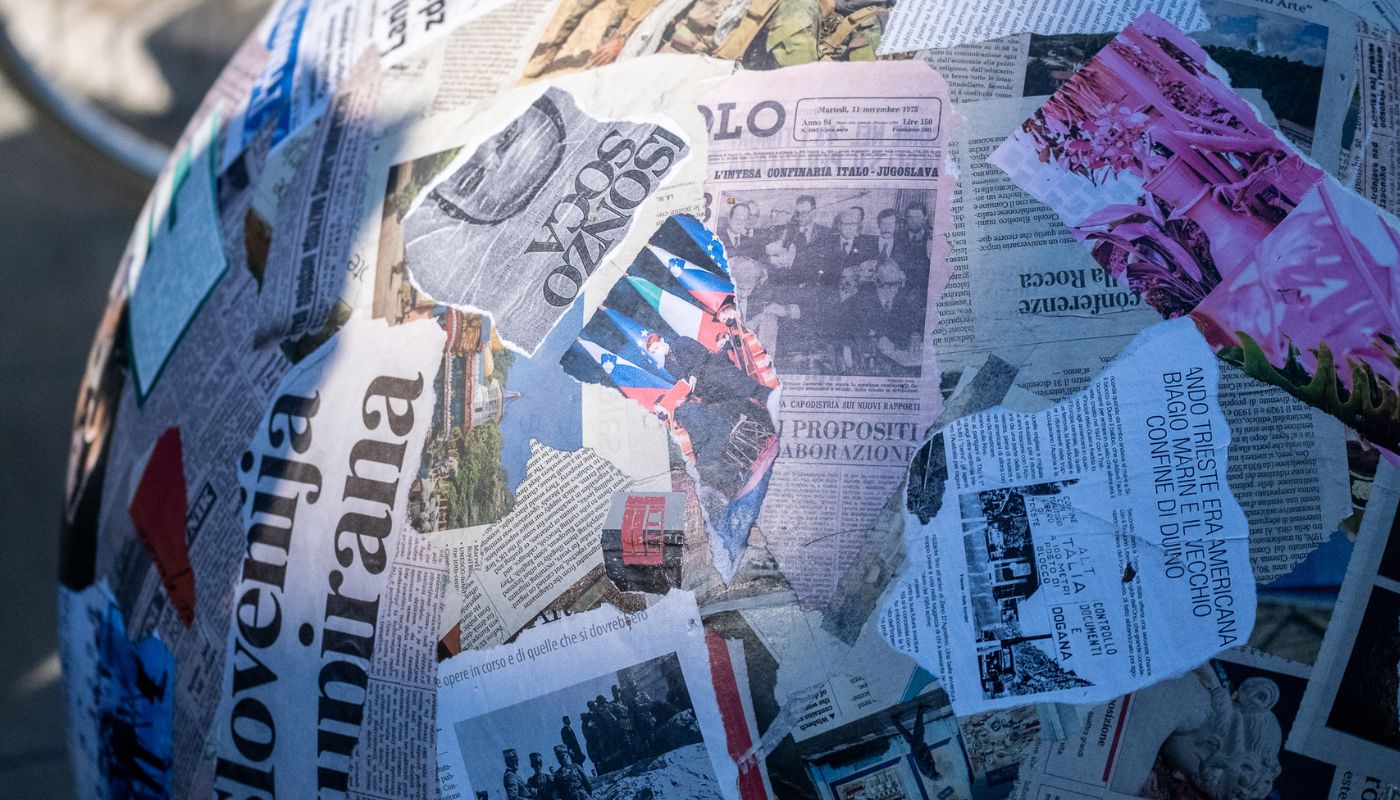
BORDERLINE PLURITUALISM IN THE ERA OF GO!2025: BETWEEN SHOWCASE AND REALITY
by GIUSTINA SELVELLI
Since the end of the Habsburg imperial era, in the Gorizia area, language has ceased to be a simple tool of communication: it has become and continues to be a political device, a marker of belonging, a symbolic battlefield, an open wound disguised as normality. Here, languages coexist, but they don’t always communicate: they brush against each other, often avoid each other, sometimes deliberately ignore each other. With the end of the Second World War, the border established in 1947 didn’t simply separate two states: it legitimized linguistic taboos and repressions that still shape the way we speak—or don’t speak—each other’s languages.
Over the course of this past year, the year of GO! 2025, this evidence has become impossible to ignore. Never before have local languages been called upon to “represent” something: an idea of Europe, of dialogue, of transcending borders. But precisely for this reason, they deserve a critical look: local multilingualism (or what remains of it), so celebrated in official speeches and promotional materials for the European Capital of Culture, is actually the product of a long history of exclusion, asymmetries, and imposed hierarchies.
Slovenian, a language deeply rooted in this region, has for decades been perceived on the Italian side as “other,” if not openly hostile, relegated to an invisible minority, tolerated at best but rarely recognized as an integral part of the everyday linguistic (and even “sound”) landscape. The result is a paradox that GO!2025 exposes: we present ourselves as a European laboratory for cultural coexistence, yet we still struggle to accept multilingualism as a daily norm, not an extraordinary event: in short, we continue to behave conditioned by a completely monolingual mentality.
The issue isn’t just about the past. Current language policies, relaunched in the context of GO!2025, also reveal this ambivalence. Teaching Slovenian in the Gorizia area is often presented as an innovation, when it should be taken for granted in a process of integrating elements of local history, characterized by centuries-old cultural contacts and multiple identities. At the same time, studying Slovenian at “distant” Italian universities—in Rome, Naples, and elsewhere—sometimes enjoys greater symbolic legitimacy than learning on the border, where the language remains unfamiliar because it is intertwined with unresolved memories, unspoken conflicts, and fictitious and fragile identity constructions. Today, we talk about curricular projects and cross-border cooperation, but often without truly addressing the central issue: what is our idea of language? Is it a technical skill to be acquired for economic and institutional reasons, or a relational experience capable of renewing our perspective on ourselves and others?
The rhetoric of GO!2025 thus risks transforming languages into scenographic elements: bilingual slogans, translated events, multicultural performances. But languages don’t live in logos or official programs; they live in bodies, accents, embarrassments, and handed-down silences. Over the past century, speaking (or not speaking) Slovenian in Gorizia has never been a neutral stance. Every language carries with it a history of power: who can afford to be multilingual without arousing suspicion? Who, instead, must constantly translate to be acceptable?
Cross-border territory has never been linguistically “pure.” Before the nation-state, the norm was intermingling; the exception was forced homogenization. Yet we continue to think of languages as watertight compartments, to be taught separately, managed with caution, as if they were explosive materials. It’s an inherited fear, which we haven’t yet had the courage to defuse.
Meanwhile, new communities—Balkan, Maghrebian, Pakistani, Chinese—are reshaping the local linguistic landscape, an enrichment that, unfortunately, has not been adequately valued in the official narrative of GO!2025’s “multilingual territory.” Here too, an implicit hierarchy emerges and a familiar pattern repeats itself: some languages are celebrated as “historical,” others remain invisible (or rather, are “invisibly” rendered invisible) or reduced to integration issues. A true European cultural capital should have the courage to recognize these presences as an integral part of its linguistic fabric and its potential for diversity. And a living border is not a static museum, but rather an unstable, uncomfortable, and disturbing laboratory.
If the Gorizia border truly wants to embody a European model, a pre-, post-, or supranational crossroads, it must stop using language as a flag of identity and start treating it as a daily practice of crossing. Accept that multilingualism is not harmony, but friction; not a decorative value, but a critical competence and a transformative experience. Languages, here, do not serve to tell us once and for all who we really are, but to remind us that we have always been more than one, and that it is precisely in this irresolvable and irreducible plurality that our potential lies.
Perhaps the deepest meaning of GO!2025 lies precisely in this: not in demonstrating that the border has been crossed, but in recognizing that it continues to speak to us. And it does so, first and foremost, through its languages.