
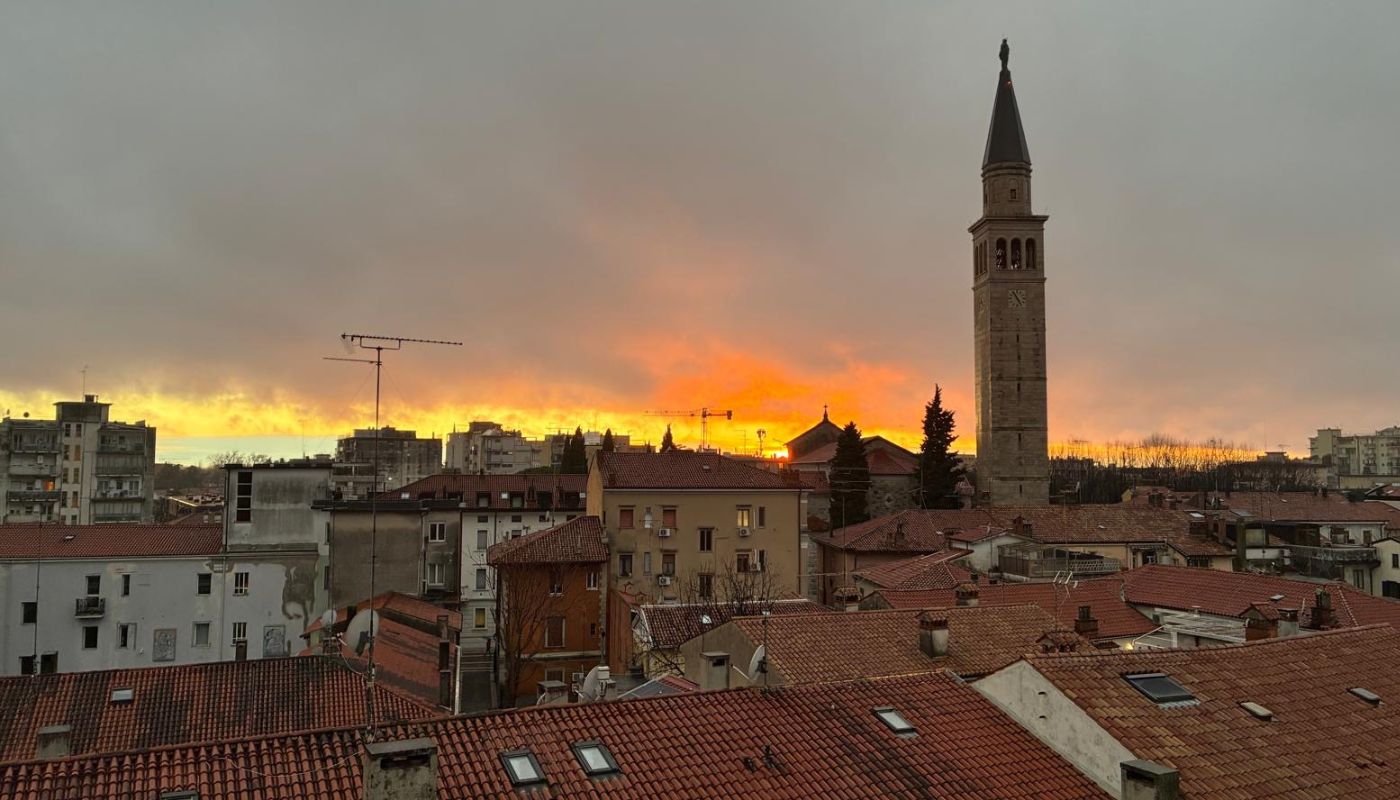
MONFALCONE, FROM SPA TOWN TO WIDESPREAD CITY
by PAOLA BARBAN AND CLAUDIO SINISCALCHI
There is a thin thread that binds the urban history of Monfalcone to the question, today more relevant than ever, on what it means to build a city “on a human scale”. It is not just about architecture, but about the balance between work, living, services, social relations and the quality of urban space. Looking at the history of the city, it is clear how economic transformations have progressively changed not only the landscape, but also the way the community lives.
In Roman times Monfalcone was known for its thermal baths, considered a place of treatment and well-being. A vocation also recognized during the Habsburg period (even before that during the Venetian one) when Emperor Franz Joseph officially confirmed its therapeutic properties. In those same years, Grado consolidated its fame linked to marine sandblasting. Two complementary identities that told of a territory attentive to health, hospitality and quality of life.
The photographs of the early twentieth century show a Corso del Popolo in Monfalcone animated by hotels, activities and presences related to spa tourism. But the city’s destiny changed quickly with the industrial expansion of the Cosulich Shipyards. Monfalcone became a city-factory and the Panzano district represented one of the most interesting examples of industrial urban planning of the time. The neighborhood was designed according to a precise social hierarchy: housing for workers, employees and managers, common services, collective spaces and even accommodation facilities for workers. A paternalistic model, certainly, but capable of offering a coherent urban organization.
The two world wars profoundly marked this balance. Yet, for decades, Panzano maintained its own urban and social identity. Today, comparing that season with contemporary reality, the contrast is evident. Many properties bought out of former shipyards have lost a unitary management of maintenance, especially in condominiums fragmented between small owners. Entire buildings still retain the original plaster of the early twentieth century, a symbol of an architectural heritage left to progressively deteriorate.
Part of the former AEUP assets, subsequently passed to the IACP and then to the ATER, was redeveloped in the early 2000s. However, the rest of the neighborhood continues to show signs of an unfinished urban transformation.
Furthermore, since the nineties, the system of subcontracting linked to shipbuilding has attracted a strong immigration, necessary to support the demand for labor. The housing pressure has been concentrated above all in the city center, where the private real estate market has often responded with improvised solutions: overcrowded apartments, sublets and growing difficulties in cohabitation. In many cases, social tensions have been intertwined with economic and management problems, accentuating the sense of urban fragility.
The paradox is that this social and housing pressure is now coexisting with a phase of extraordinary economic expansion in the shipbuilding sector. The listed company that manages the shipyard has in fact recorded record results in 2025, exceeding the consensus of analysts: net profit of 117 million euros and order backlog of over 20 billion. Among the most important strategic objectives is the doubling of the production capacity of Italian shipyards to meet the growing demand in the cruise and defense sector, together with a reorganization of the global production system to increase competitiveness and margins.
Numbers that testify to the industrial strength of the sector, but which make the gap between economic growth and urban quality even more evident. Because while the production system accelerates, the territory continues to deal with insufficient services, fragile housing stock and urban planning that struggles to govern social changes.
At the same time, many young couples have gradually left Monfalcone to move to the neighboring municipalities — Staranzano, Ronchi dei Legionari, Fogliano Redipuglia, San Pier d’Isonzo, Turriaco, San Canzian d’Isonzo — where a new extensive residential building has been developed made up of villas and suburban neighborhoods. Thus was born a “widespread city”, but without a real shared urban design.
The story of Monfalcone therefore tells an issue that concerns many European border realities: when work grows faster than the ability to plan urban spaces, the risk is that the city loses its human measure. Recovering that dimension today means rethinking not only buildings, but the relationship between community, services, integration and quality of living. Because a city is not only made up of houses and streets, but of the relationships it manages to build over time.
It is no coincidence that in these days the Region is reviewing the LUR, the Regional Urban Planning Law, whose passage in the regional commission is scheduled for mid-June. An issue of enormous importance which, however, at least so far, seems to have involved little the community, civil society and the world of associations, also due to the tight deadlines imposed on public debate. The perceived risk is that of a law in which contributions and observations can only marginally affect.
An urban planning law, however, requires time, in-depth analysis and a careful analysis of its repercussions on the territory. It is not enough to highlight individual shortcomings or needs: it is necessary to understand its overall structure. It is likely that the new LUR will define above all general principles, then delegating the application methods and concrete contents of the planning tools to the implementing decrees.
The real question will then be to understand whether this reform will still represent a law for the government of the territory or whether it will end up retreating from its role, leaving more room for the transformations dictated by the market and building regulations.
La lingua originale di questo articolo è l'Italiano.