
WILL WE BE ABLE TO MAKE PEACE WITH THE SOIL?
by SONIA KUCLER
2025 was a special year for the two Gorizie regions, in which words such as culture, languages, borders, cooperation, history, peace, sustainability, art, biodiversity, cities of the future, brotherhood were able to assert themselves and spread, overcoming physical and mental boundaries, bringing positive seeds of growth within a radius of at least 50 km. What will become of this suitcase of words now that the curtain has fallen on the most scenic part of #GO2025? What concrete and tangible signs will remain of the intentions made in the squares, in the parks, in the theaters? Above all, what remains of the word “peace” in these times of wars and hybrid wars by which we are besieged?
In this sense, the joint nomination as European Capital of Culture 2025 has become a great opportunity to demonstrate that culture should also be understood as a capacity for hospitality and creativity, which leads us to discover possible paths to peace, sustainable and concrete. Numerous events, performances and interventions have cascaded throughout the year. Also of exponents of different religious faiths, who in a theoretical way have made peace a cultural pivot.
One event above all, in my opinion, stood out: the presence in Gorizia of Michelangelo Pistoletto, eclectic artist and creator of the “Cittadellarte”, a unique path of its kind in Italy where in the former Trombetta wool mill in Biella for decades they have been working around the words art, peace, culture, creating a creative laboratory (Academy of Ideas) that involves young artists in every field of the arts (music, music, fashion, design, theatre, etc.) which has made the city a meeting point for exhibitions, conferences, meetings and debates but above all a place to share points of view, do research and exchange ideas. Over time, Pistoletto’s utopia has spread to various parts of the world, evolving and developing new philosophical-socio-economic concepts, such as that of demopraxy, that is, of a practical democracy at the service of the common good in which there is a balance between artifice and nature, and proposing a planetary project called in the early 2000s as The Third Paradise, a fusion between the first, the natural one in which human beings were totally integrated into nature and the second, the artificial one, which generated irreversible processes of degradation and consumption of the natural world in parallel with the beneficial effects.
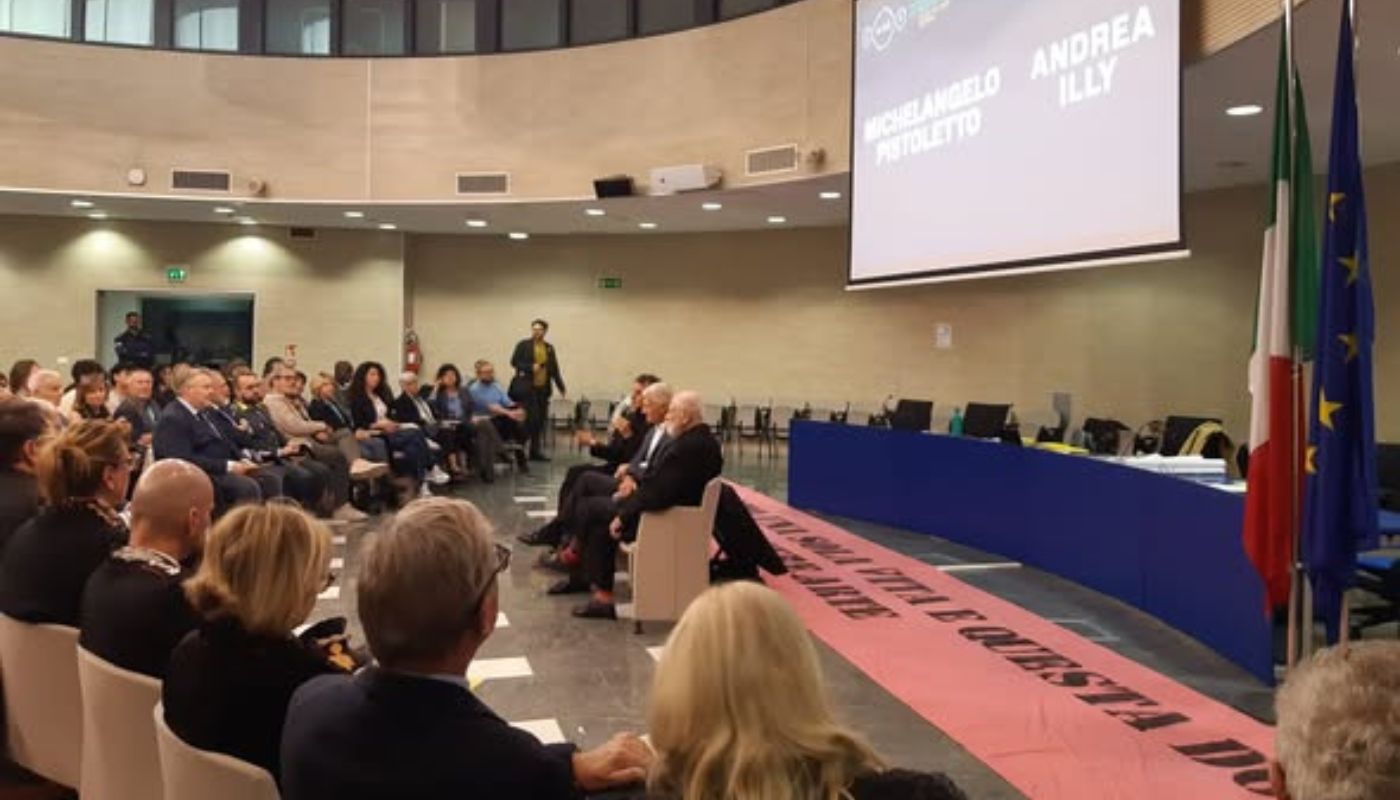
In this ideal wake at the end of October 2025, the Municipality of Gorizia organized a three-day event, the Forum “Go! 2025, City of Peace, City of the Future”, which was attended by about sixty people divided into ten discussion and work tables (culture, urban planning/environment, geopolitics, sport, bureaucracy, school, city of peace…) in which representatives of institutions, associations, categories and personalities discussed, coordinated by the facilitators of the Pistoletto Foundation. On the final day, a summary document containing the proposals to be presented to cross-border local administrations was presented, the results of which had to be verified over a year. In the urban planning table, in which I participated, we discussed to promote the protection and development of the soil in a sustainable way and to guarantee the fundamental elements of the urban ecosystem such as air, water and greenery. At the end of the Forum, a group of Italian university students presented the concept, the design proposal, of an architectural work to be hypothetically built in the green area of Piazza Transalpina, already destined for redevelopment, which Pistoletto called “Third Cross-border Paradise”, an agora with seats made from the materials of the wall that supported the border network, and which will represent the three circles of infinity, famous symbol of the artist, traced straddling the border between Italy and Slovenia. For Councillor Patrizia Artico, thanks to this artistic initiative, Gorizia is preparing to welcome an installation with a strong symbolic value intended to strengthen the link with Nova Gorica and enhance the territory.
Eight months later, the work has not yet been carried out since the decision-making process has to deal with unprecedented bureaucratic procedures; the cross-border Third Paradise will in fact be the first transnational work made by Pistoletto.
A well-known exponent of Arte Povera, of which the greatest is the “Venus of the Rags”, Pistoletto – born in 1933, enviable bearing and speech, white hat and long colored scarf – during the Forum gave a lesson full of content underlining the environmental implications of the exploitation of the planet, where the increase in weight of the artificial mass and the subtraction of natural resources forces us to spend a lot and quickly to help ecosystems not collapse. In the coming years, society will have to equip itself for environmental conservation, so it will be necessary to invest in ecosystems that have not yet been touched. Even if this change will have to take place with a slow process, the role of benefactor companies is decisive, as is the role of citizens and art, which is the flag of the world. The floor then passed to the entrepreneur Andrea Illy who supported the need for change in the name of regeneration: if the customer, if the citizen, express regenerative needs, companies must also change. Today, companies are going through a very delicate phase that should move from the conventional and polluting line, where it is risky to invest, to the demopractic. Biodiversity and natural capital need a circular economy to live at their best, said Paolo Naldini, director of the Pistoletto Foundation, to reiterate that The Third Paradise is not madness, but the third phase of humanity, which is realized in the balanced connection between artifice and nature. Unconditional space therefore for the preservation and development of all forms of biodiversity that we are able to achieve even with our small forces and in our territories. The engines of social change and inspiration for national policies are the new models of interlocal cooperation and the activation of virtuous networks. The goal is to inspire and produce a responsible transformation of society in the name of sustainability, where culture and art are levers to promote peace.
We mentally leave the muffled halls of the Forum to reflect on how much this type of utopia can really penetrate our frontier reality, we physically go to the streets, squares, suburbs of Gorizia and Nova Gorica to observe with our eyes and hear with our ears if there are already telltale signs, wishes for peace.
Peace, for example peace with the soil, is a process in progress. For some years now, the two cities have been a construction site that opens and closes roads, renovates greenery, modifies well-known places. We will have to pay attention to other forms of life, in addition to ours, in particular for the soil where the roots of life already lie in the first ten, twenty centimeters, the one we consume every day at a fast pace. This is also the hope of all the people who have been working for years, in Italy and in various locations around the world, on the “Cittadellapace” and that the administration of Gorizia has captured in its cultural orbit and that for a year they will help us to realize a utopia, defined in the intentions as a participatory process in which citizens will be able to hear and make proposals for their city of the future. In Via Rastello there is the operations center, Casa Netural, which is there to go beyond the theoretical message and make utopia a reality. It seems that something is moving in the cross-border school sector… We’ll see.
On the other hand, the Italian patrols restored at the former Gorizia border crossings are still not rhyming with peace, with the recent allocation of new border police forces to combat emigration. Last January, in a Facebook post, the State Secretary of the Slovenian Ministry of Culture Marko Rusjan said that the data did not support increases in migration flows from the Balkans, indeed the Slovenian police in 2025 had dealt with 28 thousand illegal entries compared to 46 thousand in 2024.
Perhaps Pistoletto and the curators of his Foundation would say that change is never rapid, it takes a long time even if not until the “stocks” of natural capital are exhausted!
But the “Newspaper Sphere” that was the protagonist on February 8, 2025 of the inauguration of GO! 2025, covered with press articles witnessing the different eras that the two Gorizias have gone through in the twentieth century, rolled by the students of the Max Fabiani art school along streets and squares, definitively “tearing” down the border between the two cities, this sphere has a symbolic meaning that should be a point of no return for the hesitations and moods of politics.
Is “The Third Paradise” really the new myth that could lead everyone to take on a personal responsibility in this difficult epochal juncture, and is the sign of infinity in everyone’s hands?
Yes, says Pistoletto, Because the word paradise comes from the ancient Persian language and means “protected garden”. We are the gardeners who must protect this planet and take care of the human society that inhabits it.
La lingua originale di questo articolo è l'Italiano.