
RENEWAL OF THE EUROPE AND TRENTO MARKET
by MATEJ KLANJŠČEK
The beginnings and the project of Max Fabiani
Europa Square represents, together with “Trento”, one of the most important urban places on the borders of European countries, not only because of its historical and symbolic value, but also because of the originality of its urban design. Its form and function derive from a precise vision of the modern city, formed between the end of the 19th and the beginning of the 20th century, when Gorizia was at the height of its Central European season, a border town and a strategic hub of the Austro-Hungarian Empire. In those years, key issues in urban planning concerned the acceleration of infrastructures, especially water supply, road connections and the strengthening of the rail network. The new Transalpine Railway project ( Wocheinerbahn), which would connect Trieste with Vienna, represented the possibility of transforming the northern part of the city. In 1901, the Municipality of Gorizia announced a competition for the editing of the general spatial plan, in which the architect and urban planner Max Fabiani (1865-1952), a pupil of Otto Wagner and a famous figure in Central European architectural culture, participated. Fabiani interpreted the new train station not only as an infrastructure, but as an element that would accelerate the expansion of the city: a point of representation and entrance to the city.
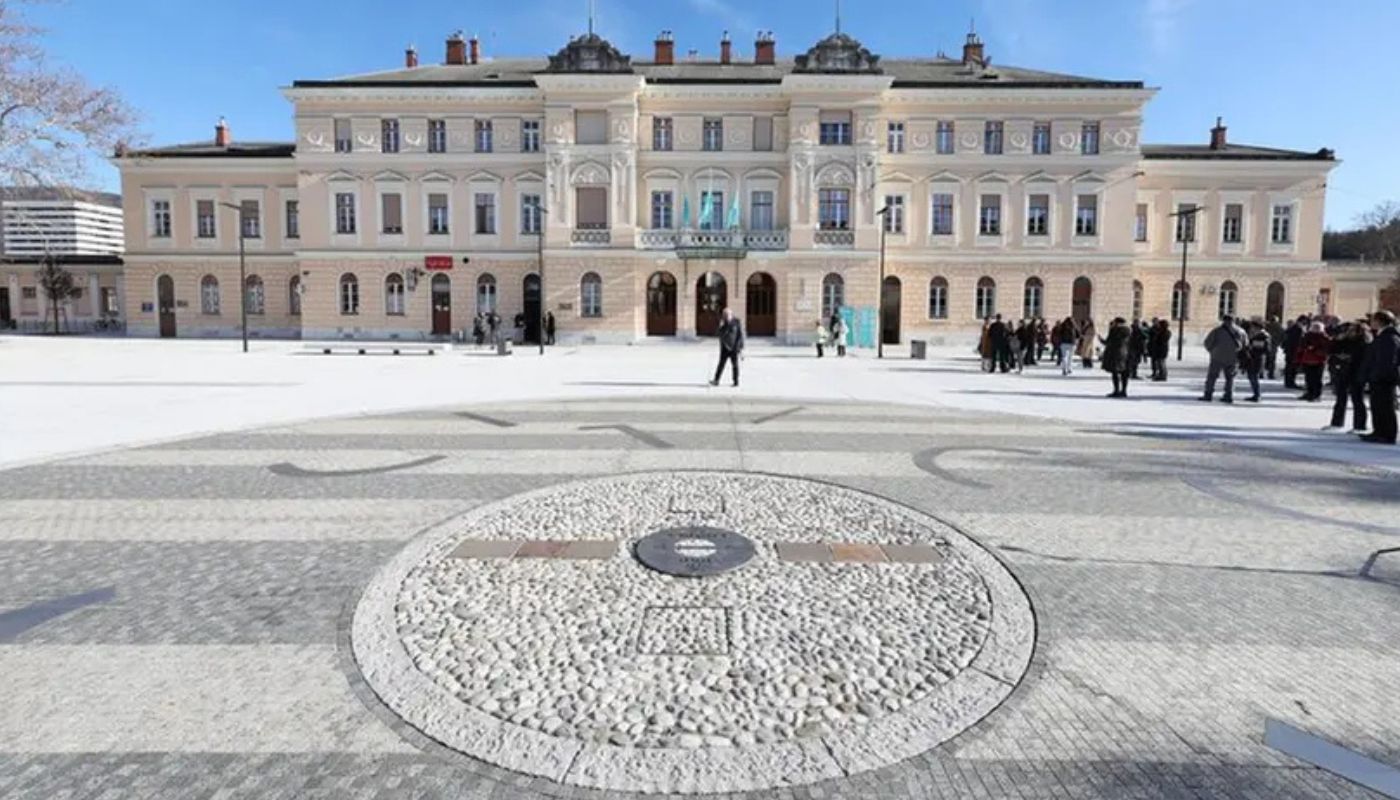
Around 1906, Fabiani designed a plan for the so-called Tridenta Transalpine, a radial road system that would line a new square in front of the railway station – then the Görz Staatsbahnhof – as the point of contact of the three perspective axes that are today Foscolo, Caprin and Luzzatto streets, connected to Monte Santo street. The system, inspired by Baroque patterns that have been reinterpreted in a modern way, combined monumentality and functional rationality, and established a harmonious connection between the architecture of the railway station, the landscape and the urban fabric. In this plan, the station – designed in the eclectic-Art Nouveau style by architect Robert Seelig – was the central element of a symmetrical composition with a three-storey central section and two two-storey side sections. It opened up to a wide square, which, without physical barriers, was arranged as a place for socializing and representation. Fabiani’s ideas found resonance and continuation in other contemporaneous or later projects, such as those of Antonio Lasciac (1905), who designed the curvilinear and radial schemes of the avenues, and in the urban plan of 1921 drawn up by Fabiani himself together with Lodovico Braidotti and Riccardo Del Neri, where a system of visual and perspective connections between large urban spaces (squares, avenues, the Soča River, hills and gardens) represented the guiding structure of the city’s expansion. This urban approach reflected the exact image of the city, i.e. the city-park, in accordance with the landscape and climate orientation of Gorizia, as celebrated by Carlo von Czoernig, who in the second half of the 19th century called it the “Austrian Nice”.
From division to reconnection
The First World War was a profound turning point: the railway station, a strategic infrastructure, was badly damaged by bombing. After the annexation of Gorizia to Italy, the building was rebuilt according to the original plans, and the square was rearranged by Fabiani himself. In 1923, the station was named Gorizia Montesanto. During World War II, the railway station was once again the scene of war events, used to transport soldiers and vehicles and, tragically, as a hub for convoys bound for concentration camps. With the end of the fighting and the definition of new geopolitical relations, the Goriška territory was entrusted to the Allied military administration until 1947, when a peace agreement was concluded. At that time, the border between Italy and Yugoslavia was drawn exactly across the Square of Europe, which, together with the city, was divided into two parts: on the one hand, part of the square, and on the other, the railway station and the land on which the new city of Nova Gorica would be built. For decades, the square was physically crossed by barbed wire and later by a fence, a concrete symbol of the political and existential division of the two worlds. From a place of meeting and representation, the square turned into an area of separation and control, a symbol of the Cold War and the European collapse.
With the break-up of Yugoslavia and the ensuing process of European integration, the market gradually regained its physical and symbolic integrity. Slovenia’s accession to the European Union in 2004 and its accession to the Schengen area in 2007 marked the end of the physical border and returned the Market of Europe to its original role as a place of passage and integration. The stone floor with a symbolic mosaic by Franco Vecchieta in the centre, which today marks the position of the old border, preserves the memory of the division, but changes its meaning: from an obstacle to a common identity sign. The square has thus become a symbol of cross-border cooperation and the heart of the integration project between Gorizia and Nova Gorica, which culminated in the European Capital of Culture 2025 award.
Renovation options
The project of renovation of Piazza Transalpine / Place de la Europa and Fabiani’s Trident is included in the framework of transformations related to the European Capital of Culture 2025, of which it represents one of the most important symbolic and infrastructural interventions. The aim is twofold: on the one hand, to reconnect the urban fabric that was divided by the border in the past, and on the other hand, to return the square and its radial system to its original role as a city gate and a common representative space.
The project aims to establish a single, integrated and cross-border urban planning system that would emphasize the architectural and symbolic role of the railway station in Nova Gorica and the area in front of it; improve urban and environmental quality and promote slow mobility and inclusive accessibility; create a common space for events, cultural and social activities with multifunctional functions; take into account the DNSH (Do No Significant Harm) principle and minimum environmental criteria in accordance with the funding from the European ERDF (European Regional Development Fund) programme 2021-2027, for both the Italian and Slovenian parts.
The project is based on some strategic principles, including: a common and open space without architectural barriers with a new, continuous paved surface and paths for pedestrians and cyclists; reducing impermeable surfaces and increasing green spaces for the benefit of climate resilience; arrangement of access for vehicles by means of hidden barriers to protect pedestrians; strengthening the storm water drainage system; preparation for events and events with integrated equipment and infrastructure; valuation of the memory of the border with symbolic elements of paving and spaces for art and memorial installations.
Administrative and preparatory aspects of the work
The project of redevelopment of the area, which includes Europe Square and Trident, was created within the framework of institutional cooperation between EGTC GO (European Grouping of Territorial Cooperation Gorizia-Nova Gorica-Šempeter-Vrtojba), the Municipality of Gorizia and the Municipality of Nova Gorica. The planning was led by the Italian-Slovenian teams Ravnikar Potokar Arhitekturni Biro (Ljubljana) and DRH Studio Dinale – Rigonat Hugues (Venice) in cooperation with SA Architetti and a number of engineering consultants for devices and infrastructure. By merging the two initially separate projects, it was possible to ensure architectural and landscape unity, as well as consistency in the implementation schedule.
The cross-border project implementation agreement laid the legal and operational foundations for the joint implementation of the cross-border infrastructure project. It defined the roles, powers and responsibilities of the parties involved, assigning the EGTC the role of sole contracting authority for the works of common interest and the two municipalities the role of owners and managers of their territorial parts. The agreement also provided for the modalities of bilateral financing between the Italian and Slovenian administrations, as well as technical and administrative coordination mechanisms to ensure the unity of the project and compliance with the legislation in both legal systems.
The project had a total amount of EUR 4.22 million at its disposal, which arose from the sum of the contributions of the two territorial parts of the project: the Italian part amounted to EUR 1.40 million, the Slovenian part EUR 1.92 million and the share intended for Trident (Gorizia) EUR 0.90 million. The total amount of the works on both sides of the border amounted to EUR 2.78 million.
Technical and engineering aspects
The analysis of the area revealed critical points related to the disunity of footpaths and cycle paths, the deterioration of structures, the non-uniformity of pavements, and the different management between the two countries. However, there was no shortage of opportunities for renewal: the introduction of greenery and street equipment, the strengthening of multimodality (bicycle rental, pedestrian rental), the emphasis on cross-border identity and the promotion of cultural and social events in the market square and the surrounding streets. This resulted in an in-depth analysis of the existing links:
- Traffic: The three axes represent the main access to the square from the Italian part of the city, with historic lanes and sidewalks that have been restored and new paving in accordance with the design of the square. Measures were envisaged to regulate traffic by means of movable, concealed barriers: four were installed in Italy along Caprin and Foscolo Streets, and a further four in Slovenia along Kolodvorska Street. These allow for the complete closure of the market to traffic, thus enabling the creation of a common space, i.e. the controlled coexistence of pedestrians, cyclists and, exceptionally, vehicles with limited speed (≤20 km/h), with priority given to soft mobility and tourist-cultural routes.
- Slow mobility: as part of the renovation, continuous footpaths and cycle paths have been established to ensure passability and safety, and are in line with UNI standards and European guidelines for soft mobility.
- Public transport: the area is connected to the railway hub of the Slovenian railway station and local public transport stops, which promotes multimodality.
- City Connections: Streets connect to the historic Monte Santo Street and connect the square with neighborhoods, parks, and city centers.
Social, cultural and symbolic value of the project and economic recovery
Today, the Market of Europe is one of the most striking examples of urban renewal as a tool for social and territorial integration. From a place of separation – marked for decades by the barbed wire of the border – the square has been transformed into a single common public space that embodies European cooperation and cultural coexistence between Gorizia and Nova Gorica.
The new spatial arrangement allows the uninterrupted use of the market by the inhabitants of both countries without physical or perceptual barriers and gives a sense of belonging to a single urban fabric. The continuous paved surface, the uniform design of the greenery and the absence of height differences between the Italian and Slovenian works are architectural elements, but also symbolic messages of unity. Every construction decision – from the continuous pavement to the shared benches – contributes to telling the story of a city that has been transformed from a border into a bridge and that embodies the values of cohesion, historical memory and a European future.
The project is part of the European Capital of Culture programme, of which it is one of the main pillars. The area is intended to host a wide range of cultural and performing activities: cross-border music and theatre events, open-air exhibitions and temporary installations, official ceremonies and commemorative events, festivals and public events. The market is designed to accommodate up to 5,000 people during high-traffic events, thanks to its integrated infrastructure (electrical appliances, ready-to-use audio-lighting systems, wired surfaces, adjustable accesses). In the future, it will take shape as a permanent European agora, a place of encounter between cultures and a workshop for municipal cooperation.
A key element of operational success is the multi-level governance for which the EGTC is responsible, acting as a sole procurator. This structure ensured the uniformity of criteria and procedures and enabled the integrated management of the two legal frameworks (Italian and Slovenian), the simultaneous coordination of tendering and permitting procedures, compliance with the financing conditions of the ERDF Operational Programme 2021-2027 for both sides of the border, and the implementation of bilateral control of construction works with full traceability of technical decisions and supply flows. Today, the EGTC GO management model represents an excellent practice that can be replicated in other European cross-border contexts, as it demonstrates the feasibility of a common infrastructure managed according to uniform technical standards and common environmental controls.
The renovation of Europa and Trident Square is a representative example of how modern urban engineering can combine functionality, sustainability and cultural value. The project is not limited to restoring the architectural and environmental quality of a historically endangered area; It demonstrates how public infrastructure can serve as a tool for social cohesion and territorial diplomacy to redefine the physical and mental boundaries of cities.
Prvotni jezik tega članka je slovenščina.