
GAP THE MIND. THE CITIES IN(DI)VISIBLE
by MARCO MARANGONE
Gorizia/Nova Gorica is a transnational city whose two parts that compose it I have typographically separated (or made match) with the glyph “/”, icon and memory of the border bar in the crossings. A sloping line that optimists see half raised and pessimists half lowered, this barrier still exists in fact, although not physically, in the police garrison of city crossings restored for some years. This separative hyphen also evokes the line drawn in 1947 and then reaffirmed in 1975 with the Treaty of Osimo by which more than a few at the time felt mistreated, a line that established where one state entity ended (Italy, Yugoslavia) and where another began (Yugoslavia, Italy).
That line, which was initially drawn on a map and which was later transposed to the territory, separated Gorizia from its past and, redefining the entire context, allowed the rise of a new city where before the bombings had shattered the eternal rest of a cemetery.
Now let’s do a bit of off-piste on perception, imagination and attribution of meaning to space, playfully shuffling what we believe to be true.
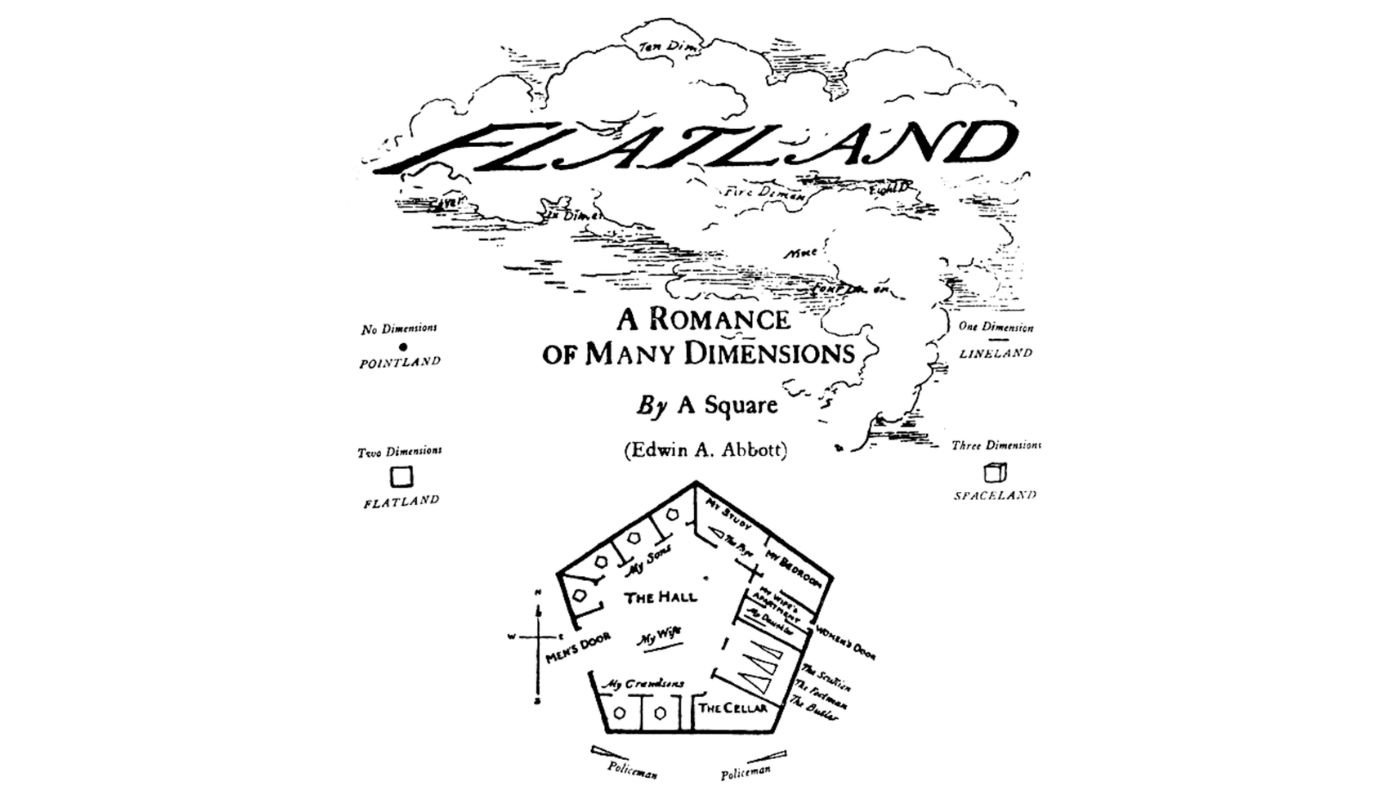
Flatland is one of the fictional realities described by E.A. Abbott in the book of the same name published in 1882. In the one-dimensional reality (Lineland) all the beings that inhabit it lie on the same straight line and, from their point of observation, perceive each other as points. Instead, in the two-dimensional reality of Flatland, polygons can only “see” each other as linear strokes; when a sphere (an inhabitant of Spaceland, a three-dimensional reality) crosses Flatland, it occupies a circular surface first increasing and then decreasing corresponding to the variability of its section as it crosses the two-dimensional plane; however, the circumference is perceived by the “flutes” only as a segment that extends and narrows. The appearance of an inhabitant with a higher dimension trying to explain his condition generated disbelief and irritation in those who existed in the lower dimension. Here’s what the squared sphere says: “You too could leave it, this plane, if only you could muster all the willpower you need.”
If I talk about point and line, what does your mind do? It projects a visual representation of them because imagination works, precisely, through images. Geometrically speaking, the dot is an a-spatial entity (zero dimensions), while the dot (probably black) you imagined is instead a tiny disk occupying a surface, however small it may be like the one that ends this sentence (here it is:). The same goes for the line (segment), which is a one-dimensional entity (the length); as a succession of a-spatial points, it is in turn not graphically reproducible because, in order to be visible, the stroke that depicts it necessarily also has a width. We now come to the two-dimensional geometric figures, circles, ovals, polygons: they occupy a portion of space but their ontology does not provide for a perimeter contour line. When you draw such an outline trace on the flat surface of a physical or digital medium, you are not creating a square from scratch (for example) but you are separating the portion of space included in the square shape from the surrounding one. Such a surface therefore existed even before we isolated it from the area surrounding it (assuming that you can surround a square!) by tracing its sides. If you respect the nature of the polygon as a shape that does not have a contour line, that square exists on the sheet even without drawing it and potentially on that same portion of space any geometric shape, regular or irregular, can exist: the sheet/blackboard/digital board can accommodate an infinite number of shapes.
If you cut out the square to make it visible by avoiding the perimeter trace, you are deceiving yourself: no matter how thin it is, paper inevitably has a thickness and what you will have in your hand will no longer be a square but a parallelepiped. In order to free the square from the two-dimensionality in which, if not drawn, it lay indistinct, you brought it to a higher dimension.
But … Are we talking about geometry or awareness?
Hold on, we’re almost done. Dogville is the fictional town that gives the title to the film directed by Lars Von Trier in 2003. It is a theatrical film: the whole story takes place in a closed space that is scenically almost aseptic, artificially lit during the day and with black flooring on which white lines are drawn that define the plan of the buildings. Three-dimensional there are people, some furniture and furnishings. The dog is also drawn as a silhouette on the floor. The community of Dogville participates in the story, which has its fulcrum in the character of Grace (Nicole Kidman), as if the absence of walls, roofs and real doors were completely normal.
Our perception of the world depends on the perspective we take on it.
Between 1970 and 1986, Osvaldo Cavandoli created and developed the animated series La Linea (in Slovenia Badum Badum) with a brilliant inventive stroke: the character lives on a continuous line and interacts with the author, inviting him to add with his pencil whatever he gradually desires so that the story can unfold. He speaks an invented (Grammelot) and mumbled language, composed of phonemes charged with emotional intensity, and its very incomprehensibility was the key to La Linea’s international success.
At the same time, can we ignore that by skillfully alternating lines and dots, communication is actually possible (Morse code)?
And so we have reached the end. The line can be a problematic boundary or an ideal os(m)otic membrane regulating a dynamic flow of exchange between two communicating subsets.
It is just as possible to stumble over a virtual line as it is to enliven it with humor and intelligence. May everyone do their best to determine their own spaces of freedom, above all by emancipating themselves from their personal convictions.
In Dogville, even the prison was a simple rectangle drawn on the ground with a white line. Gap the mind!
La lingua originale di questo articolo è l'Italiano.