
GORICA OF THE FUTURE THROUGH THE EYES OF YOUNG PEOPLE
by FEDERICA BELLO
How do children and young people imagine the city of the future? Will it be full of technology, floating vehicles and tall buildings, or will nature, community and space for people be in the foreground? Project 3333, which in the 2025/26 school year brought together third grades of different levels of education in Gorizia, tried to answer these questions. The Ringaraja Kindergarten, the Oton Župančič Primary School, the Ivan Trinka Primary School and the Cankar-Vega-Zois Technical Institute participated in the special vertical project.
The activity, dedicated to thinking about Gorica of the future, was born out of the desire for intergenerational cooperation and creative reflection on the city in which young people live, grow up or go to school. In four meetings, younger and older students went together to the year 3333 and imagined what Gorica would look like at that time. The meetings were based on collaboration, conversation and artistic creation. The special value of the project was precisely in connecting different ages: the youngest brought spontaneous imagination and a playful view of the future, while the older ones upgraded their ideas with reflections on space, technology and quality of life in the city.
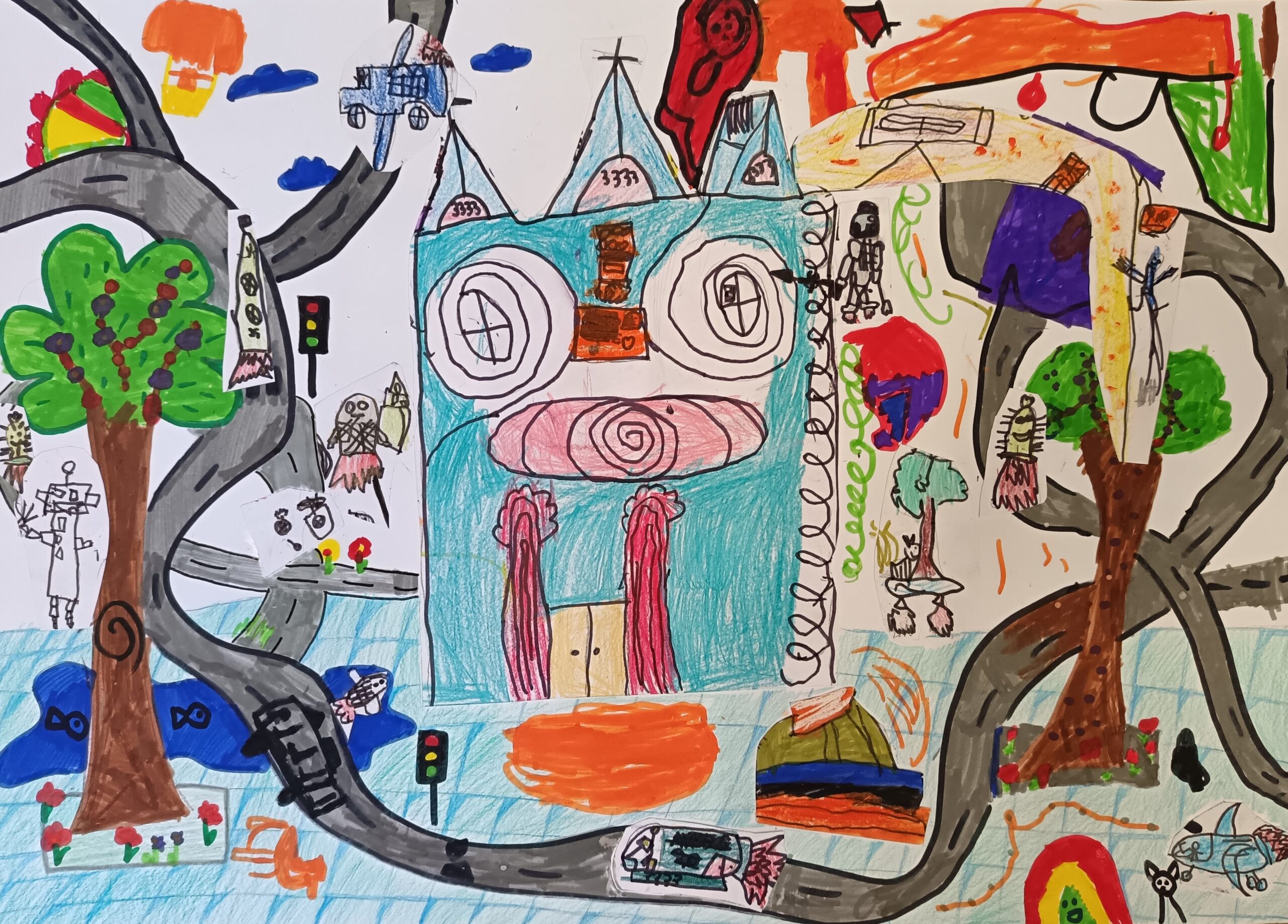
Seven art products were created from the joint work, which depict the city of the future in different ways. Almost all of the products feature recognizable motifs, such as St. Peter’s Church. Ignatius, Goriška Castle and the Soča River. This is no coincidence, as the creative path of Project 3333 began in Travnik, where groups of children and students began to get to know each other for the first time. There, young artists also sketched, created and prepared the first beginnings of art products. The mentors chose Travnik as the starting point of the project, as it represents the true heart of Gorica and the place where its most characteristic symbols are located. It was there that the first drawings and sketches were created, captured directly on the spot. The younger members of the groups meticulously supplemented, edited and painted them in the other two subsequent meetings. At the final joint meeting, which took place at the Oton Župančič Primary School, all the groups reunited and created final works of art of a larger format. In doing so, we tried to include individual drawings, motifs and ideas that were created throughout the project in the most interesting and effective way. The resulting products have a distinct children’s stamp, because the children from the kindergarten were the most dominant in the creation with their imagination and creativity. The works are full of vivid colors, playfulness and imaginative images, which is characteristic of the creation of the youngest. It is particularly interesting to observe individual products in more detail and discover how children imagine Gorizia in the future. Some saw the city as a place of joy, joy and lively happenings, observing it through the screen of their phone. Others envisioned a city of the future that was also developing underground. On many products, the ecological aspect stands out strongly. The city is depicted as a green and sustainable space, full of trees, flowers and green spaces. Even the tall skyscrapers that reach up to the sky are surrounded by greenery and plants, and playgrounds are distributed in all corners of the city. Futuristic means of transport also have a special place in children’s imagination. Almost all of the products feature rockets, spaceships, and flying vehicles flying through the air or following winding roads drawn between existing buildings. Occasionally, figurines resembling Martians or creatures coming from other planets also appear.
The initiative for the project originated at the Oton Župančič Primary School, where teacher Ingrid Komjanc conceived the idea of young people thinking together about the city of the future. With her energy and dedication, she was able to impress other educators, teachers and professors, who participated in the initiative with great joy and enthusiasm. Under the guidance of mentors Federica Bello, Irina Tretiak, Alja Slamič, Sara Ferletti, Janja Korsič, Helena Braini, Majda Klanjšček and Vanja Batistic, a valuable experience of cooperation between different levels of schooling has developed.
The project ended in the Trade Hall in Gorizia with a presentation in which all groups of young people from different levels of education participated. Kindergarten and primary school children enriched the event with musical performances, students of the first level of secondary school connected the individual points of the program, and students of the second level of secondary school prepared a short video with the most beautiful moments of joint meetings. At the end, the older students emphasized that cooperation with the youngest brought them new energy and fresh imagination. Thinking together about the city of the future, they rediscovered the relaxation and creativity that is often somewhat lost in the teenage years. The project thus became much more than just artistic creation – it became a place of meeting, listening and mutual inspiration. After the final presentation, the art products were exhibited for several weeks in the premises of the Feigl Library in Gorizia, where they could also be viewed by the general public, parents and visitors to the library.
This project was the first attempt at vertical cooperation between different levels of education in the Goriška region, so it represents an important step towards connecting the school space and the community. It is precisely because of the successful cooperation, creativity and positive response of the participants that such an experience would definitely be worth repeating and upgrading in the future. Perhaps it is precisely the visions of the youngest that hide an important message for today: even the city of the future will be pleasant to live in only if it knows how to maintain humanity, connection and contact with nature.
Prvotni jezik tega članka je slovenščina.