
SOLDIERS, DESERT, BECAUSE IN ITALY YOU WILL HAVE EVERYTHING IN ABUNDANCE!
writes WILLY THE LITTLE PRINCE
When it comes to languages, everyone would first think that an article with “learned” explanations would touch on the linguistic differences in a territory like our Gorizia. In the current state, which we have just concluded, after the important European Year of Culture 2025 for Gorizia, two autochthonous languages prevail: Italian and Slovene and, unfortunately, to a lesser extent, Friulian, which has recently, albeit rather shyly, been making its way into the public eye again. A century or more ago, German and a bunch of other languages of the then Austria-Hungary were also present. Truth be told, even now, in both cities we hear a wide variety of languages from European and non-European areas, such as Albanian, Romanian, Ukrainian, Russian, Serbian, as well as Chinese, Arabic, Urdu and Pashto, as well as a bunch of African languages and dialects. These are the languages of newcomers and refugees who are here temporarily, and therefore cannot be classified as indigenous languages.
As mentioned, even a century ago, Goriška was very diverse from a linguistic point of view. The article before us will touch on the linguistic diversity on our soil in a somewhat unique and unusual way. It is known that the First World War broke out in 1915, which left the bloodiest and most devastating consequences precisely in Goriška. Here, in the Karst and in the Soča Valley, two armies fought a positional war, trying in every way to prevail over the opponent in two and a half years of fighting. In addition to constant shelling, attacks and counterattacks by infantry, psychological and propaganda warfare also took hold, convincing soldiers in dirty trenches to surrender and thus save their lives. And here begins the story of the persuasive methods of the Italian army, which invited Austro-Hungarian soldiers in various languages to desert and defect to the Italian side.
Recently, an acquaintance of mine was quick to explain to me that he had found a pile of paper in a dump near Gorizia that someone had previously thrown away. Since this acquaintance of mine, whose name is Boris Venica and is from Gorizia, is also a collector of various documents, objects and photographs that tell the story of Gorizia’s history, among the found papers he also saw propaganda leaflets that the Italian forces sent to the Austro-Hungarian side of the front during the Isonzo Front. These leaflets were probably dropped by planes and carried by the wind far into the rear of the first combat positions. The command of the Austro-Hungarian units naturally ordered the immediate destruction of the leaflets, which in various languages invited the soldiers of their regiments to desert, as they would be much better off in Italy than under the dual monarchy. However, some of these leaflets were preserved and someone collected them and took them home after the war. There is also a possibility that this person found these leaflets in some abandoned Italian bunker or cavern after the war and simply stored them. While he was alive, these leaflets were carefully stored in some attic, but when he was no longer there, his descendants cleaned out the house and took all this material to the dump, where my acquaintance later found it.
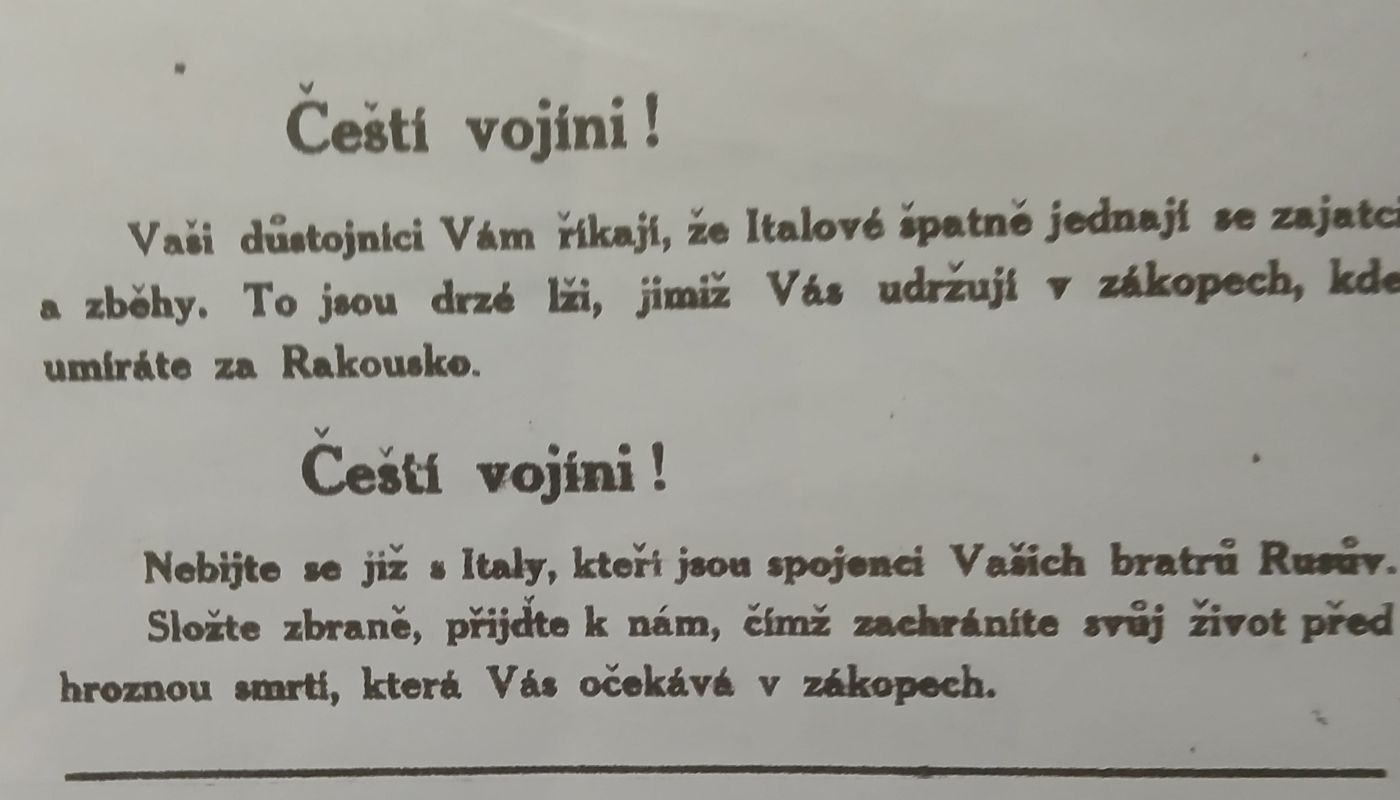
The leaflets found were printed in Croatian, Czech, Polish, Romanian and Hungarian. These texts probably also contain several grammatical and spelling errors, but we must know that these leaflets were not written by linguists and experts in foreign languages; they were most likely prepared right at the front, following recommendations whispered to them by various deserters, who were also not very proficient in their literary languages. The closest to us is Croatian, and therefore we immediately notice that the call itself is missing, which states: Krvatski in ne Hrvatski vojnici. There are also several spelling errors in the short text. All translations, however, convey more or less the same message: Soldiers! Your officers tell you that we Italians do a terrible job with deserters and defectors. These are lies with which they want to keep you from dying for Austria! Soldiers! Come to us without fear. You will save your lives from certain death, and with us you will get white bread in abundance. The Czech text adds that there is no point in fighting the Italians, who are allies of the Czech brothers, the Russians. The Romanian leaflet, however, states that the soldiers should remember the evil that the Hungarians caused to them and their families. And further: Don’t sacrifice yourself for your enemies!
Unfortunately, none of the leaflets found were in Slovenian. Who knows whether they were lost or if they were never printed in Slovenian at all.
Two leaflets, written by hand, have survived. They were probably then reproduced on a cyclostyle, or some other printing method of the time. They are written in Polish and Ukrainian. We found people in Gorizia who translated them. The texts are exactly the same, except that one is written in Latin (Polish) and the other in Cyrillic (Ukrainian). Both sheets are signed by the non-commissioned officer-deserter Martyn Buchko – 10th Company of the 80th Infantry Regiment. The translation reads:
Dear comrades
I successfully made my way to the Italian trenches, where the Italian soldiers welcomed me as a friend. Here I was convinced of the gross lies that come from the mouths of the superiors in our regiment. They talk about imaginary cruelties that never existed. I swear to you that here they treat the prisoners better than our superiors do.
The food is excellent; we have coffee, rice, macaroni, lots of meat, lemons, and a loaf of white bread every day, which we haven’t seen in the last two years. We eat twice a day and get coffee in the morning.
Come, boys from Galicia and Bukovina; why should we die for Austria when our Russian brothers have occupied Bukovina and a large part of Galicia. You can only write to your loved ones from Italy. In a few days, all the Galicians and Bukovinians, those of us who have gathered in Italy, will be able to go to our beautiful homeland. We have finished the war and we have stopped suffering.
Come, comrades from Galicia and Bukovina – come all of you!
25.7.1916
Goodbye
Petty Officer Martyn Buchko
Company No. 10 – 80 RP
It is not known, however, whether similar leaflets were also flown in the opposite direction. It is known that from the Austro-Hungarian trenches, megaphones were used to call on Italian soldiers to surrender and lay down their arms. But what about other European fronts? There was probably a propaganda war going on elsewhere as well, as these activities were also part of the positional battles typical of World War I.