
THE POLITICS OF LOST LOVE
by FRANCO JURI
In politics and diplomacy – it is said – friendship, love and feelings do not count, they do not exist. Instead, only interests exist and count, at least that’s how realists and pragmatists explain it to us. Politicians often and willingly, as sources of inspiration for their programs and their actions, prefer to flaunt “values” and “morals”, but then they almost always end up operating according to interests; economic, pecuniary, corporate, geostrategic, geopolitical, class or religion. Perhaps there was a time when politics, understood as the management of the res pubblica, was something else than a mere and cold technology of power. There were politicians who had feelings, passion, even love, and believed in them. Often naively. It was above all after the Second World War that, despite the ideological clashes and tensions of the Cold War, maintained in politics a charge of humanity and culture that arose as if to compensate for the barbaric dehumanization of the war behind it and the apparently defeated Nazi-fascism. I do not intend to idealize the politicians of the time; there were moral corruption, hypocrisy and pettiness galore even in those times. But large sectors of society experienced politics as a true promise of democracy and social justice; an agora in which participation was also made up of feelings, ideals, passions, love, sincerity, ethics and hopes. Personally, I have seen and perceived in more recent times, only very rare cases of statesmen or personalities inspired by a remarkable ethical depth and love for humanity. I can mention a few; Salvador Allende, Martin Luther King Jr., Nelson Mandela, Pepe Mujica, to mention just four great examples, but also Pope Francis, of whom Prevost is a good moral heir.
But what is the perception of politics and diplomacy today? Is there room in them, even if only in rhetorical form, for love, friendship, affection? Politicians are basically men, under whose skin blood flows and a heart beats.
Let’s start with gestures, body language; it will be almost thirty years now that statesmen, commissioners and ministers in the European Union kiss and hug each other at every meeting. With a few exceptions; Victor Orban, for example, preferred and used to stop at a chivalrous kiss for ladies. I remember that this affectionate ritual, the kiss on the cheek, far from being a Nordic or Central European peculiarity, was introduced in EU salons especially by the Spanish. In Spain, in fact, the kiss on the cheek between man and woman, as well as the tu, at the first meeting, is almost a must, perhaps the result of the post-Franco transition and a certain relaxation in social relationships. The kiss was also customary among colleagues in the diplomatic corps in Madrid and then, gradually, this intimate gesture of apparent complicity and empathy, so Mediterranean, was made its own in Brussels even by the nomenclature of the coldest Eurocrats. In the past, it had only been the fiery Soviet Russian embrace with a kiss on the mouth à la Brezhnev-Honecker included. Now, smiles, kisses and hugs seem to be an exquisitely European prerogative. A way, more calculated than natural and sincere, to present oneself to Europeans with gestures of warm humanity. To express the friendship and trust that bind or would bind the members of the EU. We are a family, and family members kiss and embrace. Love? Friendship? Affection? No, just simple protocol! Look at how everyone hugs, and then hugs, caresses, kisses and pats Zelensky on the back every time he appears and asks for new military aid. Everyone looks at him between admiration for the hero and compassion for a child with specific needs. But let’s not be fooled. All this show of affection is the script of a kermesse for European public opinion. Behind the kisses and hugs brood prosaic interests, improbable tactics, dangerous strategies, often far from any empathy for humanity. Kisses and winds of war, hugs and arms sales, smiles and drones. The European Union is now obsessed with the Russian danger, preparing for war and arming itself, hoping to boost its economies in crisis by manufacturing tanks, rockets and anti-aircraft systems, thus envisaging a scenario of desolation in which, like mushrooms after the rain, the extreme right grows. Will Ursula Von der Leyen and Alice Weidel also kiss soon? Will Antonio Costa and Santiago Abascal hug?
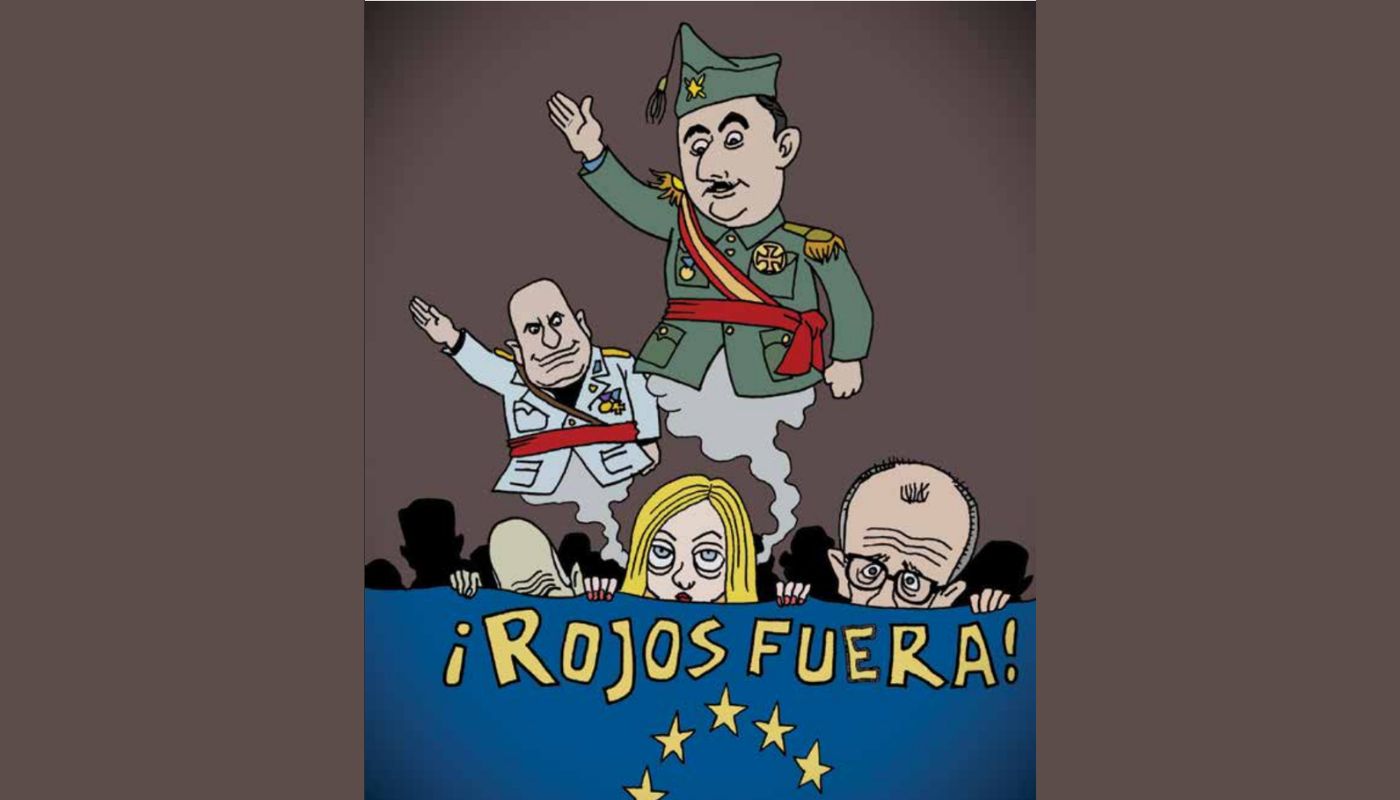
Among the European leaders with the greatest expressive impetus, theatricality and ability to act on the subject is undoubtedly Giorgia Meloni, whose irises and eye sockets always tell everything and more. She knows how to be sweet and lashing in the space of a few seconds. But what is the point of all the European coquetry, if after the Ceuta crisis, planned and guided from a distance, Italy announced that it was suspending the Schengen agreement with Spain, instead of expressing solidarity, as the Sanchez government did with Italy during the landings of immigrants in Lampedusa? After Trump’s anathema to Pedro Sanchez, because he was critical of the American war against Iran and of Israel for the genocide in Palestine, instead of kisses the Spanish socialist prime minister came criticism and instrumental reproaches from those who should be Madrid’s natural allies. From Giorgia Meloni and the Italian right in the first place. The world and Europe change quickly. The most extreme right-wingers, convinced that their time has come, act together and wink at Trump and Netanyahu, the German one also does so with Putin. Do the extreme right-wingers love each other? Do they discover that they love Israel even if anti-Semitism has always crawled into their ranks? The only thing that seems to associate today’s politics with love, the blindest one, is an apparent absolute lack of logic, of rationality. But this is also just an optical illusion. In the close alliance between the Israeli extreme right and the European and American one, there is an Ariadne’s thread, logical and rational, that binds the sovereignist movements in the intent to change the world, from the Americas to Europe, sweeping away the residues of liberal democracy and socialism, to impose populist, nationalist, illiberal and unbridled neoliberal regimes. It is precisely in this context that the President of the Slovenian Government Janez Janša, surprisingly, but perhaps not excessively worrying everyone in Brussels, vetoed a joint European declaration condemning the illegal Israeli settlements planned in the West Bank and the settler violence against Palestinian civilians. The first declaration to have obtained an almost unanimous consensus of EU members. Almost, given that Slovenia, until yesterday in solidarity with Palestine and the population of Gaza, has sided without ifs and buts, denying that what is happening in Gaza could be genocide, with the Israel of Bibi, Smotrich and Ben Gvir. And with the Israeli settlers, in what even senior members of the Ljubljana government now call by the names dear to the Zionists; Samaria and Judea. Immediately afterwards, on the sidelines of the UN General Assembly in New York, Janša reunited, smiling, with Netanyahu, now his political mentor in all respects. The Slovenian government, which now does little or nothing to conceal its ideological closeness to the European far right, has made a 180-degree turn to the country’s foreign policy, in stark contrast to that of the previous center-left government led by Robert Golob and the president of the republic Nataša Pirc Musar herself.
The warm embrace between Giorgia Meloni and Slovenian Prime Minister Janez Janša at the first European Council in which he participated should also be understood in this context. An outpouring with marked political significance. The hug with kiss, uncommon for the wooden and usually gloomy Janša, came after the Slovenian premier had expressed his admiring congratulations to Giorgia Meloni on the duration of her government. Meloni and Janša are two ideological and political allies, both close to Trump, Netanyahu and Milei, despite the fact that the latter’s party, the SDS, is still formally affiliated with the European People’s Party. Janša in recent weeks has been photographed – perhaps to redraw his old image of a permanently conspiratorial and suspicious politician – smiling, satisfied, almost happy. But even after the loving meeting between the two leaders, Fratelli d’Italia continued to vote against any attempt to give the Slovenian community a guaranteed presence in parliament, as Slovenia does for the Italian and Hungarian ones. While the Italian government has not repealed the temporary border controls between Italy and Slovenia which have instead been extended again until December 18, 2026. And then we will see. If this is love…