by NEVIO COSTANZO
Visual language is a spontaneous and immediate form of communication: it allows us to directly convey concepts, ideas, representations, or simple messages. The emoticons we use daily represent a contemporary form of visual language, simple and intuitive. Unlike ancient figurative writings, such as hieroglyphics or cuneiform signs—complex systems that required specific knowledge to decipher—today some images are immediately legible, while others still require a minimum of interpretation to be fully understood.
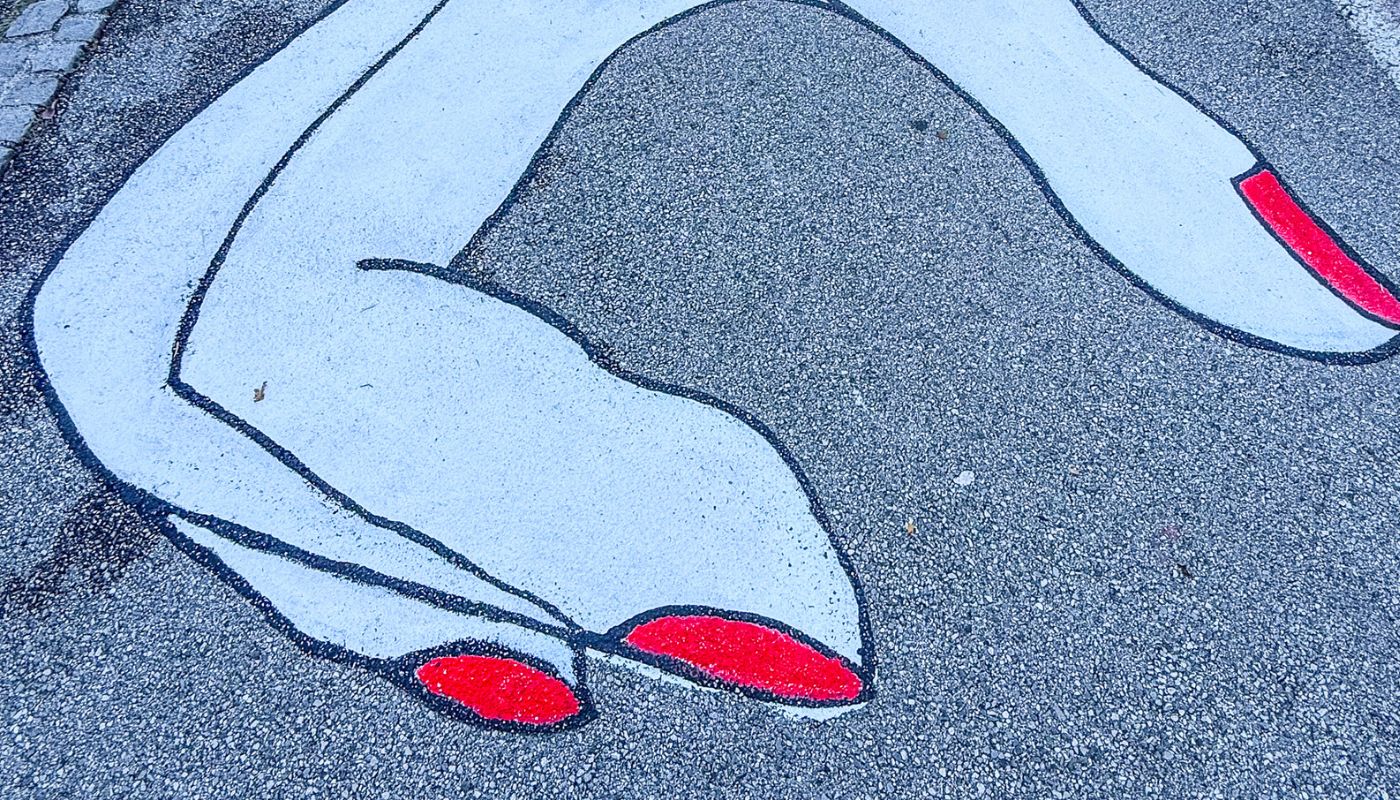
Some spaces in the cities of Gorizia and Nova Gorica—all public, with the exception of one made available by a private individual—have recently been redeveloped and transformed into expressive spaces. Normally anonymous places, like asphalt or a simple wall, have become open-air canvases for artists from different parts of Europe.
Thanks to the ArtCycle GO project, the language of art invites citizens and visitors to pause and embark on a sort of artistic treasure hunt along a 6km route. Through colours and shapes, the works convey ideas of sustainable mobility, or at least those related to it, and imagine a more livable city, designed to be pedestrian- and cyclist-friendly.
The route—which allows visitors to explore the works of artists from France, Germany, Poland, Slovenia, Italy, and Spain—doesn’t necessarily have a beginning or end. However, for convenience and to follow a natural rhythm of stops and crossings, it’s best to start with the first work, located near the Municipality of Nova Gorica.
1. Antoine de Salaberry (near the colonnade of the municipality of N. Gorica towards Bevkov trg)
Human Connections Človeške vezi: Faces and Connections to Connect People and Green Mobility.
2. Mattia Campo dall’Orto – Macross (pedestrian crossing between Kidričeva ulica and Erjavčeva ulica)
How do we get there? Kako priti tja? – An invitation to ask not only where we’re going, but how, between a sustainable future and climate risk.
3. Davide Boscarol – Macross (along Erjavčeva ulica, even number side)
Borderless Flow Tok brez meja: dynamic graffiti that invites you to cross the border between Slovenia and Italy in a sustainable way.
4. Josephine Kaiser (along Erjavčeva ulica, even number side)
Love Story – Ljubezenska zgodba: a tribute to ArtCycle, a project that brings the bicycle back to the center of urban life.
5. Aleksander Politański (after the level crossing)
Light up your bike – Osvetli moje kolo: Neon colors for cyclist visibility and safety.
6. Murdo Ortiz (Rafut Pass)
Turboprimitivo: Pre-Columbian reasons to promote cycling and reduce cars and pollution.
7. Alessandro Giorgi (via G. Bombi)
Even the divided cow goes by bike Tudi razdeljena krava vozi kolo: nature and humanity united along the cycle paths between Italy and Slovenia.
8. Tomaž Milač (Via S. Pellico, corner of Via GB Formica)
Perpetuum mobile: turquoise and yellow as symbols of vital impulse and infinite mobility.
9. Gregor Persolja – Macross (via S. Pellico, opposite the Art Institute)
The Invention of the Wheel – Izum kolesa: a stylized and geometric bicycle, an invitation to rediscover the bicycle as a way to move between cities and borders.
Only one of the works, Perpetuum Mobile, was created on a wall with the owner’s permission; the others are on the ground and more difficult to photograph except from above, with ladders or drones.
For this reason, I am offering some details with the pleasure of your discovery!
For more information: https://www.youtube.com/@KUDMANIFEST