
BORDERLESS IN THE RIGHT PLACE AT THE WRONG TIME
by ANDREA PICCO
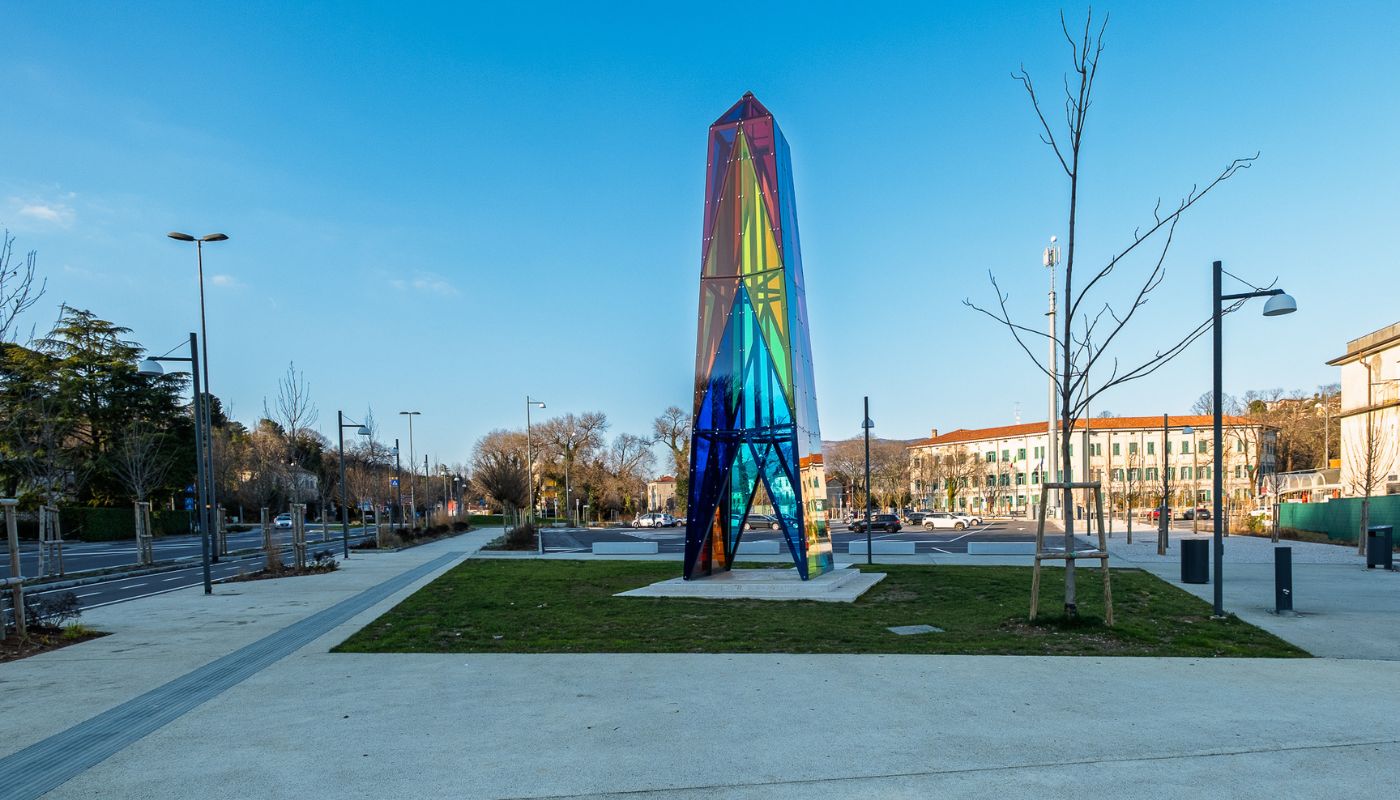
Now that it’s over, a question arises: what the hell did this European Capital of Culture mean for Nova Gorica and Gorizia? I mean: what did it really mean, what profound changes did it bring about in the two communities, what processes did it set in motion at all levels, regardless of the events and the avalanche of money that rained down on the two cities? The more I ask myself, the more I can’t find an answer—at least, not the one I expected to find today, now that it’s all over. Looking back, I’d say that the winning intuition that allowed us to be in the global spotlight for a year—that is, to be “a single dual city,” as Andrea Bellavite brilliantly defined it—has remained just that. And the beautiful slogan, Go borderless!, remained on paper, both as an idea and in practice, with the police, and sometimes the army, guarding the borders throughout the year in which, paradoxically, Europe celebrated us as an example of overcoming them. From here, from this original sin of not even attempting to be a single, true cross-border European Capital of Culture, a cascade of missed opportunities this year follows, as if the border, rather than being overcome, actually represented the channel through which everything that was appropriate, but not right, to say and do for this territory could flow. The most important of these opportunities, the one for which we were awarded the title, concerns the last century and the impact of the tragedy that swept through these lands. Rather than basing the entire narrative on this and exploring it in all its aspects, we deliberately chose to ignore it, to not talk about it. Thus, with no common ground, the fracture created by the twentieth century reappeared in another form: no longer a single capital, but two capitals that managed the “capital” pouring in from Ljubljana or Trieste without stepping on each other’s toes, inviting each other to a series of events without a common thread. The only real reason it was worth coming here this year, and also the only real reason it was worth being a part of this territory as citizens at this historic moment for both cities, was deliberately sidelined by the two administrations. The epitome of paradoxes?—the reason why in Gorizia, every month throughout the year, people demonstrated in front of the town hall under the slogan “Gorizia European Capital of Hypocrisy”—the issue of the failure to revoke Benito Mussolini’s honorary citizenship. Not so much because Ziberna and his followers refused to revoke it, but because the topic of fascism was banned from official events in the capital. It hasn’t been discussed anywhere, either on this side or the other side of the border, with the exception of Kaja Širok’s exhibition at the Epic Center, which opened at the end of November, after the capital was already over. It’s a shame it was the core of the twentieth-century disaster in these lands, the real theme around which this year should have revolved. Not to look back, no. To look inward and look forward. A common ground for reflection on this should have been established, at all levels, from the moment we were proclaimed European Capital of Culture 2025. Instead, Nova Gorica has fallen into Gorizia’s trap: let’s not talk about the twentieth century, because we’re losing tourists—who, incidentally, have been far fewer than expected, so much so that they haven’t affected the city’s sleepy daily life in the slightest. Let’s show that we get along well, that the past is past and doesn’t concern us, that the future is borderless even if it isn’t, because everyone is watching us and we can’t make a bad impression. Let’s pretend, for a year, that we’re brothers. Without realizing that we’re not borderless precisely because we haven’t faced, metabolized, or overcome that past, and that’s why we close the border at the first hint of a breeze. We know exactly where it is because it never went away. We know where it is in our minds and in our soil, and even though we’ve crossed it, we’ve never overcome it. We preferred not to talk about it, hoping that time would heal that tragedy. But time can heal the surface; makeup can rejuvenate, beautify, hide, but it leaves what it finds underneath intact. It’s just a postponement to the next opportunity, with the grave responsibility that an opportunity like this will never come again. So, confusing a historic moment of real possibility for change with a year-long celebration, a sort of mega-Frontier Gusti, is, in my opinion, a grave sin. And here I come to the—excuse the pun—complex of “And…afterwards?” What has changed for those who live in this territory? Have the people of Gorizia and Novogorje become a community? Are they on the path to becoming one, perhaps by laying the foundations in schools for mutual language understanding, or by jointly addressing common issues, such as mobility or the environment, broadening the concept of culture to other fields? What is the legacy, a term so trendy today, of this capital? Let me give you a figure: do you know how many times the city councils of the two cities have met since their proclamation five years ago? One. Do you know how many joint discussions have been created to jointly plan and implement something for the capital? Zero. It’s clear that there have been two capitals: an Italian one managed by the Region, which has spread events everywhere under the Go Borderless banner—just think of the Robbie Williams concerts in Trieste and Sting at Villa Manin—and a Slovenian one managed by Nova Gorica. So what remains for the future? Speaking for the Gorizia area, I say that nothing has changed. The avalanche of money that the Region, the State, and Europe have poured into the city, aiming for no change, having no purpose other than the enjoyment of a limited time, has had no impact whatsoever on its present and future. Indeed, in 2026, Gorizia will find itself having to raise local taxes to cover a shortfall in current spending. A mockery, considering that for this special year, at least €120 million had been received, even at a low estimate; in practice, a million euros could have been spent every three days. With the lights out, the problems of the past remain, sidelined in 2025, aggravated by the fact that this unique opportunity was wasted. It’s as if the Capital of Culture was missing a thought, the Thought. Priapic works remain—a kaleidoscopic phallus erected, passed off as an obelisk of peace, in Casa Rossa, as well as the installation in Galleria Bombi, whose sole claim to fame is being “the largest” multimedia gallery in Europe—the Mayor’s chatter about how good we’ve been, and the feeling that the capital has yet to begin, given the countless construction sites that have been underway for years in the city, especially for this occasion, and never completed, despite the administration’s promises and reassurances. We managed to arrive a year late, and now that it’s over, we haven’t even realized it, and starting tomorrow we’ll be anonymous again; the lights will be turned on elsewhere. Unfortunately, we found ourselves in the right place at the wrong time, when the city was led by someone whose only political skill was luck. That’s how it went. What a shame.