
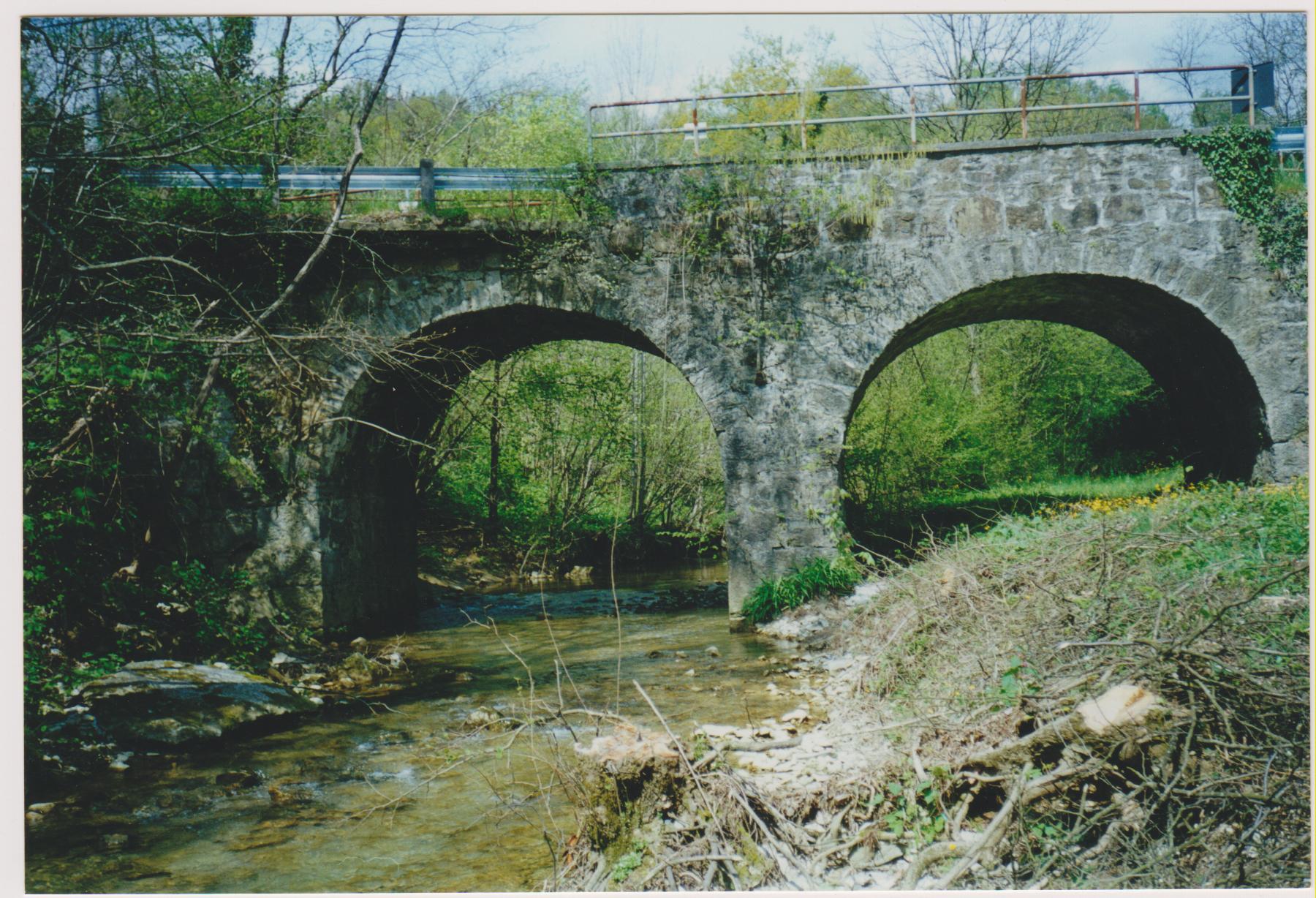
THE STONE BRIDGE UNDER ŠTMAVROM CELEBRATES ITS 151ST ANNIVERSARY THIS YEAR
writes WILLY THE LITTLE PRINCE
When we talk about constructions, this is far from implying that only buildings represented by human dwellings, administrative buildings, churches and other palaces fall into this category. Construction facilities also include transport infrastructure, which, in addition to road and rail connections, is most evident in the construction of bridges and viaducts of all types and purposes. Last May, the Goriška Auditorium hosted a transparent and highly instructive exhibition on the bridges on the Isonzo River, which was conceived by engineers from both sides of the border and met with a resounding reception among the people of Gorizia. In the picture and bilingual descriptions, 23 bridges were on display (9 in Slovenia and 14 in Italy). The description of each bridge or footbridge consisted of three sets: 1. the history of the structure, 2. the construction technology, and 3. the current appearance of the bridge. The exhibition was of a travelling nature and was set up in various places on both sides of Goriška.
So much for the bridges on the Isonzo, our beautiful river, which with its directional color gives a strong stamp to the picturesque country through which it flows. With this article, we will take a look at the little-known bridge that connects the two banks of the Pevmica stream below Štmavro. However, it is a building that celebrates 151 years of construction this year and has quite an interesting history behind it. Browsing through chronicles, “learned” books and other sources reveals that this bridge, which is also called “at Štant”, or in the “Devil’s Hole” (Bus dal Diaul), has already reached an enviable age, as it was built in 1875 with the intention of connecting the villages of Pevma and Štmaver with the road in the nearest direction. Until then, the two banks were connected by wooden bridges and footbridges, which, however, were carried away by the rising current of the Pevmica during heavy rains, so that the stream had to be elm many times. This probably caused quite a lot of concern for drivers when transporting heavier loads, at that time with ox or horse-drawn carts. The locals therefore decided to build a stone bridge that could also defy the occasional high and rippling water of the stream. Available sources indicate that the native boys and men built the bridge with batting work. These sources, however, do not provide information on whether they were paid for this work, or whether it was a voluntary approach. It is known, however, that the construction was financed by the heirs and custodian staff of the Duke of Blacas, who owned large tracts of land. The bridge over Pevmica therefore also has “noble” roots. The Duke of Blakaš was of French descent and fled to Gorizia together with the last French king, Charles X of Bourbon. He was the king’s court minister. Charles X ascended the French throne in 1824, ten years after the fall of Napoleon. However, after the Little July Revolution of 1830, he and his family had to leave Paris and go into exile. After six years of wandering around various European cities, the royal family found refuge in Gorizia in 1836 with Count Coronini. Charles X of Bourbon, on the other hand, died of cholera only seventeen days after his arrival in the doomsday city. He was buried in the church in Kostanjevica. In the church crypt, next to him, his immediate family members are also buried. In a special niche in the crypt, the royal minister, Duke Pierre Louis Jean Blacas, Marquis of Aulp, also found his eternal resting place. The Duke of Blaka, a man nearly two feet tall, died in 1839. His successors sold the estate in Štmavr in 1891. The extensive land of the estate was bought by the former caretaker Ivan Fonzari.
As if by a miracle, the stone bridge withstood all the destructive power that the 1st World War brought to our region. From the available data, it is not possible to trace that the bridge was demolished or damaged in any way. However, he suffered a more serious injury during World War 2. Some locals still remember well the night when the partisans blew up the bridge. This happened in January 1944. By blowing up, the partisan movement wanted to prevent or at least complicate the sudden incursions of the Germans into Štmaver and the slopes of Sabotin. Until then, the Germans and members of the fascist militia had been coming to the village with trucks and other vehicles, but due to the large hole in the northern arch of the bridge, they had to leave the trucks on the Pevmica side and go on foot to the slopes of Štmavr. As for the blasting of the bridge itself, the locals know how to say that a group of partisan saboteurs first ordered all residents of nearby houses to retreat to a safe distance. The first explosion was weak and did not cause any damage to the bridge. Immediately afterwards it was followed by another, much more powerful, and a large hole was made in the upper arch of the bridge, which was not repaired in the continuation of the war. Locals also remember the ferocity of the explosion, which shattered the pillars on all the windows and threw the front door off its hinges.
The hole in the bridge was not plugged until after the end of World War 2, and some maintenance work was occasionally carried out. Water, ice and constant tremors, caused by increased traffic in all the post-war years, were the main culprits for the formation of larger and smaller cracks that appeared on the girders and the arches of the bridge themselves. After several years of efforts by the local community for Pevmo, Štmaver and Oslavje, the municipality of Goriška has finally taken care of a thorough intervention. The work took place for quite a long time, from the summer of 2014 to February 2025. The restoration work was led by and. Renzo Lupi, who apologized for the long months of work, said that after a detailed inspection of the facility, he estimated that the defects on the bridge were worse than initially thought and therefore required more attention from the contractors. In addition to the cracks on the bridge itself, the instability of the terrain on which the building rested was also revealed, and therefore it had to be further strengthened. The road over the bridge was slightly widened, newly asphalted and the already dilapidated and dangerous fence was replaced. During all those months, the road to Štmaver was closed, so that the inhabitants of the village had to take longer and more remote routes.
With a modest but emotional ceremony, in the presence of Mayor Rodolfo Ziberna, the bridge was officially opened on March 1, 2025, thus solving many problems in transport on the main traffic line to Štmavr.
Prvotni jezik tega članka je slovenščina.