
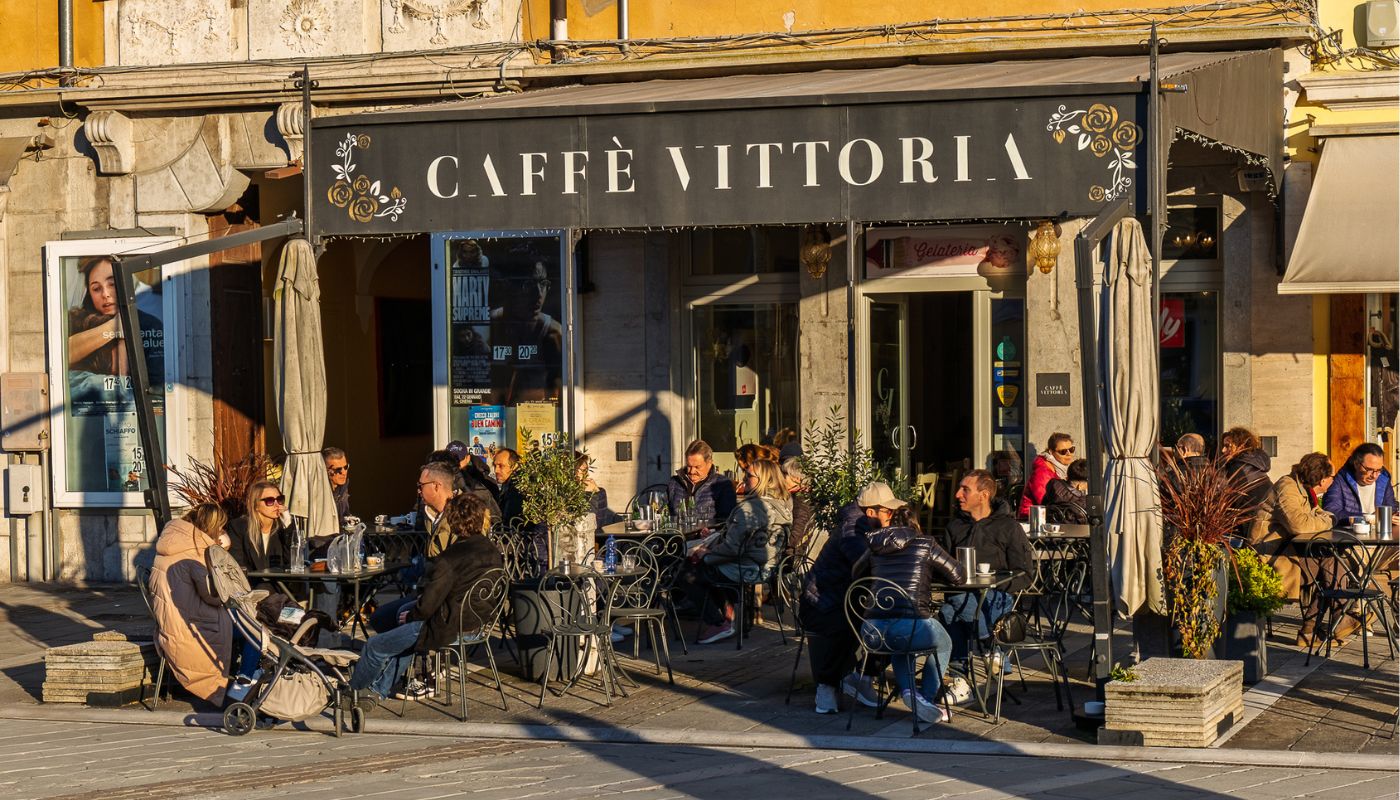
“LET’S GO FOR CAFFÈ?”
written by JULIJA COTIČ
This is how we most often negotiate with our peers and friends when we invite each other for coffee. At least three layers of our space are hidden in the short question: Slovenian, the Primorje semivowel and the Italian “caffè”. The sentence shows visible linguistic contamination, a symptom of clear and loud assimilation, as the invitation does not follow all grammatical rules: instead of the dual, the plural appears, the Slovenian sentence contains a borrowed word, while the second is pronounced in the native language. But this is precisely where the true image of our space is revealed. Such an invitation arises in a relaxed, sincere conversation, in which we, the speakers, express ourselves as we live.
However, we can see something more in it than just adapting to the majority language. It is not just a question, but a small, everyday proof of some deeper coexistence, anchored in centuries. In my eyes, this is the echo of a space that is not divided by sharp boundaries, but rather intertwines its characteristics into a real pearl. I live in the Karst, which stretches from the sea to the Brda, from where the view stops at the whitewashed Alps. This geographical diversity is a true example of a beautiful mosaic. And that is exactly how the linguistic composition of our space is: it is not monochromatic, but layered, moving and alive. Every bit is precious, unique and worthy of attention.
When I look closely at this geographical map, I also admire with enthusiasm the linguistic rainbow that stretches across it.
I firmly believe that the most intimate sign of the existence of a culture is language, or rather the means by which we express what we feel and what we are. Too often we perceive it merely as a practical, functional tool for communication, something taken for granted, although in my eyes it is something deeply fascinating: it is composed of a more or less limited number of words that, in infinite combinations, create countless meanings, emotions, worldviews and identities.
I am happy that I can present myself to the world in my own language, authentic and original. What is even better is that I can also live in Italian on our territory, absorbing Friulian, Trieste dialects and a version of Slovenian with a cross-border accent. All this constantly creates new shades of my identity and at the same time deepens my love for Slovenian. This is an invaluable wealth of our space, a treasure that we are still too little aware of. We know that it exists, but it often remains buried.
What if we finally dug up this treasure? What if we firmly believed that diversity does not weaken us, but strengthens us? That in kindergartens along our Soča River, every child would know how to ask for “a little water” or “un po’ d’acqua” or “pocje d’aghe”? That students in every single school in Gorizia would discuss Aškerec and Gregorčič, Saba and D’Annunzio, in both Slovenian and Italian? From this could grow a true forge of young people of the future, marked by even more vibrant imagination, creativity, curiosity and love for their own roots.
I often imagine languages as colors: each with its own nuances, rules, and patterns. Together they create a mosaic that is beautiful precisely because each color maintains its own identity. That is why it is important to take care of each language individually, to nurture our own while at the same time getting to know others that grow in the same or neighboring garden.
I know very well that “Gremo n caffè?” is a sign of assimilation, adaptation, and an often unconscious and negligent attitude towards language. However, I would like to emphasize that caring for a pure, authentic language is the guiding principle of my everyday life, my active involvement in various Slovenian sports and cultural associations, and ultimately, the reason for choosing to study Slovenian at the university level. This article is not about encouraging the creation of some kind of ‘Esperanto’, which would undoubtedly deny the uniqueness, if not of both, then certainly of the much weaker language. The intertwining of our cultures is inevitable; they merge within domestic walls on a level as intimate as language. However, I would like to emphasize that these contacts can be a source of wealth for all the inhabitants of our area.
That is why I wish that this process would not be one-way. That the intertwining of languages would not mean the gradual disappearance of one, but rather its visibility, appreciation and presence alongside the other. We have a real example in the period before the First World War, when the people of Gorizia spoke each in their own language and understood each other just as well, although German was still spoken at that time. The European Capital of Culture sprang from the very idea of creating bridges and breaking down borders, although in my opinion, the friendship of two cities unfortunately too often relied on the work of translators. I wish that the principle of the borderless would also be internalized at the linguistic level. That language would no longer be the first, most instinctive obstacle between fellow citizens, but rather a bridge over which we step towards each other.
That is why I wish that all the inhabitants of the Soča region would listen with curiosity to the different linguistic echoes on their local streets, just as they admire all the geographical diversity of our corner of the world. That they would perceive their neighbor’s language not as foreign, but as an opportunity for enrichment and more sincere relationships. That the spirit of true friendship would truly resonate in everyday invitations for coffee as well as in institutional collaborations: in Slovenian, Italian, Friulian or in their spontaneous intertwining. As a silent but persistent testimony to a space where diversity is not an obstacle, but a way of life.