
NAMES
by ALDO RUPEL
Regarding the visible, as well as the auditory use of the Slovenian language in public, we have often said, described, outlined and praised very diverse versions of their manifestations, but their audibility and visibility are increasingly sinking into the depths of silence and blindness, into the abyss of embarrassing shyness, because it seems to us that by using a sequence of consonants, let alone with sibilants and sibilants, we force the majority to wade over two, three bristly and spiky consonant ridges, before they hhh-slurp and grgg-slurp into the soothing murky waters of vowel flat uniformity. In proportion to the encouragement of its use, we have announced a shift in the field of Slovene and Friulian naming of various parts of the Gorizia municipality, including the city center.
It is not a matter of marking or translating individual streets and squares with Slovenian names, but at least of recalling several centuries-old designations that originate from tradition. Over time, the inhabitants abandoned a number of names, as they were replaced by others, for example, when streets and squares with rows of new buildings were formed. Radical changes occurred in the years after the First World War, when the black government systematically transformed the external appearance of the city and the suburban area and the remote surroundings. It also eliminated the German and Friulian designations with the aim of transforming the messages for new immigrants, visitors from northern Italy and other parts of the Apennine boot. It was imperative to prove that the thousands of dead were justified in appropriating the not yet occupied areas – irredentists, indeed! In reality, it was a trade: Italy would stab the Austro-Hungarian allies in the back, in return for which it would receive control of the Littoral, sorry, that is, the Julian Alps up to the peak of Snežnik, Istria and Dalmatia.
At the same time, we announced a meeting of the Municipal Consultative Committee for Urban Minority Community Issues. (a linguistic diversion to avoid the adjective ‘Slovenian’, which must not remain visibly recorded in official documents), which was dedicated to this issue. After the meeting, it was already underway, and then a commission met at the mayor’s office, which the municipal council instructed to draw up a proposal with forty names. The names were to be written on brown plates, which the competent technical service was to install – that same year! – at the appropriate points at the same time as the Friulian and Italian ones.
The commission therefore chose one third of the names from approximately one hundred and fifty possibilities in order to remain within the limits of what was “allowed”: fifty of the most characteristic and evenly distributed throughout the municipal territory in Štandrež, Podgora, Pevma, Oslavje, Štmavr, the Svetogorsk district, Podturno, Gorišček, the Korna Valley, Pristava, Grajski grič and the center itself. If their number had to be strictly limited to forty, the list would have to be trimmed a little more.
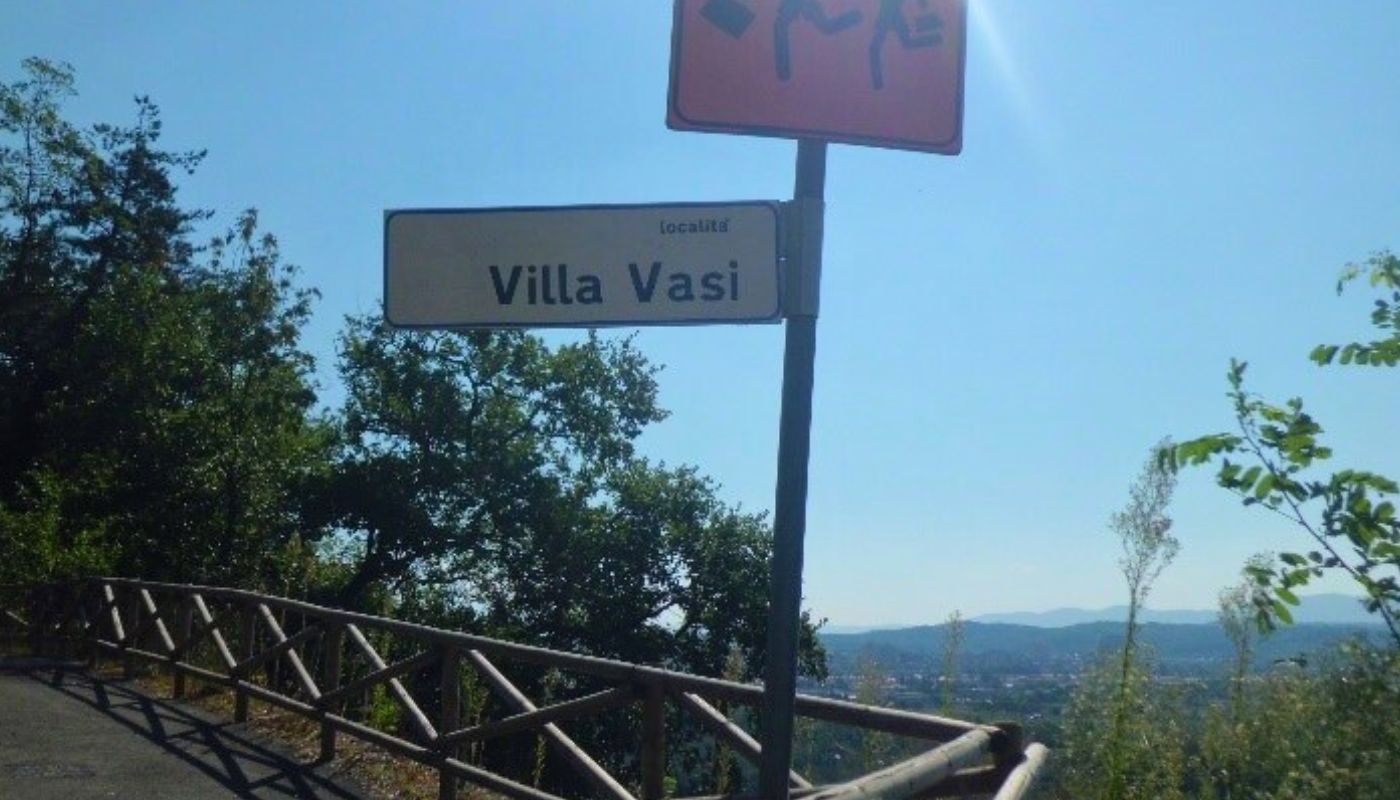
The decisions were certainly a novelty, as it had not been planned, let alone allowed, to officially and publicly record Slovenian onomastics for decades, and especially not in the 20th century. The exception was some maps and cadastral maps, which were not (were) available to the general public, especially not to outsiders. In this paper-based, unreal practice, there was always a stumbling block or ‘solution’ explanation that official documents or maps did not have Slovenian names written down. If they did, they were marked in German written Spakedran, so that it was impossible to understand what they actually meant. A well-known example is the naming of a district in Štmavr recorded as Villa Vasi (?!?) and ‘vas’ turned into the Italian ‘vaze’.
The prepared proposal was received by the consultant through the Slovenian “window” at the mayor’s office, who was supposed to confirm it and then submit it to the municipal administration for approval. We awaited with keen interest how and to what extent the subsequent installation would follow.
Meanwhile, the European Capital of Culture was approaching. In the Slovenian environment, we began to define which points, squares, streets, staircases could be given names that were in use among the Slovenian and partly Friulian population. Meetings, filing and grinding, cancellations and some additions that came from private individuals when they remembered the names in use among grandfathers and grandmothers, aunts and uncles, less so among mothers and fathers, who already had to speak only Italian in public.
We also published a few columns with names, with the support of the Friulian Philological Society – around 130! But whoever holds the scissors and the canvas at the administrative level has overheard and overlooked everything that has come too close to the left bank of the Soča and the right bank of the Vipava. They have even avoided the names of city districts such as Podturn, Gorišček, Stražice, Severna postajā, Pevmenski park, Grajsko naselje, Seneni trg, Pilošče, Svetogorska četrtu, Pri Cedri, Na Pilošču, Na sklacah, Pri šintarju and dozens of other names.
For decades we have been hearing the self-evident answer: ‘NO SE POL’. The belief that the Venetian lion on the castle gate is a historical hoax for the eyes of foreign visitors and long-time walkers here would fall. Let alone recording somewhere the interwar rebel district division of the city into Four Quarters: Northern, Southern, Eastern and Western Quarters with all the OF Committees. Another form of detour is the constant romantic redirection to the situation before the First World War, when as many as four spoken languages were present in the city. Today, the only Slovene-worthy sign at the entrance to Raštel, measuring 30×15 cm and five meters high, marked Travnik, is the only one. Don’t fool me!
Ljubljana sends instructions to everyone:
“Change the lyrics there!”
You have borderline disgusting syntax,
but delve into it now,
that the speech of Lachon may not prevail,
He should rather agree with Cankar.
Listen to the marsh, frog reports
and in them sounds, examples, announcements!
We listen to the radio, we watch TV,
Verbal woe immediately overwhelms us:
foundation, lobby and title
the college and the statue and the razor,
motif, donation, pastilles and thermal cure,
declaration, visitation and pink haircut,
guarantee, debate, alternative, education,
conception, arbitration, selection, evaluation,
sottilissimi Rio mare and homage and decree,
natural drink, fascicle, secretion,
inventory, distance, concession and tradition,
aggressor, market, medicine and petition,
control, deluxe and sounding at the same time,
Don’t be afraid of Spakedran!
He cultivates it in union, all in a row,
The horrified Cankar turns around in his coffin.