
THE ERASURED IN SLOVENIA
by ELIO CANDUSSI
A friend insisted I read a book that tells a dark story about Slovenia. A story unknown to me, despite it having unfolded in recent years, following the state’s declaration of independence. In Italy, I’ve never heard about it, neither in newspapers nor in other media, perhaps because it hides embarrassing aspects that are best ignored.
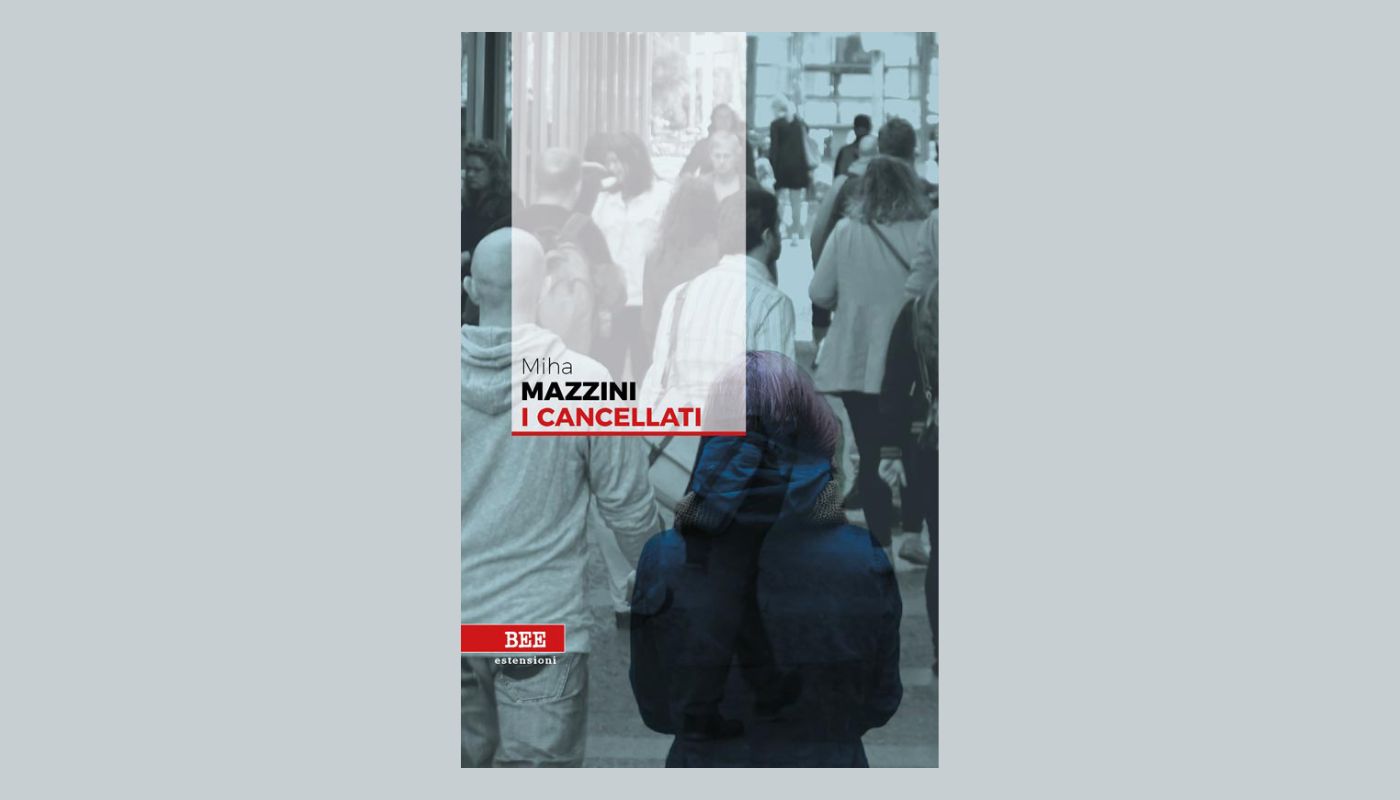
The book’s author is Miha Mazzini, a writer, screenwriter, and director born in Jesenice. The story is fictionalized but plausible, as “many of the events and destinies described” are unfortunately real. It recounts the experiences of a single mother, Zala, of Serbian origin but resident in Ljubljana for over 20 years, whose identity and that of her newborn son are suddenly “taken away” by the Slovenian state. Hence the book’s very explicit title: “The Erased,” published in Italy in 2018 by Bottega Erranti Editori of Udine. The original Slovenian edition, titled “Izbrisana,” dates back to 2014, and the book has been translated into eight other languages.
The novel describes the paradoxical and dramatic situations Zala experiences over the course of two weeks, from April 20 to May 15, 1992. What was happening? She goes to the hospital to give birth, but her name isn’t listed in the computer. Suddenly, she feels like a foreigner, she doesn’t exist legally, and her newborn son is an orphan and therefore eligible for adoption. Neighbors occupy her apartment, she loses her job, her health insurance, and therefore has to pay for medical services. Through a ruse, the vigilant bureaucracy deprives her of her Slovenian identity card and passport. She effectively becomes a “stateless person” in the Slovenia she considered her homeland. Zala recounts: “When I lived in Bitola (North Macedonia), the children made fun of me because I was Slovenian. In Rijeka, I was Slovenian, too. When I went to Trieste, the Italians despised me because I was Slovenian. Then you kick me out of here because I’m not Slovenian enough?” She’s desperate, spending her days seeking help everywhere, alternating between hope and disappointment. The book was also made into a film in 2018.
In the book’s appendix, Lana Zdravkovic explains the historical reconstruction of the actual events in detail. On February 26, 1992, the Ministry of the Interior of the newly formed Republic of Slovenia erased 25,671 people from all registers. Virtually overnight, they lost their status as “resident citizens.” Most of them were originally from other states of the former Yugoslav republic, often of mixed ethnicity. In effect, “they were stripped of all rights associated with residency status, such as work permits, healthcare, and housing rights. Their documents were declared invalid and then destroyed,… mostly through deception.” Essentially, they had become foreigners in Slovenia and were invited to return to their homes, their homelands.
In 1999 and 2003, Lana recalls, the Slovenian Constitutional Court declared the “erased decree” unconstitutional. In reality, however, nothing changed, and in 2004 a referendum was held on the adoption of the “technical law on erased status,” which rejected the repeal of the law on erased status by a large majority. In 2010, the state attempted to address the problem by issuing a regulation implementing the previous law, which, however, displeased many. Finally, the European Court of Human Rights was involved, which, in June 2012, declared a violation of the European Convention on Human Rights and ordered Slovenia to redress the grievances suffered by the erased. Thus, in December 2013 (after 20 years), it enacted a law on compensation for the erased. However, due to various bureaucratic complications, approximately 13,000 people were unable to obtain this compensation.
Miha Mazzini denounces an aberrant law, kept secret because it was considered shameful, and whose consequences have not yet been fully resolved. One wonders why a seemingly purely administrative measure could turn into a tragedy for thousands of people, and why historians and intellectuals have so long failed to provide explanations for these events, not only in Italy, but at least in Friuli Venezia Giulia. We remain patiently waiting.
Finally, at the end of the book, there is a passage from a famous, frequently cited poem that makes us reflect on “silence when the rights of others are violated.” It is by theologian and Protestant pastor Martin Niemöller, who was interned in a Nazi concentration camp:
First they came for the Jews
and I didn’t say anything because
I was not Jewish.
Then they came for the communists
and I didn’t say anything because
I wasn’t a communist.
Then they came for the trade unionists
and I didn’t say anything because
I wasn’t a trade unionist.
Then they came for me
And there was no one left
That he could say something.