
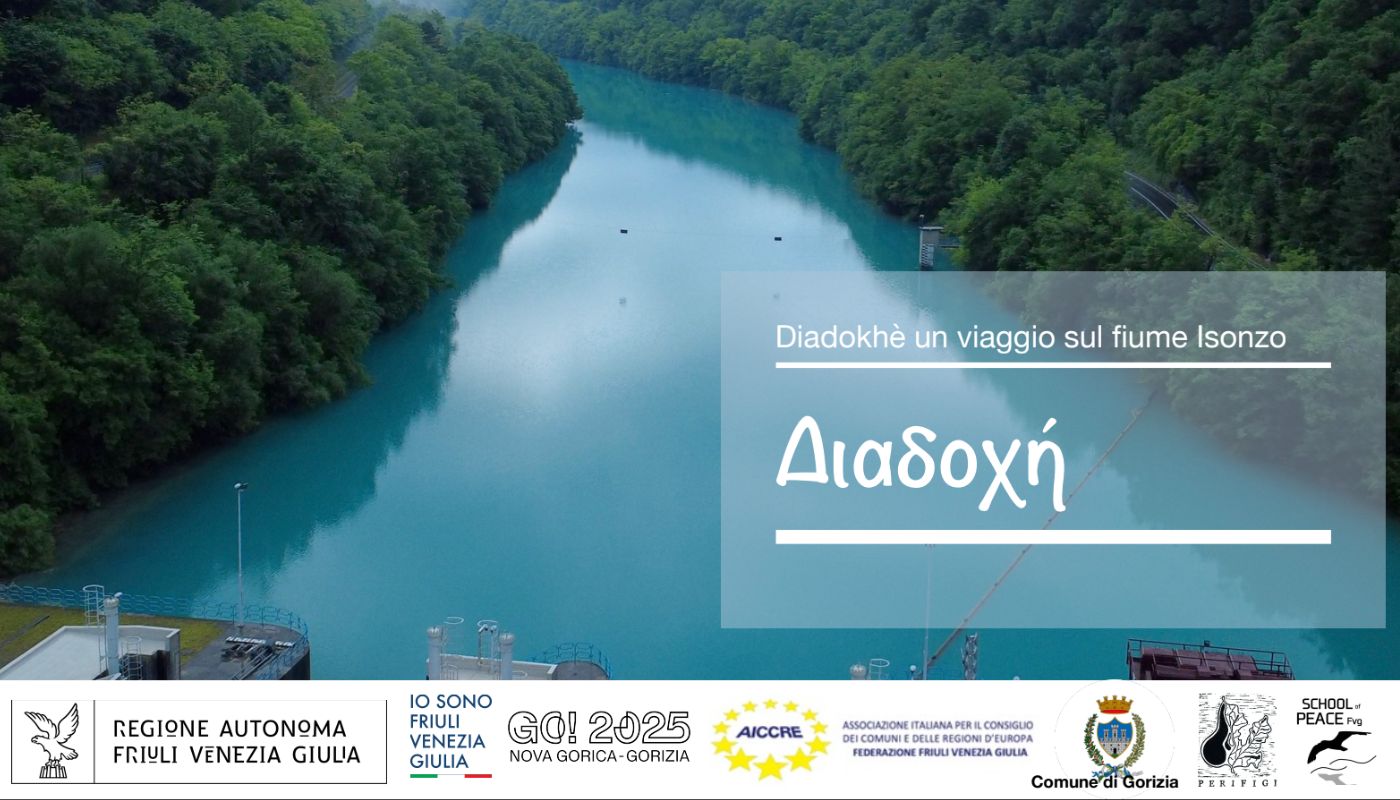
Διαδοχή (Diadokhḗ). A JOURNEY ALONG THE ISONZO/SOČA RIVER
by INGRID MARCUS, HASEENA ZAHURI BARBANA
The bond with a river—to which you entrust a dream, to which you grow, or into whose waters you leap with joy—is almost a metaphor for childhood. A childhood that, in a globalized world often searching for direction, needs to be recognized, supported, and protected. Yet, for many children today, knowing the river that flows beneath their homes is not something to be taken for granted. Learning its history, listening to the stories of those who have lived there, and carefully observing how the seasons transform it can be even more challenging when one’s family has no roots in that area, or comes from distant lands and cultures. How can one forge a bond with a river with such a special color and history as the Isonzo?
The Διαδοχή project was born from this question (Diadokhḗ), from the ancient Greek “succession, passing of inheritance, transmission of knowledge,” is the name chosen for a project that traverses the Isonzo–Soča River like a collective memory. Children from diverse backgrounds, descendants of families who have found homes near the mouth of the Isonzo River, set out to explore this freshwater river that meets the sea in a still-untouched landscape. It is a journey from mouth to source, between rural and urban, between past and present, between the children of yesterday and those of today, in search of a thread that still unites the communities living along the river. Diadokhḗ is an anthropological project that has given life to a feature film dedicated to the relationship between man and nature, constructed through the testimonies of men and women who have inhabited these places for decades. Their words, in Italian and Slovenian, become a guide for the young people participating in the journey, accompanying them in the discovery of stories, legends, landscapes, and ways of life that are at risk of disappearing. Moreover, they also wonder how a distant culture can enrich, transform, and enhance this fragile memory of a different time—a slower time, made of observation and deep listening to nature.
The route starts from the port of Sistiana, where Berti Bruss, of the DisEquality association, a former sailing champion and now a promoter of inclusive sports, leads the group towards the mouth and beyond Punta Sdobba. After passing San Canziano and Turriaco, the young people arrive at Sagrado, where they participate with Legambiente to the “Let’s Clean Up the World” day, a concrete gesture of care that becomes an integral part of the narrative. In Gorizia, Aldo Rupel, a central figure in Slovenian sports in Gorizia, awaits them. He guides them from the station to Piuma Park, to Piazza Vittoria and then to Solkan, where they live an adventure experience at Adrenalinski park Soča fun park. The journey continues by train to Plave, where they meet Nadja Velušček, a teacher, director, and screenwriter born in Plave. She recounts the time when cherries were loaded onto trains bound for Vienna, painting a vivid picture of a now-vanished rural economy. Nadja Velušček’s hope is that children can love her river as intensely as she loves it now and as a child. Indeed, it is precisely through lived experience and the river’s vital rhythm that distances are transformed into closeness and sharing.
From Plave, the group reaches Most na Soči, spending an afternoon on the riverbanks and crossing the lake by ferry, always accompanied by Aldo Rupel. In Kobarid, they meet Zdravko Likar, a multifaceted figure and founder of the Kobarid Peace Museum. Zdravko leads the group through the museum and along the snow-covered paths of the former trenches of the First World War, which make up the extensive network of Sentieri di Pace (Paths of Peace)—Pot Miru—The Walk of Peace. The group then ascends in a small van to Livek, a panoramic viewpoint at an altitude of 1,000 meters overlooking the entire Soča Valley. Here, they meet Katja Roš, a journalist, expert on local legends, and author of a book on the history of the Soča Valley. Krivopete. From Livek, Katja accompanies the children to Jevšček, home to Pepa Nježna, a wise woman who was widowed during World War I and a guardian of traditions and knowledge that she passed on to the village children. The final leg of the journey leads to Bovec and then up the Trenta Valley to the source.
Thanks to the support of the European Capital of Culture GO! 2025 project, it was possible to give shape to this journey, both real and imaginary, towards a utopian pure spring, which in the narrative and iconography of the film becomes a symbol of the mother, who is mother even when empty, before the fertility of summer fills her with water.
The project aims to recover ancient memories and knowledge, reconstruct stories, cultures, and traditional ways of life, instill in young people an authentic connection with the territory, and enhance the artistic, cultural, and environmental heritage of the municipalities it passes through. The filming and testimonies cover twelve locations in eleven municipalities in Italy and Slovenia: Staranzano, San Canzian d’Isonzo, San Pier d’Isonzo, Sagrado, Gradisca d’Isonzo, Gorizia, Nova Gorica, Solkan, Kanal, Tolmin, Kobarid, and Bovec. The young travelers are children of members of the School of Peace FVG and, for the most part, children of migrants from various countries around the world.
The documentary was born from the participatory experience carried out by School of Peace Fvg with students from ISIS BEM in Staranzano and STŠ in Koper during the educational project “La fattoria De Dottori degli Alberoni sulla Quarantia,” funded by the Friuli Venezia Giulia Region in 2023. On that occasion, local men and women shared memories and archival photographs, bringing back to the children a time when nature was experienced with freedom, risk, toil, and wonder: the forest, the fields, the road, the riverbank, the beach were places of life, play, and work, perceived and acted upon by the children in often harsh but unconditioned conditions.
The film’s central idea is to shift our gaze from the global to the local, from the virtual to the concrete, from the noise of the world to the voice of the river. The Isonzo becomes a common thread that unites places and generations, fostering a sense of community rooted in our human, environmental, cultural, and linguistic origins. A careful poetic observation by Andrea Bellavite highlights the subtle difference between the male and female mythological figures of the river and the reason why it is called the “river of peace,” adding a symbolic dimension to the narrative.
Also important is the collaboration with the Slovenian association Kulturno društvo Perifigi, an integral part of the project. The dual perspective on the river—which changes course, light, and colors along its course—opens up a complex and vibrant space for co-creation, capable of engaging different generations.
The association curated the soundtrack, intertwining memories of folk songs from the various areas crossed by the river. The children’s final encounter with the Korenine choir from Tolmin brings the song to life in its most authentic form: a voice passed down orally from generation to generation, inscribed in the bodies and memories of these women. Through their sensitivity to the land and to song, they bear witness to their origins and a profound connection with nature.
The encounter between the child of yesterday and the child of today becomes the true narrative device: a passing of the baton, a seed that can sprout hidden in the darkness of the earth, where the mystery of a river’s birth is kept. And it is toward that mystery that the children were guided, who, in turn, guided all of us to rediscover a curious and unexpected perspective on things.
Team Diadokhḗ
Ingrid Macus – Ass. Perifigi – soundtrack;
Lorenzo Fabbro and Maurizio Carraro – video shooting and photography;
Emanuele Pertoldi – sound and post-production; Marco Marchioli – post-production;
Haseena Zahuri – School of Peace Fvg – direction and editing;
Ingrid Macus – Perifigi- and Barbara Frandolic – School of Peace Fvg – Italian/Slovenian translations
La lingua originale di questo articolo è l'Italiano.