by MARCO MENATO
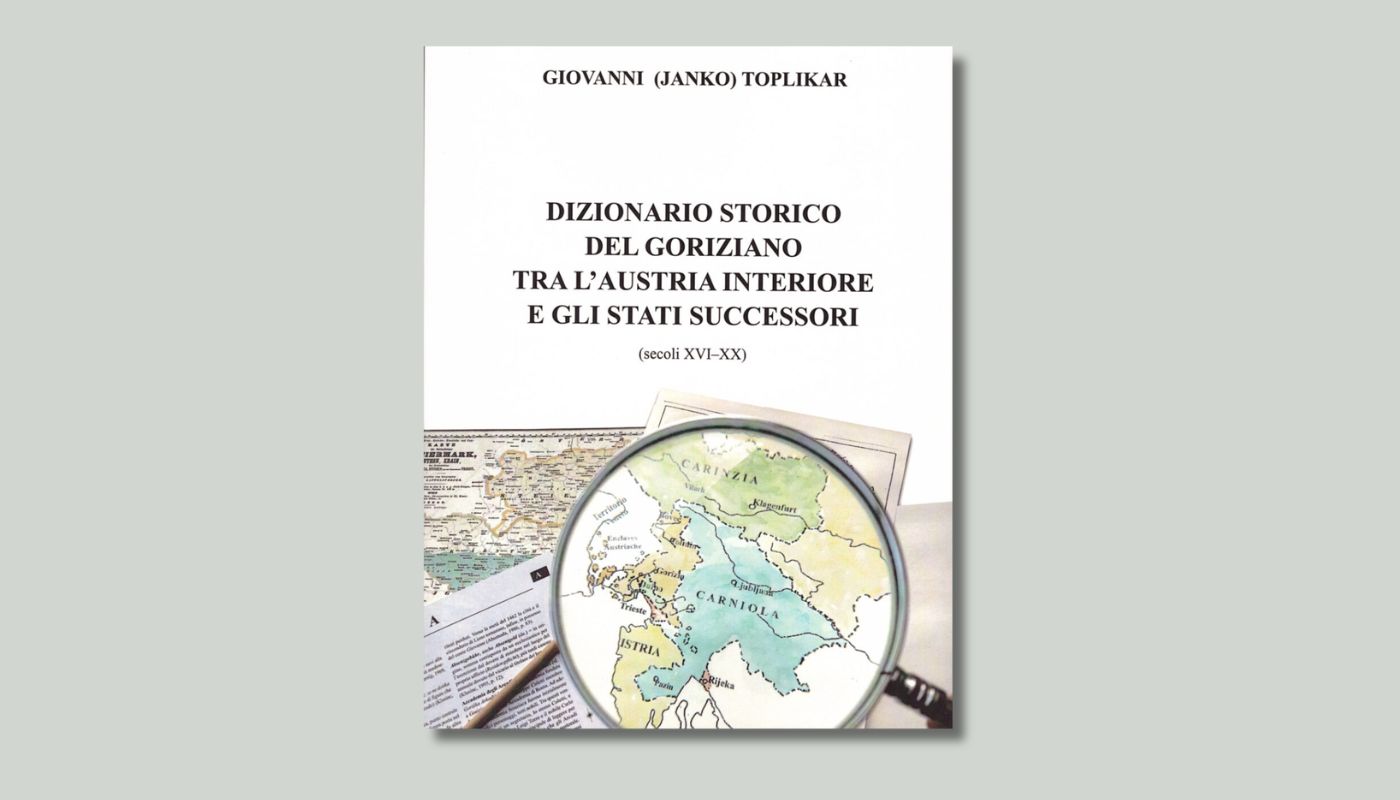
The Historical Dictionary of the Gorizia area between Inner Austria and its successor states (16th – 20th centuries) , published in Rome by Lithos at the end of 2025, is the fruit of a long and passionate study of historical bibliographical documentation combined with the awareness that it is not always easy to fully understand the meaning of terms (with the exception of personal biographies) concerning, above all, the history and functioning of institutions over the course of five centuries and, moreover, in a multilingual territory, such as the Gorizia area, today separated by barriers that are more cultural than administrative.
Some tools have been published over the years, almost always to support specialized studies, but this type of information is often passed down among scholars and information technicians (i.e., librarians and archivists), but is not always considered the object of in-depth and independent investigation, as it is considered to be a support for research. This is how inventories, censuses, catalogs, and bibliographies are most often classified—necessary, but not the ultimate goal of Research, with a capital “R.” Even encyclopedias, dictionaries, glossaries, handbooks, and so on have suffered the same fate, despite constituting a significant portion of the history of bibliography, which is nothing other than the history of culture. All this vast and erudite bibliographical instrumentation is now channeled into electronic memories and it is difficult to believe that it will enjoy a new spring, so much so that even the antiquarian market seems to no longer attribute any particular economic value to these sources, which are slowly disappearing even from reference rooms, with the sterile justification either of excessive space taken up or of the now immediate availability on digital channels.
Janko Toplikar had initially contacted me to resolve some citation technical issues, and I had thus had the opportunity to review the work he had been working on, now in solitary growth, for many years. For various reasons (among which, I believe, the difficulty, in an era of microspecialization, in weighing the scientific value of comprehensive and multidisciplinary investigations), it had not found a publishing outlet or, perhaps, had lost the purpose for which it was originally intended. Hence the decision to publish it under the Lithos imprint, with the contribution of the Roberto Visintin Foundation. Indeed, Prof. Branko Marušič (who wrote an introductory text in Slovenian), at the time a scientific collaborator at the Milko Kos Institute in Nova Gorica, had proposed to him a research project that was initially supposed to be limited to a list of entries of general historical interest with the correct Slovenian translation (for this reason the title on the title page and many entries show the corresponding Slovenian and German versions).
The Dictionary It consists of 3,316 lemmas, in alphabetical order, containing essential explanations of various natures, historical, literary, artistic, ethnographic, etc., concluded by at least one verified bibliographic reference and four appendices, including an extensive bibliography and sitography, for a total of 605 pages. It is therefore an undoubtedly useful tool for studies, especially for those venturing into territories that over the centuries have been subject to different state situations, studied or, more often, not studied in the respective national historiographical traditions. In this case, the history of the Gorizia area, focused on multiple national fronts, is a clear example of the difficulties facing the scholar or cultural enthusiast.
The Dictionary also inaugurates the new Lithos series, Studies and Tools , whose first volume, edited by Alessio Stasi and Federico Vidic, must ideally be considered the one dedicated to the Cobenzl family, originally from a small village in the Karst (the area covered by the Dictionary ), which enjoyed great prestige throughout Europe between the sixteenth and nineteenth centuries, demonstrating how History, large and small, cannot be delimited by administrative borders, yesterday as today!