
THE SPY NEXT DOOR. CARLO HAKIM DE MEDICI, “MODERN EPICUREAN AESTHETE”
by LUCIO FABI
Go trust literary figures. You appreciate the reclusive figure of a Gothic writer of undoubted talent, also a talented artist, who lived in Gradisca d’Isonzo in the early 20th century, was discovered a few years ago and quickly became a national literary sensation, and then you find him a spy for the regime, with all that that entails. That shadow of mystery that hovered over him was nothing more than an effective cover.
This is what happened to Carlo Hakim de Medici (Paris 1887 – Como 1956), the only son of a wealthy Jewish financier who spread his business between Alexandria, Paris, Milan, and Gradisca d’Isonzo. He was active in the 1920s and 1930s, author of noir books and stories illustrated by himself, successfully republished by Cliquot in Rome (Gomoria, I topi del cimitero, Racconti crudeli, Nirvana d’amore). Among the cursed writers of the early decades of the twentieth century, so beloved by genre enthusiasts that he appeared in a horror comic, de Medici called himself “a modern epicurean aesthete,” but was in reality one of the most despicable figures used by Mussolini’s regime to control the movements and thoughts of Italians. That sinister spy, so to speak, depicted without indulgence in so many films and fiction about the twenty-year Fascist period.
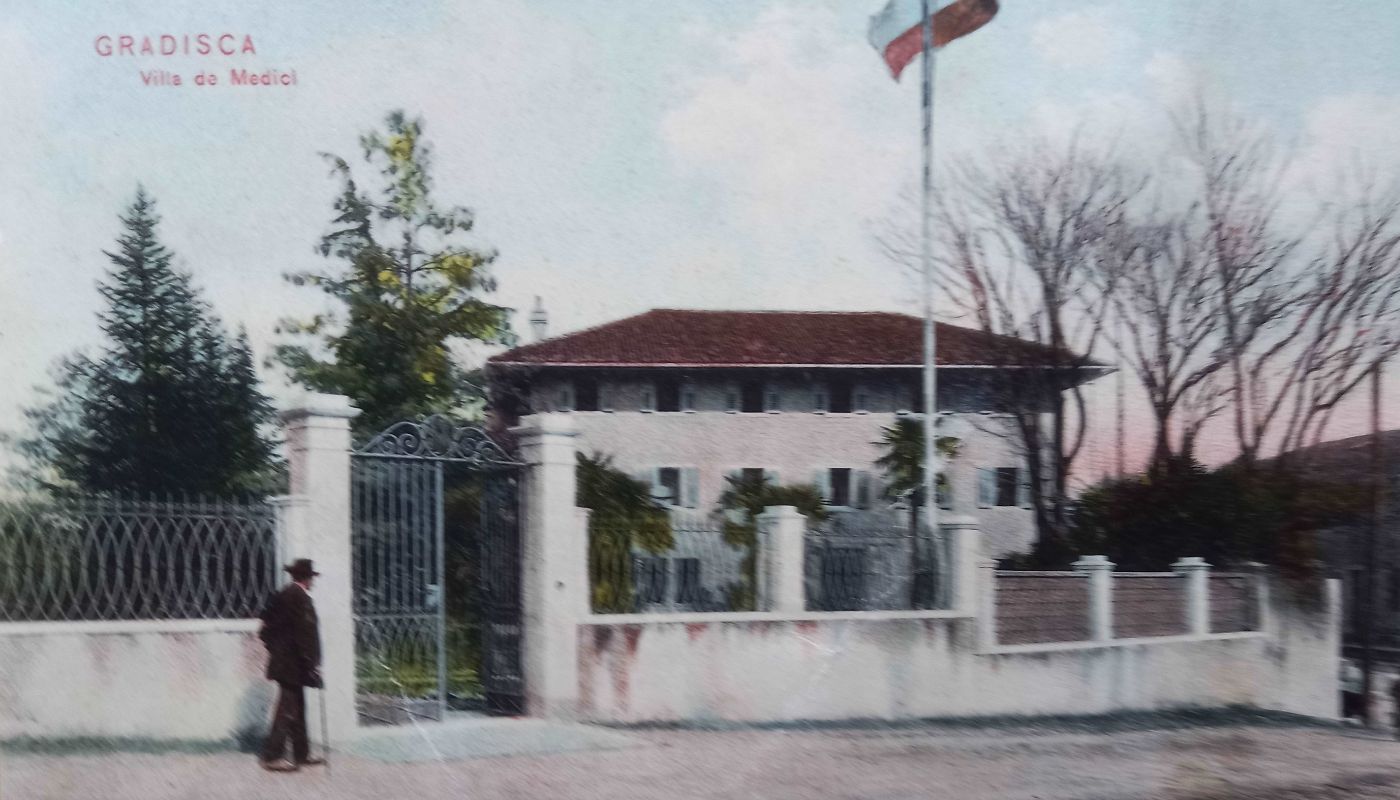
Carlo’s childhood, spent mostly in the family villa in Gradisca, but also in Milan and Paris, where he developed an early interest in spiritualism and esoteric texts, was a happy one, despite his father’s death in 1900 and the resulting loss of much of the family’s income. Parisian by birth, Jewish on his father’s side, Polish on his mother’s side, as soon as he came of age he joined the Lega Nazionale, a pro-Italian association based in Trieste with connections in Gorizia and Gradisca. He continued his esoteric studies, publishing essays in Italian and French at his own expense. An irredentist and a fervent supporter of the Italian identity of lands he evidently considered his own, but not to the point of enlisting and risking his life in the trenches at the outbreak of war with Austria. Carlo fled to Milan, where he lived the life of a bohemian intellectual. . Some unsuccessful business ventures forced him to sell his villa in Gradisca in 1921 to pay off various debts. Between 1921 and 1925, he published “Gomoria” and “I topi del cimitero,” macabre and voluptuous tales, with the publisher Facchi. He also published “Nirvana d’amore” and “Leggende friulane,” recently republished by Cliquot.
All good, then, until, with a leap of 100 years, we find him in the list of names of OVRA confidants. Published by the Ministry of the Interior in the “Gazzetta Ufficiale” on July 2, 1946. Accompanied by over six hundred spies and informants of the fascist regime’s political police, established by Mussolini himself in 1926 with broad powers, he began his spy and informer activities in March 1931. According to historian Mauro Canali, Carlo Hakim de Medici, code 440 and cover name “Cam,” began his spy and informer activities in Cormòns, Gorizia, and Trieste, with the aim of tracking down and monitoring individuals suspected of activities opposing the fascist regime.
For his work, Carlo moved to Gorizia, renting the first floor of number three on Via Petrarca, across from the public gardens. He traveled extensively, by train and bus, allowing him to probe the conversations of those he came into contact with. His area of operations included the town of Cormòns, Gorizia, and the surrounding Slovenian villages, but also extended to Monfalcone and Trieste. Adequately financed by secret funds from the OVRA, he relied on several collaborators, such as the Slovenian Vittorio Simsič, from whom he received information on foreign proletarian circles, and a certain Monsignor Maghet, a former chaplain of the Austrian navy and a regular visitor to the aristocracy of Gorizia and Cormòns, largely pro-Austrian and therefore disliked by the regime.
This explains the mystery that until now hovered over the existence of Carlo Hakim de Medici, an informant for the OVRA about whom nothing was supposed to be known. He certainly did so to shore up his own wretched finances, given that as a trusted and reliable confidant, capable of moving in circles he knew well and in which he was recognized as an esteemed writer and artist, he could count on an income of several thousand lire. But he would not have been unfamiliar with the irredentist and anti-Slavic sentiment that pervaded certain Trieste and Julian society at the beginning of the twentieth century, which then resulted almost entirely naturally in the “border fascism” that arose precociously in the territories of the nascent Julian March.
In fact, the documents that emerged from Mauro Canali’s research outline the certainly unclear figure of an informant who, operating in the shadows and with a good deal of duplicity, identifies, reports, denounces, and has the police arrest anyone who in any way shows disapproval of the fascist regime. He was mainly dedicated to identifying and controlling subversive groups among the communist and Slovenian components, but he also controlled influential Slovenian figures, such as the former deputies Don Virgil Šček and the lawyer Karel Podgornik, confined to Macerata in 1941.
His extensive reporting primarily concerned Italian and Slovenian communist militants from the Gorizia area, whom he sometimes photographed. He contributed to the arrest and prosecution of several youth resistance groups in Cormons and the immediate Gorizia area, many of whom ended up before the Special Fascist Tribunal. He received information on his activities from Commissioner Luigi De Michele, an OVRA official stationed in Rijeka, whom he met in Gorizia. When necessary, he traveled to Rome to meet with the central police authorities.
In the days leading up to Italy’s entry into the war, he noted the citizens’ lack of enthusiasm. In a letter dated June 14, 1940, he reported that the Duce’s declarations had not aroused “among the people of Gorizia the patriotic enthusiasm that could have been hoped for; on the contrary.” His reputation as a writer (he published “La papessa Johanna” and “Aquileia seconda Roma” in 1936) allowed him to come into contact with diverse circles. He frequented intellectuals and artists from Trieste and Gorizia, such as the futurist Sofronio Pocarini, to whom he dedicated one of his books. He chose as his base the luxurious Caffè Garibaldi, on the main street, a meeting place for the intelligentsia. Gorizia, from where he hand-wrote, in a beautiful, rounded hand, the reports he sent to Rome. Over 1,880, one every two days, from 1931 to 1941.
In Gorizia, he gave drawing lessons to the daughter of the owners of the house on Via Petrarca, in the large first-floor apartment, while in the internal courtyard, a warehouse on the ground floor served as his studio. It was there that he must have begun carving the headstone for the tomb of a wealthy Jew from Trieste, a certain Bruno Baar. It was left unfinished when, at the end of 1941, he had to flee to Milan, likely for fear of being discovered and suffering a tragic end, given the resurgence of Slovenian resistance in the city, which had intensified after the occupation of Yugoslavia.
With the end of the war, Carlo de Medici’s spy career ended. He eventually settled in Como, where he maintained correspondence with several local friends, including Edgardo Loy, a childhood friend from Trieste. In some letters to his friend between 1944 and 1949, he makes no mention of his past activities, but offers many insights into his state of mind and his remaining literary ambitions.
He never returned to the places where he had worked, given the changed international and local situation, with Gorizia cut in two by the border with Yugoslavia and Trieste under Allied government, but he joined, from a distance, the reconstituted National League, dissolved during the Fascist period and “reborn” in the post-war period.
In his letters to his friend Loy, in addition to lamenting the precarious economic situation he found himself in, he bitterly denounced the division of lands that he considered inalienably Italian. He lashed out violently against the “Slavic occupiers” of May-June 1945, accusing them of seeking to permanently seize Trieste and Istria. His greatest hatred, however, was directed at those in Italy who seemed to justify international treaties and accused those who, on the contrary, wanted Italy’s return of base nationalism. He expressed strong disdain against a certain Italian public opinion, which seemed to ignore local nationalist demands, given that the war had been lost and a price had to be paid. He lamented the fact that, historically, Julian irredentism, of which he felt a part, was never considered during the Fascist years, in favor of Italian immigration that stripped local resources. These are the theories of Trieste’s autonomism, seasoned with a repressed and unheard love of country. Alone against all, local nationalists are expected to react en masse. He even dreams of returning with cannon and machine gun fire to Istria and all the places now entrusted to Marshal Tito’s Yugoslavia. Finally, he calls himself a “non-fascist,” never having been one, and having acted only on behalf of his lands, that Italian Venezia Giulia in which alone he identifies. Astonishing. How duplicitous on the part of the spy writer, the modern epicurean aesthete, as he calls himself in one of his writings. Now defeated by history, haunted by demons far more present than those he himself had captured on paper, the man had no choice but to resume his old plans, dream of reprinting his writings, the impossible complete works meticulously outlined in his last letter to his friend, along with the project of a four-thousand-page literary encyclopedia of Friulian places and landscapes that he would never complete. He died a few years later, in 1956, and was buried in the Como cemetery.
La lingua originale di questo articolo è l'Italiano.