
PRIPOVEDUJEM TI O SVOJEM JEZIKU, I’LL TELL YOU MY LANGUAGE
by IRINA MOIRA CAVALON
This article tells of a meeting. A meeting that, now in its third edition, continues to expand its boundaries far beyond the classrooms in which it originally took shape.
The protagonists are the students of the third and fourth classes of the Gregorčič High School of Human Sciences and the pupils of the second classes of the Ascoli secondary school in Gorizia. The former tell, the latter listen. But they also listen to teachers, school staff, parents who collect the story of the story at home, curious colleagues, the scientific community that accompanies the project. And who knows where the story of Pripovedujem ti o svojem jeziku.
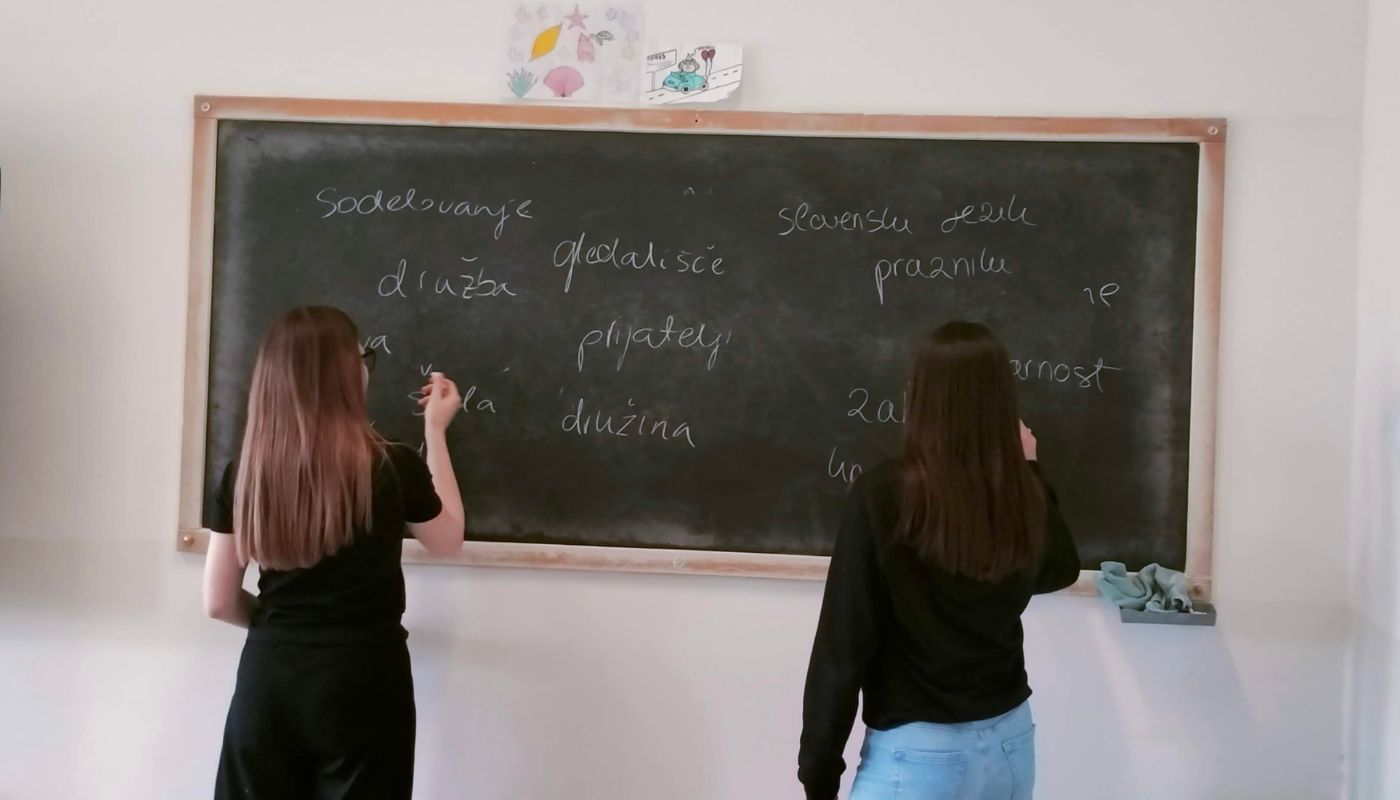
The echo of this meeting speaks of stories prepared, discussed and rethought by the students of Gregorčič. Stories about the Slovenian language, culture, community and the relationship that everyone builds with them. Stories entrusted to girls and boys who, for a few hours, become teachers. To welcome them there are the very young students of the Ascoli school, who for six consecutive weeks have opened the doors of their classes with sympathy and an ever-growing curiosity.
In those hours you learn new words. You listen to stories, anecdotes of life, traditions. Symbols, festivals, music, flavours and places of local Slovenian culture meet. But above all, you learn to look at the territory with new eyes. Gorizia and the surrounding villages appear more articulated, more sonorous, more colorful, a sort of reality made augmented by the “story of the other”. A “different” Gorizia in a simple sense: a diversity that does not distance but brings us closer; which prepares us to understand the near and, therefore, perhaps, even the distant.
For the students who told and for the students who listened, the experience was an opportunity for growth. It was also for the two school communities involved. And it was for the scientific research that accompanied the project, transforming these lessons of children for children into an opportunity to observe and understand how a teaching of the Slovenian language for non-Slovene speakers can take shape, built together, rooted in the territory, authentic, narrative and capable of starting from people even before manuals.
We offer this contribution in the form of a story with several voices, because this is how the project was born and this is how we would like it to continue to live. In the story there is space for people, relationships, surprises. In the story, the desire for encounter does not stiffen into a scheme, but continues to walk together with those who cross it. And every path, even when it follows the same path, is never really the same as the previous one.
So let’s leave room for the voices of the protagonists.
Because this story is theirs.
Voices from the Ascoli school (edited by Antonietta Vitolo and Laura?)
Pripovedujem ti o svojem jeziku / I’ll tell you about my language was for us the result, the landing, in some ways unexpected, of a not a little tiring path, to allow our school with the Italian language of instruction, to bring Slovenian into the classrooms and make it an integral part of our educational offer.
We cannot, therefore, fail to talk about this long and passionate preliminary journey, because otherwise we would not be able to fully understand with what gaze, from what point of view, with what energy and with what hopes we have brought and continue to carry out this project.
Let’s take a step back. A small group of teachers, almost all of them “daughters of Erasmus”, as we like to call ourselves, have tried to implement in the school where they work what they consider natural and necessary in this area: the inclusion, within the curricular activities, of Slovenian language lessons. Not only that, we immediately understood that, unlike English or German, Slovenian represented something different. It was not simply a “third community language”, not only a means of having greater possibilities of communication, but a new and necessary vision, an attitude, a specific will: that of putting oneself in a true relationship with what and with those who strongly characterize our territory, that is, the Slovenian community, on both sides of the border.
This is why we immediately wanted language lessons to be combined with something factual, real, which would really complete that process of mutual knowledge with our neighbor. We looked for ways and opportunities that would put us in contact with the schools of Nova Gorica and with the schools of Gorizia with the Slovenian language of instruction. Only through the encounter with the other and the exploration of his places can a real path of knowledge begin.
For this reason, what some people call perhaps too simplistically “Slovenian language lessons” have actually been considered by us to be something more: lessons to introduce the Slovenian language and culture. The schools in our area not only have the enormous need and opportunity to learn the language of the other, but also to see it, to observe it, to live it.
Since 2021 we have started twinning and meetings with students from Nova Gorica, which have subsequently been expanded thanks to funding from Law 482, which has allowed us to introduce Slovenian language lessons in all classes. The support of the then director Eleonora Carletti made it possible to consolidate these initiatives, including them permanently in the PTOF and in the programming of Civic Education. The meeting with the Center for Scientific Research in Koper and the Contacts project – a project that brought together pupils from both sides of the border who learned each other’s language – then strengthened the path, also offering training opportunities for teachers. Once the funding ended, we identified the Slovenian community of Gorizia as the ideal partner to promote an encounter between Italian and Slovenian culture. With the convinced support of the headmistress Carletti, in 2023 the dialogue with the Gregorčič High School was born, a school a few steps from ours, but with which we had never had any kind of relationship.
Thus began the experiment of a unique experience: guiding the creation of an encounter that, this time, had something more. It had to be made by the pupils for the pupils. We teachers have remained behind the scenes: we have prepared them, we have guided them, we have tried to keep the management of their meetings in balance and then, with a cool head, we have reasoned about it, we have talked about it, we have dismantled and reassembled, reflecting and preparing for the next week’s appointment.
“So guys, how did it go? Was it interesting? What struck you?”, “Professor, so these kids don’t go to school in Slovenia?”, “I didn’t know that there was a school so close to us where we only spoke Slovenian during lessons!”, “I already knew some words, my grandmother sometimes speaks Slovenian!”, “I am Croatian and I understood almost all the words in the games!”, “Prof, there is also the son of a friend of my father’s… but then they speak perfectly in Italian and Slovenian!”, “I had fun, it’s nicer to have lessons with young people!”, “For me it was nice, I attended Slovenian elementary schools. Now I don’t speak Slovenian so much anymore, but this experience reminded me of when I used it every day at school.”
Questions and reflections that come together as in a collage on a single background: our territory. Every question, every reflection is never far from what the young people have already seen or experienced, but the experience has helped them to observe and understand what is lived in our city, but often not known.
This convinces us more and more of the fact that the Slovenian community of the city has, perhaps sometimes even unconsciously, the possibility of becoming a link on this border: a border that is so much mentioned, but which is still too little experienced by the school communities on both sides of the line.
The organizational efforts remain enormous, often entrusted to a few willing people who stubbornly believe in the absolute value of this educational path. Formative for the children who tell, for the children who listen, for the teachers who watch, listen, compare and get to know each other. A training project in every step, in every aspect, for each of its protagonists.
Voices from the Gregorčič High School of Human Sciences (by the coordinator for the project in the school, Marianna Kosic)
When the project enters the classrooms of Gregorčič, the students discover that speaking Slovenian or their mother tongue (not necessarily Slovenian) means telling about themselves, their family history, belonging to a community and a border area. From this path of introspection a new awareness of the role that language plays in their daily lives was born: it ceased to be mere grammar and vocabulary to reveal itself as a vehicle for the values, thoughts and feelings of a historical community.
Once the initial stimulus dilemmas were resolved, the next phase became organizational: divided into groups, the students took on the responsibility of co-designing workshops for the students of the Ascoli school. Meeting them for an hour a week for six weeks, the students experienced a real reversal of perspective: from students they became teachers, putting themselves on the line to transmit the Slovenian language and culture to the youngest children, and calibrating educational activities to stimulate their interest and participation as much as possible.
Although the initial obstacles – such as anxiety, shyness and the fear of not being up to par or appreciated – united many of them, the impact with the reality of the classrooms immediately revealed all the complexity of this didactic challenge of getting into the classroom, and then gave way, in the end, to a deep sense of relief, gratification and self-efficacy.
To unblock tensions and stimulate keen interest on both sides was the methodological flexibility, a real ace up the boys’ sleeve: the adoption of active methods, such as games and quizzes on Kahoot, made the difference. The synergy with the host teachers, whose support boosted the motivation of the participants, also proved to be fundamental.
To broaden the horizons and lexicon of an audience that, despite living close to the border, often ignored Slovenian traditions, the groups focused on everyday topics used as real cultural bridges: local holidays (such as Carnival and St. Nicholas), the meaning of the national anthem, legends, music, sport also through icons such as Luka Dončić, and the gastronomic culture of the area, from typical dishes to osmize.
This effort also required significant linguistic flexibility. Having to teach new Slovenian words and explain in Italian complex concepts that they usually deal with in Slovenian forced the students to reshape their register based on the pre-knowledge of the host students. A mediation exercise that has developed in the students themselves a greater awareness of how the two languages alternate spontaneously in their daily lives.
The maturation of the students was confirmed and appreciated by the professors of Gregorčič. Observing the process in itinere and in the field, the teachers highlighted how the project has brought out the submerged potential of the children, stimulating cooperative learning, the spirit of initiative and personal growth. The experience has thus enhanced a wide spectrum of skills: from linguistic and intercultural to organizational, digital and cultural awareness skills. In addition to the development of these soft skills, the course had a strong value of professional orientation, as emerges from the words of the protagonists.
Eva: “When they remembered the words we had taught and asked us so many questions, so interested, I was happy. I felt joy and I felt effective, but I also realized how demanding teaching is and requires patience.”
Mia: “The teaching profession has entered my heart; I know that this could be a concrete path for my future.”
Filip: “I have clearly understood that the teaching profession is not for me and does not reflect my inclinations, but I wish similar opportunities to test themselves and train to anyone who wants to take this path.”
For Filip and many others, however, the experience has allowed them to look with new eyes at the value of teamwork, which has proved to be fundamental to successfully overcome those complexities that could hardly have been faced individually.
The most significant value of the whole experience lies in the growth of students’ identity awareness. Having to explain their culture externally to others helped them to put themselves in perspective, overcoming a certain initial self-referentiality: the amazement and interest of the Italian-speaking students in Slovenian and multilingualism aroused in the students a genuine sense of pride in their roots and their language.
Mitja confesses: “I used to take everything for granted. When an Italian pupil said that Slovenian was special and interesting, I felt real pride for the first time.” A thought that is reflected in that of Eva K., according to whom “speaking Slovenian does not only mean teaching new words, but talking about the feelings that the language brings with it, the ties with the family and one’s land.”
Eva C. says: “I realized that the Slovenian language is an important part of me and that it is nice to speak two languages and get to know two different cultures. Thanks to this project, I am more proud of my roots and appreciate Slovenian more.”
Giulia recalls that “through language we develop respect and closeness”, while Nicol concludes that “belonging to a multicultural space is not an obstacle, but an enormous advantage and a treasure to be preserved.”
Summing up this rich mosaic of voices – recalling the great teamwork, sometimes even tiring, carried out behind the scenes – the profound transformation experienced by the students clearly emerges. Although the initial enthusiasm of some was simply linked to the opportunity to carry out part of the school-work training hours during curricular hours, the dynamics in the classroom have evolved towards a much more genuine interest. The students let themselves be fully involved, investing their heads, hearts and hands in an all-round learning path. The success of the project lies precisely in this fundamental transition: the transition from a formal fulfillment to a real involvement, which saw the students become the real protagonists of the experience, eager to continue it.
The complexity of the role of educators and ambassadors of the Slovenian language and culture, understood as a relational bridge in a border area, was thus understood. This maturation translated the experience into a feeling of gratitude and a continuous flow of new ideas, projecting the project well beyond the end of the school year and converting the closure of the activities into a new starting point.
The terrain of the exchange has proved to be fertile and welcoming, so much so that the proposals for the future already look at new common initiatives that go beyond the simple teaching of Slovenian: from outings to the city with Gregorčič students as guides, to picnics in the school park with typical tastings, traditional dances and evenings to celebrate multilingualism. The wish for tomorrow is to keep curiosity alive, continuing to enrich each other through similar experiences along this shared path.
The voices of school principals
Director Peter Černic, Gregorčič
The project “Pripovedujem ti o svojem jeziku” was a valuable opportunity for our students to reflect on the meaning of language as a tool for communication, identity and connection between people. For the students of the Slovenian school in Italy, the awareness of the role of intercultural mediators is almost an integral part of their daily experience. In fact, they grow up in a context in which Slovenian and Italian cultures meet, where it is necessary to understand both languages, both historical experiences and both cultural environments.
Precisely for this reason our school has a special mission. It is not only concerned with the preservation of the Slovenian language and culture, but also with the training of young people capable of building bridges between communities. The national minority is not a space of separation, but a space of union. Its greatest value is its ability to create a dialogue between different worlds and to seek common paths where others would see boundaries.
The project allowed students to better understand how important knowledge of both cultures is for effective intercultural communication. Only those who truly know the language, values, habits and sensitivities of both communities can become a credible mediator between them. At a time when Europe and the world are increasingly in need of people capable of dialogue and mutual understanding, this is a valuable skill and, at the same time, an important contribution that the Slovenian national community in Italy can offer to the wider context.
Headmaster Filomena Nunziata, Ascoli school
“I’ll tell you about my language” represented much more than an opportunity to get to know a different language: it was an experience that helped our students to understand the value of meeting different people, cultures and histories. We live in a territory that, by its very history, has been a crossroads of peoples, languages and identities over the centuries. A borderland that has known divisions and oppositions, but which has been able to transform them into opportunities for dialogue, collaboration and common growth. This heritage is now an extraordinary educational resource. Through discussion with students from the Slovenian community, the students concretely experienced how diversity is not an obstacle, but a possibility of mutual enrichment. Knowing the language, culture and traditions of the other means learning to recognize the value of differences, developing respect, curiosity and listening skills. The hope is that our young people, strengthened by the historical and cultural experience of this territory, can become citizens capable of building bridges between different people and communities, overcoming mistrust and borders. In an increasingly interconnected reality, they can be the concrete example of a society that is both local and global: a community in which everyone can proudly preserve their roots, their language and their culture, while feeling part of a common project based on mutual respect and acceptance. If we know how to convey these values to them, our territory can continue to be a laboratory of coexistence and peace, a place where different identities do not oppose each other, but dialogue and collaborate, contributing together to building a richer, more open and aware community.
Not to conclude, that is, not to stop the story
More than a few concluding thoughts are already contained in the words of the protagonists of this story.
Here we would just like to add a wish: that this initiative, and others in which the protagonists are citizens – young and old – and their desire to get to know each other through learning the language of “the other”, can continue to be born and multiply. May they continue to build a path to which new travel companions are always joined, becoming Sopotniki, as well as Popotniki, wayfarers, to take up the subtitle of this issue of the magazine.
And to the reader who has accompanied us so far, we address an invitation: tell this story. Telling it with the power of storytelling – pripovedujem ti – and with a lucid and confident look at the journey in which we can all take part.
Thanks to all the storytellers and all the storytellers who have given voice to this contribution.
La lingua originale di questo articolo è l'Italiano.