
THE CROSS-BORDER FLANEUR
by MIRT KOMEL
original in Slovenian, translated by the editorial staff
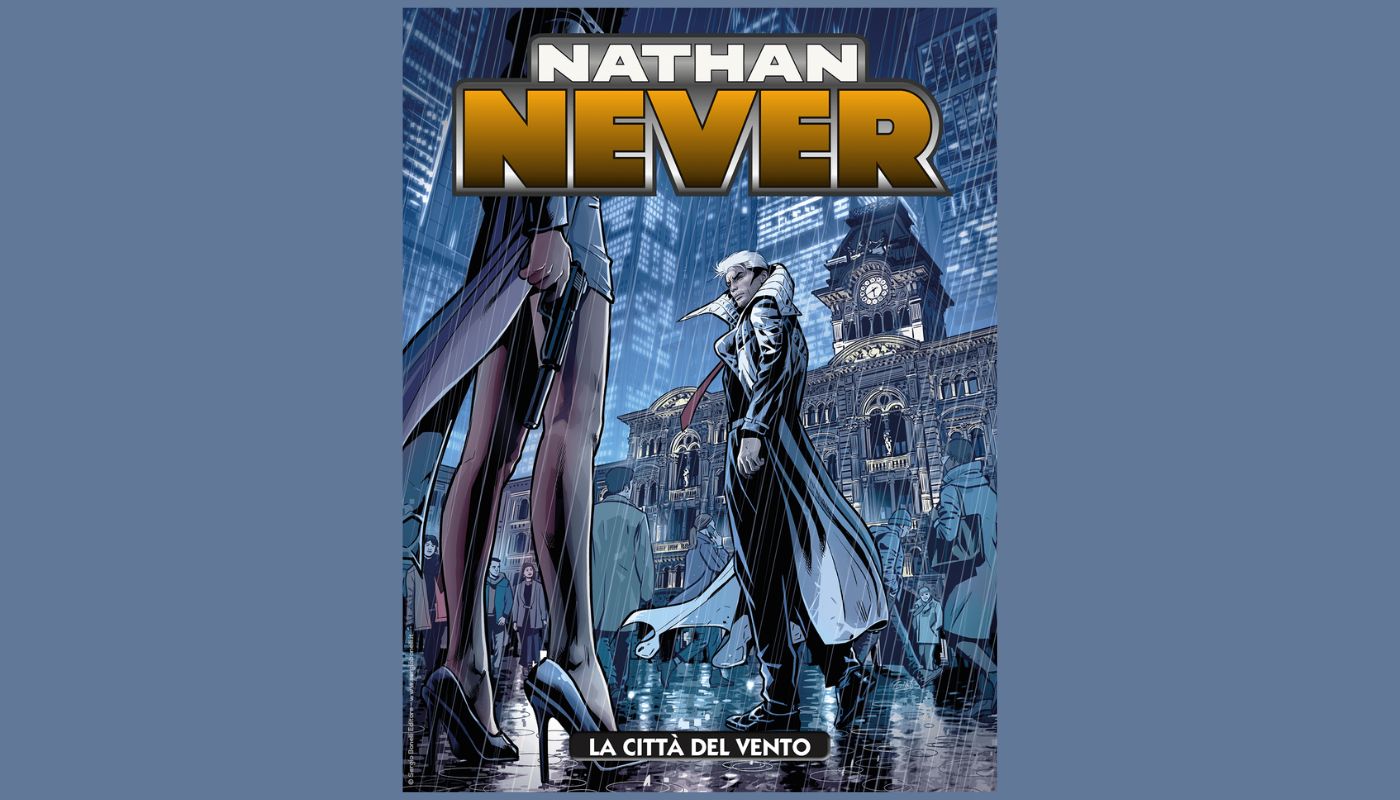
In the four issues of the legendary comic series Nathan Never, published at the time of the European Capital of Culture GO! 2025 by Bonelli editore and later also translated into Slovenian by the publisher ZRC SAZU, we can learn about our science fiction future – or at least one of the possible futures – which implements cross-border in a very specific way, i.e. with the geopolitical triangle Trieste-Gorizia-Ljubljana, united in the autonomous unit of the Protectorate.
In the spy story signed by Bepi Vigna, but above all in the futuristic visions of Trieste, Gorizia and Ljubljana – but also of Bled and the Isonzo Valley – illustrated by Romeo Toffanetti, we can see what a territory that has freed itself from national borders and that has at the same time brought together all the different cultures will be or could be like. taking on new life. From an architectural point of view, these are ancient city nuclei, around which real urban metropolises have developed with skyscrapers that rise in the blue, creating particular Skyline, while in the streets and squares we see how the crowds of the future walk, among which – as in architecture – we can recognize famous historical faces, secretly drawn by the illustrator in the various cartoons. In the multitude of these known and unknown faces, the protagonist of the comic, Nathan Never, agent of the Alpha Agency, emerges on a new mission.
But at times, here and there, our hero takes a few moments off from his task, for example when he walks through Trieste and ventures into the San Marco cafeteria/bookshop, where he leafs through books as if they were artifacts of the past – the same books that, in an even more distant future, in which humans fight against Technodroids, he collects and preserves in his submarine Nautilus – an action that leads him to feel that particular sense of idleness guilt which, as we will see shortly, is also typical of the contemporary wayfarer: “I feel guilty for being here doing nothing. This deal is becoming paradoxical. Every time I come to this area of old Europe, I find myself in complex situations that I have to solve. Perhaps complexity is part of this territory… and in many ways also its wealth.” (Arrest Nathan Never)
Nathan Never, the cross-border flâneur of the future?
What appears to be the distant future is already possible today – the flâneuristic wandering, albeit as an archaeological anachronism of a culture born in the nineteenth century with the rise of large urban centers such as London or Berlin, but above all Paris, where the flâneur was born, to whom Charles Baudelaire dedicated both a poem and an essay entitled The Painter of Modern Life, in which he writes, among other things: “The crowd is his kingdom, as the air is the kingdom of birds, and water is that of fish. His passion and profession is marrying the crowd. For the perfect flâneur, for the passionate observer, it is the cause of immense enjoyment to take up residence in number, in that which fluctuates and moves, is fugitive or infinite. Being away from home and feeling at home everywhere; To see the world, to be at the center of it and to remain hidden from it: these are some of the most common pleasures of these independent, passionate, impartial spirits, which language struggles to define. The spectator is a prince who enjoys the unknown everywhere.”
The moment of incognito, of anonymity, is fundamental in verifying the possibilities of wandering on the Trieste-Gorizia-Ljubljana axis, since what is true for the relationship between the two Gorizias is also true for the relationship between Ljubljana and Trieste.
In fact, in Nova Gorica everyone knows everything about everyone, even things that even you don’t know about yourself, but just move to nearby Gorizia and you can already enjoy the pleasure of the anonymous prince-wayfarer, despite the fact that Gorizia is not a metropolis at all. And even in the science fiction future of this conurbation, as it shows us Nathan Never, in no painting does any mad crowd appear in which the tramp can immerse himself. And anyway, the cross-border moment works in such a way that both we in the present and Nathan Never in the future can merge with the city, which serves as a landscape of wanderers.
The same can be said of the relationship between Ljubljana and Trieste: in Ljubljana, despite the fact that city life is represented, everyone knows everything about everyone, and if the Ljubljana people want to catch their breath from Ljubljana they have to go to Trieste, where they can taste what the city means in the flâneuristic sense of the term. Despite the fact that, under the pressures of the current capitalist ideology of productivity and consumerism, they have to justify each of these trips, both to themselves and to others – with vulgar-materialistic purchases or with some nobler purpose, such as visiting some exhibition, where they do not appreciate art, but consume it. This is obviously not true wandering, which, on the contrary, presupposes walking quietly (aimlessly), looking at shop windows (without purchases), and above all observing people (without interest).
What hinders this wandering is precisely the typically capitalist feeling, a sort of secularized version of the Christian guilt that comes from doing nothing – exactly as Nathan Never proves it in the passage quoted above: “I feel guilty for being here and doing nothing.” But this is precisely the point: do nothing or, rather, do nothing. Actively not-do.
Starting from Baudelaire’s essay, Walter Benjamin reshaped the wayfarer in the archetype of the urban, modern and even modernist man of the twentieth century, who with the freedom of wanderers, the serenity of observing people and the pleasure of detective investigation tries to free himself from the hooks of a productivist capitalist society. “The crowd is actually nature’s game, if we are allowed to bring this term into social relations. The street, the outbreak of a fire, the car accident bring together people who are not divided into classes. You see concrete groups; from a social point of view, however, they remain abstract, isolated in their own interests. Their model is consumers, who – each for their own interest – gather in the square around the “common thing”. These groups most often exist only statistically. Statistics hide what they actually have that is monstrous… that is, the concentration of individuals as such due to the casual identity of their private interests. When these groups become visible – and totalitarian states take care of this, commanding that the concentration of their clients be constant and mandatory for all projects – their dual nature is clearly revealed; especially to the victims. The randomness of the market economy that has brought them together in this way is seen as “destiny”, in which the “race” is found and recognized. In this way they let themselves go both to the herd instinct and to automatic behavior.” (Flâneur)
Hence the meaning of cross-border flâneurism, which must be able to cross the “fate” of race and class, but at the same time rebel against the herd instinct and automatic behavior, which leads it to spend in the store, to squander all the profit, in favor of a mixture with the statistical crowd in the “superior unit” of the consumer, which appears supra-ideological, but is in reality extremely imbued with capitalist ideology.
Just before arriving at the department store, the wayfarer must already defend himself, with his aimless wandering, in order to escape the inexorable production-consumerist logic: “If the gallery is the classic form of the interior – he shows fragments of the street to the wayfarer – the department store is the image of its decline. The department store is the final area of the flâneur. If the street has become internal, then the latter has become a street and he loses himself in the labyrinth of the goods offered, as before in the labyrinth of the city.” This reciprocal transformation of the interior into the exterior and vice versa, that is, the externalization of the interior and the internalization of the exterior, is one of the most distinctive phenomena of the city in which we can recognize the concrete form of the abstract, and, therefore, the still more fundamental problem of the fact that in capitalism personal relations are commodified, while the relations of commodities are anthropomorphized. But urban man, in these conditions of developed capitalism, says Benjamin, does not realize that he is a commodity and nor, on the contrary, that the commodity is anthropomorphic, so it is not surprising that public space is increasingly privatized and that in its place private space presents itself as a new pseudo-public space, the “ideal synthesis” of this double movement is then represented by social networks, which are neither public nor private.
We can convince ourselves of this double movement not only on social media but also with the most empirical example of the current phenomenon of shopping centers, which appears in Ljubljana as BTCity, in Nova Gorica as Qlandia, in Trieste as Towers of Europe: commercial conglomerates that both from the external façade and above all from the organization of the interior spaces express that flattened calm, that economic uniformity that we also see outside, in city life adapted to tourism, when all the clubs in all the cities always offer the same drinks and the same foods (gourmet burgers, avocado toast with eggs, fruit smoothies etc.). From this point of view, the contemporary traveler is not the same as the tourist, who sees the city as the backdrop of his experience, which must be identical to the one he lives in his daily life, no matter where he comes from, but on the contrary it must be an alienating experience, which allows him to recognize what is foreign in the midst of what is familiar (not the other way around, as does the tourist, who looks for the familiar in the stranger). From this point of view, tourism is configured as an extension of the old colonialism to the conditions of contemporary globalism, whose downside is none other than war, something of which we were able to be completely convinced when looking at the images of tourists fleeing Dubai at the outbreak of the conflict between Iran and Israel, for which the USA is drying up.
Deleuze & Guattari in their Anti-Oedipus They correctly observe that the typical mechanism of action of the current capitalist system is a twofold, only apparently paradoxical, link between production and anti-production: work and consumption, construction and war, knowledge and nonsense, all this goes hand in hand, when at the same time one builds and demolishes, works and consumes, teaches and makes fools. Consumption according to one’s budget is the other side of work according to one’s possibilities, which leads to burnout; the war of destruction is the other side of the construction of tourist infrastructure; The nonsense shared on social media is the other side of contemporary education, which in theory produces knowledge.
The cross-border flâneur, if it were not just an anachronism, and if he were already at the level of his ideal, ready for the challenges of the future, must oppose all that has been mentioned with lines of escape that are transversal, in such a way as to allow him not to build or demolish, not to work or consume, not to teach or to make foolish, but in order to do nothing – and not to “do nothing” – non-doing will be its principle.
Prvotni jezik tega članka je slovenščina.