
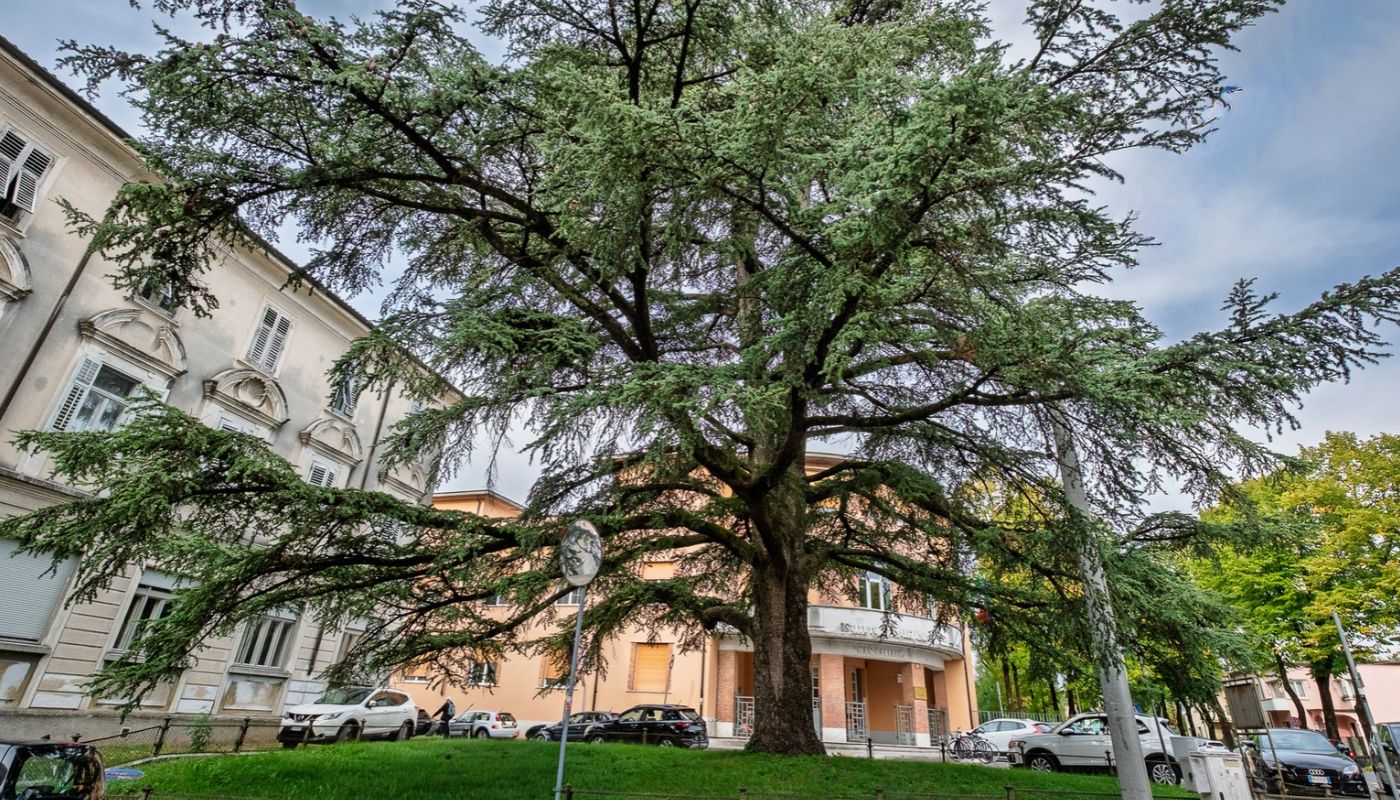
GREGORČIČ’S CHEDRA
by HARJET DORNIK
Gregorčič’s cedar in Goriška – a living memory of the popular poet Simon Gregorčič in our city. The Slovenian people expressed their gratitude to the Goriška nightingale by planting a tree at the place of its last residence, which has been a symbol of greatness, strength, incorruptibility and adaptability since ancient times. Due to its slow growth, this tree develops stronger and more resistant, and among other park trees, it stands out for its magnificent trunk and decorative pyramidal crown. Cedar has always been valued for its extremely durable, healthy, beautifully scented wood and invigorating sap. In antiquity, cedar wood was chosen to protect valuable quality writings that would deserve a lasting memory, immortality, so they marked the highly valued thing as Raise a cedar – worth a cedar – . The Slovenian people had a similar feeling about the poem of their dear poet, so after his farewell, on November 24, 1906, they planted a cedar tree in his lasting memory.
Between Gorizia and Gradišče
The poet Simon Gregorčič spent almost a third of his life in the town of Goriška. After the one-year school in Libušnje, his education continued at the Goriška Normal School (1852-1855), at the age of eleven he transferred to the Goriška Gymnasium in the autumn of 1855, which he completed with an excellent graduation in 1864, and then continued his studies as a priest at the Gorizia Theological Seminary (1864-1868). He first served as a chaplain in Kobarid until 1873, then in Rihemberk – today’s Branik – until the end of November 1881, and finally in 1882 he retired as a vicar to Gradišče nad Privačina, where he spent twenty-one years. During this period, with the help of friends, he published all three volumes of his Poems and an updated reprint of the first. However, when his body and heart finally became very hot and he was surrounded by dark forebodings, he decided to return to Gorizia, sold his “hill” and retired to Gorišček, where he spent his last three years – from 1903 to 1906. From the place of his last home, a loving crowd of several thousand people accompanied him on foot in a magnificent procession along his beloved Soča to his native places. In each village on the way, the procession stopped and placed the coffin with the poet on the prepared altar so that the locals could honor him and join the procession.
Sochi
From the Goriška period, the surprising reality stands out that Gregorčič sang an ode to his homeland to his river, the Soča, as an eighteen-year-old. The idea dates back to his high school years, and he published it in Stritar’s Zvon in Vienna only seventeen years later, in 1879, with a correction in the final work.
Its main compositional element is the flow of the Soča River in the mountain and plain world. The poet’s lyrical creativity follows the natural characteristics of the beloved river: it is light, lively and clear in the first part, bitter and bloody prophetic in the second, when the river flow calms down, mighty and violent in the last. The symbol of beauty and health, as a memory of one’s native places and people, spills over into an image of national threat and a thought of a dark future, which grows into a prophetic vision and indulges in vengeful horror.
Just as almost all the natural elements of a river are present in the course of the Soča River, so in the poem dedicated to it we can admire most of the lyrical and structural elements, which raise the magnificent monosyllabic ode to an enviably timeless level. Gregorčič has woven all kinds of vocal and verbal figures into his lyrical language, and its extraordinary structural diversity is enriched by numerous poetic means: various rhymes, vowel and consonant verses, parable, personification, anaphora, polyphony, consonance, doubling, chorus, rhetorical question, anadiplosis, hyperbaton and others. The repeated exclamatory apostrophe is also particularly beautiful – you are gorgeous, daughter of the mountains!
In addition to its lyrical nobility, the ode undoubtedly has a prophetic vision that depicts the horrors of the bloody Isonzo offensives at least 35 years before the outbreak of the First World War. The poet’s prophetic clairvoyance is probably unique in European poetry and in literature in general. In his extremely sensitive nature, Gregorčič had already sensed the hardships and tensions in this exposed territory several decades earlier and prophetically confessed them in an ode to his beloved river.
Love of the Vipava Valley people
When Gregorčič worked as a chaplain in the Vipava Valley, he fell in love with the local villagers – both in Rihemberk and in Gradišče – as he had done before, and they gratefully returned this love to their dear poet. They deeply appreciated that there lived among them a poet who caused a real explosion of melodiousness in Slovenian poetry and breathed in simple and selected words the miraculous power to lift them from the everyday lowlands into the superreal world of beauty. They honoured him in the most beautiful way that can be shown to a poet – by writing his poems deeply in their simple hearts and pouring these verses into the hearts of their children with love and pride. The locals also lovingly passed on the poet’s life experiences, habits and peculiarities from generation to generation. The value of his song was such that the whole nation loved it and knew it as their own.
The poet’s decision for Gradišče
The creative, at the same time bitter time in Rihemberk brought the poet his first public recognitions due to his numerous poetic publications, but at the same time he was tormented by a large parish with strenuous pastoral work and a difficult coexistence with the parish priest Brezavšek. Thus, at Christmas time in 1881, barely thirty-seven years old, he took refuge in temporary retirement. His own sensitive nature was looking for a solution from existential distress. She wanted to rise above the dark valley of personal dissatisfaction, loneliness and sadness, cramped freedom, social disappointment and imminent envy. His soul was looking for a remote shelter where he could live more peacefully. The path lured him among simple peasant people, into the hilly world, which at least slightly reminded him of the mountain outlines of his hometown below Krno. He wanted more, even to change his profession, to go to Vienna or at least to join Gorizia’s intellectual friends and like-minded people, but his loyalty to “higher role models” prevailed. He accepted the modest position of vicar in Gradište, became “the shepherd of a simple flock in the country” and bought a piece of the estate of the painter Josip Tominec with savings and loans. Before Easter 1882, he moved to a new homestead and in a sunny lull he indulged in his favourite farming, viticulture and the demanding construction of a house. Before moving to Ljubljana, however, with the help of his friend Ignac Gruntar, with whom he had already founded a reading room in Kobarid, he took care of everything necessary for his first collection of poetry to be published and thus arranged his poetic status.
A Celebration of Poetry and the Bitterness of Blows
The poet moved to Gradišče on 4 April 1882 and soon after, on 17 April, he saw the publication of Poetry, his golden book, which elevated him to the rank of Slovenia’s best living poet. With this, Gregorčič exposed himself poetically and socially. The enthusiasm, praise and emotions of his fans flared up to the end. Franc Levec declared his Poetry gold, and the high circulation of copies was quickly sold out. The soft sonority and firmness of his verses resounded and quickly spread among the Slovenian people, who invited him to all national celebrations and festivities. The sweet speech, selected melody and emotionality of his lyrics reached deep into the hearts of simple people and took over their souls, lifting, comforting, joying and cheering. In the cultural and political sense, the year 1882 was indeed the year of Gregorčič.
However, the time of celebration of his lyrics did not last long, dark clouds of envy and criticism were already gathering over him. Only three years later, when an updated reprint of his Poems was published in 1885, it was in this village that the poet experienced his most difficult times. Spirits began to divide around him, and the poet was seized by a storm of narrow-minded and relentless criticism from Anton Kržič, Janko Pajko and Anton Mahnič, who publicly slammed his creations and “dangerous” sanctity. The poet himself intervened in the controversy in defense of his verses, which made him all the more vulnerable and emotionally affected. This was very severe for his sensitive character. The judgment of his peers not only hurt him and undermined his self-confidence, but also stifled his joy for poetic work. The poet wrote somewhere that he destroyed a whole series of poems himself, “probably for two volumes”. He stayed as vicar for five years, and then, mentally bitter and physically exhausted also because of a weak heart, he asked for retirement. He persisted in this decision for a decade and returned to vicar work in the same village for only two years, from 1897 to 1899 for the possibility of retirement, and then finally withdrew. His creative power had already withered, he was plagued by illness problems and debts, and his friends certainly helped him in the publication of the second (1888) and third volumes of Poetry (1902). Eventually, his body and heart weakened, so in 1903 he decided to go to Gorizia, sold his hill and retired to Gorišček until 1906. During this time, translations of the Bible Job, Jeremiah’s Lamentations, and Psalm 118 were published in 1904, and then, on November 24, two years later, his broad heart put aside all sickness. From this place, where the cedar tree commemorates his last stop, loving crowds escorted him back to his native lands.
Gregorčič’s Trail
People who wanted to keep his spirit alive in these places decided on some important initiatives. On the centenary of his death in 2006 and at the same time the 140th anniversary of the death of the painter Josip Tominac, the Vipava village of Gradišče created a memorial park in their memory next to the cultural center on the hill leaning against the poet’s house. There, on June 4, it hosted the Gregorčič Days for the first time under the title Continuous Song, adapted by the literary club Govora. In memory of the stay of the Goriška nightingale on the Vipava Valley soil in 2010, the people of the Vipava Valley also arranged the Gregorčič Trail, which led mainly through Gradište. The places where the poet descended from his hill at one end towards Renče and at the other in the direction of Dornberk were connected into a memorial and walking trail. It was created on the initiative of the Rhine sociologist and poet Radivoj Pahor and leads from the Rhine school through Arčone, through Rabatovec and past its hill and the church in Gradišče to the edge of the village in Cinkovec and the famous oak tree, in the shadow of which the poet – according to oral tradition – liked to take refuge. His soul was invigorated by the view of the beautiful parts of the lower Vipava plain all the way to the Friulian lowlands. With his gaze, he could touch the sixteen bells and the wreath of his beloved peaks. Walks along this path were a consolation for the poet. Between the free-growing trees and planted vines, he was gathering strength and writing a flash of verse right on his sleeve.
At the key points of the footpath, there are eight commemorative plaques with carefully selected lyrical content and excerpts from the poet’s life. In addition to the olive tree in memory, there are three painted barrels with the poet’s verses, which concisely summarize the scope of his lyrical work and sing about “the homeland, poetry, charm and truth, the sun – the holy scripture”. On the way, hikers can also step into his Garden and sit on a bench next to the poet’s statue.
My Gregorčič
Gradišče and Gorizia, the birthplace of my Vipava people and my beloved town. I walk this path with great gratitude and at the same time sadness that I am the only person who still connects the two places where the poet lived the longest. The path seems especially beautiful to me because I have carried his verses inside me since I was a child and I was given to live on his hill, in his house and among his people. When I walk with the poet in my heart on the path where my young steps overlapped with the blurred traces of such a noble predecessor, then the stone on the path comes to life under my feet, the trees beloved by me, oaks, maples, autumn, walnuts and vines along the path glow. Next to me walks the poet who defied “the fate of the storm”, who “rushed into it, but the spirit of pride did not bow to him”. I feel the power of his confession and his pain, his proud and noble spirit, his love for the Slovenian man, in whom he consolidated the meaning of poetry and national consciousness. I feel how his love ennobled my Vipava people through verses, gave them strength and meaning to make their way through poor and difficult times, and built me through them. He became my companion in existence, because he breathed creative power into my sensitivity and the awareness that it is just like that. That I can be proud of who I am. Just like he was.